• Hi all and welcome to TheWoodHaven2 brought into the 21st Century, kicking and screaming! We all have Alasdair to thank for the vast bulk of the heavy lifting to get us here, no more so than me because he's taken away a huge burden of responsibility from my shoulders and brought us to this new shiny home, with all your previous content (hopefully) still intact! Please peruse and feed back. There is still plenty to do, like changing the colour scheme, adding the banner graphic, tweaking the odd setting here and there so I have added a new thread in the 'Technical Issues, Bugs and Feature Requests' forum for you to add any issues you find, any missing settings or just anything you'd like to see added/removed from the feature set that Xenforo offers. We will get to everything over the coming weeks so please be patient, but add anything at all to the thread I mention above and we promise to get to them over the next few days/weeks/months. In the meantime, please enjoy!

Flattening a plane sole

AJB Temple

Sequoia
Joined
Apr 15, 2019
Messages
7,743
Reaction score
1,222
Not a flat plane obsessive but I know some people are. Despite my father being an engineer, I was unaware that you could scrape metal to get a dead flat finish, using a tungsten scraper, and that it gives a slippery finish too. Video showing exactly how an engineer does it.

https://www.youtube.com/watch?v=z0ACMMm-ZGc
 
That's how my boss (a mechanical engineer) has done all of his planes and he swears by it. Scraping is on my list to learn / try one day
 
MattS":9gycruf8 said:
Maybe not necessary but still interesting to see! I didn't know you could scrape metal like that.

It's how the precision slideways for most high-end milling machines and lathes are/were made. The most accurate engineering surfaces are hand scraped.

If you ever get a chance to get your hands on a copy of "The Foundations of Mechanical Accuracy" by Wayne Moore for a sensible price, then I'd highly recommend it. I borrowed a copy from my boss and read it cover to cover. It goes through the way that the Moore Tool company produced precision flat surfaces, square references and rotary tables and how they ensure that everything is perfectly flat/square/evenly divided or whatever, including how to get to (for example) perfectly flat from first principles.

The last couple of chapters are a bit more specific to Moore Tools that they were probably trying to sell at the time, but the rest of it is well worth a read.
 
One day I'll try these out. maybe. :)
 

Attachments

  • IMG_0686.JPG
    IMG_0686.JPG
    230.2 KB · Views: 671
One of the points the engineer made in the video is that you can use hardened steel scrapers, but they need regrinding several times just to do one plane sole. The tungsten carbide one he used had a reversible blade and didn't need frequent sharpening.
 
I think anyone who uses and sharpens hand tools would be well aware of the difference between tool steel and tungsten carbide, it's pretty basic. ;)

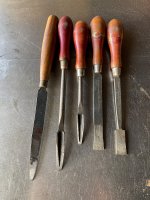
The scrapers I own were a gift from the widow of a departed friend who died aged 70, they had previously belonged to his father, a well respected senior engineer at British Aerospace so quality old tools from someone who knew how to use them, which of course I don't. :)
 
You miss my point Lons. The video man was basically saying its really very tedious using conventional hardened steel for anything substantial. Whilst I claim no expertise in hand tools at all, I had never seen or hear of the carbide scraper tool before that engineers use.
 
AndyT":1g4sbvzo said:
https://archive.org/details/Foundations_of_Mechanical_Accuracy_by_Wayne_R_Moore_1970

That's the one. Well worth a read at that link if you can face reading books on a computer screen.
 
When I worked in the nuclear industry, our company had a few old chaps who occasionally got involved in scraping stuff that was being refurbished.
I spent a couple of days ( of my own time) with them shortly before they both retired as I was interested in the dying skill.
I have a rudimentary knowledge of the process, but like many highly skilled jobs, the main thing I learned was that it’s a lot harder than the theory implies.
I managed to blag a few scrapers and have used them to fettle some wood planes for myself and others.
 
Interesting. Purely out if interest I tried to find a tool like the TC scraper used in the video (he said he got his from eBay) but apart from decorating scrapers, drew a blank. They do seem to be available in the US.
 
Scraping and sharpening are two perennial debates; they return to 'collective consciousness' on forums like ours every few years. One aspect of the former practice is: is it necessary for woodworking tools? Over the last four decades, I've read umpteen articles on same. I remember (I think) Bob Loader of M.E.W. fame, writing that scraping was a necessary evil in precision engineering where "tenths of a thou" were important. Others, more wood-centred, particularly Japanese working afficionados, held the belief that 'three points of contact' were sufficient, and scraping the whole plane sole to a high percentage contact on a surface plate was tedious and unecessary, given the greater tolerances (relatively speaking) of timber.

The late, great, D.C. - amongst others - took a middle ground and rubbed their plane soles smooth(-ish) with abrasive on either a paper strip, or, emery powder and the like on a glass plate. Bill carter still practices a form of this with his lapping plate and paste approach to his plane soles.

I think it boils down to contentment and horses for courses. If the rhythmic, long-winded, scraping/testing regime gives you satisfaction, you love your hands impregnated with 'blue' and you've got the requisite surface plate, then do it. If you have other priorities and just want a workable tool, stick it on the sandpaper. Neigh problem, either way.
 
I found a surface grinder the best tool for flattening plane soles & squaring up the sides & takes up less of my life than the other options :?
 
I'm in the camp where I've never flattened a plane, or a chisel back, nor even considered doing it. My mixture of brands includes some old stuff from eBay or my father, and I just sharpen the blade and see if it works on the wood. If it does, then that's good enough. :|
 
SamQ aka Ah! Q!":hmzxbwx9 said:
Scraping and sharpening are two perennial debates; they return to 'collective consciousness' on forums like ours every few years. One aspect of the former practice is: is it necessary for woodworking tools? Over the last four decades, I've read umpteen articles on same. I remember (I think) Bob Loader of M.E.W. fame, writing that scraping was a necessary evil in precision engineering where "tenths of a thou" were important. Others, more wood-centred, particularly Japanese working afficionados, held the belief that 'three points of contact' were sufficient, and scraping the whole plane sole to a high percentage contact on a surface plate was tedious and unecessary, given the greater tolerances (relatively speaking) of timber.

The late, great, D.C. - amongst others - took a middle ground and rubbed their plane soles smooth(-ish) with abrasive on either a paper strip, or, emery powder and the like on a glass plate. Bill carter still practices a form of this with his lapping plate and paste approach to his plane soles.

I think it boils down to contentment and horses for courses. If the rhythmic, long-winded, scraping/testing regime gives you satisfaction, you love your hands impregnated with 'blue' and you've got the requisite surface plate, then do it. If you have other priorities and just want a workable tool, stick it on the sandpaper. Neigh problem, either way.

:text-goodpost: :text-+1: ...and Sam, you obviously mean Sir David of Charlesworth, just to be clear :lol: - Rob
 
Rob,

D.C. was never knighted, :eusa-naughty: but I’m pretty certain that he was canonised :eusa-think:
 
Lurker":3a8bndx3 said:
Rob,

D.C. was never knighted, :eusa-naughty: but I’m pretty certain that he was canonised :eusa-think:
I stand corrected; St. David of Charlesworth :lol: - Rob
 
Doug":1snxv8fc said:
I found a surface grinder the best tool for flattening plane soles & squaring up the sides & takes up less of my life than the other options :?
Yes agree, the first time I tried it though I quickly learned to leave everything fastened to it, it’s amazing how a solid lump of cast iron moves about!
 
AJB Temple":whscpwx0 said:
I'm in the camp where I've never flattened a plane, or a chisel back, nor even considered doing it. My mixture of brands includes some old stuff from eBay or my father, and I just sharpen the blade and see if it works on the wood. If it does, then that's good enough. :|

I have, lightly, once. The plane in the video has exactly the fault that made me do this. A concave sole. Makes it unusable; the cutter does not touch the wood until you wind it out far enough, then it takes a series of big bites rather than a smooth cut. A slightly convex sole is little problem, provided you expect to use a straight edge or well trained eye to judge flat rather than expecting the plane to magically do it on its own.

Mine was a record 5 1/2 - nice Stay-set one with the solid frog, roller on the lateral adjustment and narrower 2 1/4" cutter, stolen from somebody on eBay for £15. Worth the bother. Otherwise I'm inclined to agree with Adrian.
 
Flattening a plane sole isn't something I do out of choice and I've never bothered with anything from LN, Veritas or stuff from WH or CHT. The worst culprit I ever came across was the Record 'Calvert Stevens' smoother which had a 'mountain' :eusa-whistle: just behind the mouth and it was simply impossible to use straight out the box. A short time after I got rid of mine, I came across another where the cabinet maker who owned it was completely perplexed as to why it wouldn't work; when I put a rule across the sole to show him the penny dropped! - Rob
 
postby Woodbloke » Today, 13:06

Lurker wrote:
Rob,

D.C. was never knighted, :eusa-naughty: but I’m pretty certain that he was canonised :eusa-think:

I stand corrected; St. David of Charlesworth :lol: - Rob

Yes, an honourable canonization for David. Great man, bloomin' good ambassador for cabinet-making, patient educator.

I'd also add St. Robert of Wem. :eusa-whistle:

And, possibly, in the light of a recent thread: St. Jim of Deepcut. :D
 
Back
Top