I asked Google AI why hot hide glue
doesn't warp the wood and I quote:
- Does not cause wood fibers to swell: Hide glue introduces minimal moisture to the wood compared to modern PVA (polyvinyl acetate) glues. This is because it is applied hot and in a thin layer, and its water content evaporates relatively quickly during the application process (especially when using traditional techniques like hammer veneering with an iron). Since the wood fibers do not absorb as much water, they do not swell, which is the primary cause of warping.
- Minimal shrinkage on drying: Unlike other water-based adhesives that tend to shrink as the water content evaporates, hot hide glue does not shrink significantly when it dries. This stability in the glue line prevents the build-up of internal stresses that can pull on the veneer and substrate, thus preventing the assembly from warping.
Ain't AI wonderful? - Rob
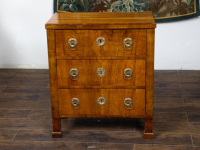
AI in my experience ain't wonderful as a source of woodworking knowledge: I've tested it from time to time and it quite often talks gibberish in this field and I suspect that's because it tends to pick up the verbal diarrhoea of limited knowledge or wrong knowledged woodworkers, both amateur and professional. There are plenty of examples of one sided veneering, i.e., veneered panels lacking a balancing veneer. Hammer veneering with hide glue certainly can add significant water to the wood of which I have experience as can caul veneering where both the ground and the veneer (which is usually thicker, e.g., 1 - 2 mm) are heated prior to gluing up and pressing. Antique decoratively veneered drawer fronts are a common example of one sided veneering as already mentioned and I have repaired the broken sabre legs of numerous tilt top, sofa, and similar tables, primarily from the Regency period veneered on just one face. I have similarly restored or repaired quite a few items of cabinet furniture in which panels were veneered on just one face, and where this occurred on table tops they were frequently hollow sometimes requiring flattening with various tricks.
I refer you to Antique or Fake (1984) by Charles H Hayward, page 203 in my copy and who knew a thing or two about old furniture. "With the exception of flush doors used in many walnut presses and writing cabinets of the walnut period, nearly all period furniture was veneered on one side only. This did not matter a great deal for carcase work and for drawer fronts which were largely held flat by other structural parts, but it will often be found that table tops have pulled hollow, and this can be disastrous on pivoted leaves which have no means of stiffening."
Of course, it has to be remembered that all that veneer Hayward was whanging on about was applied to solid wood panels. Today, most veneer is applied to man-made board and, given that, I'd say that in most cases veneering on both faces is probably sensible especially as it's so easy and quick with guillotines, stitchers, and heated presses of various types, e.g., hydraulic and bag types, etc to handle the modern 0.6 mm thick veneers, i.e., traditionally peeled leaves and engineered stuff.
Enough from me, I think. Slainte.


 )
)
 You should be ashamed of yourself Rog