• Hi all and welcome to TheWoodHaven2 brought into the 21st Century, kicking and screaming! We all have Alasdair to thank for the vast bulk of the heavy lifting to get us here, no more so than me because he's taken away a huge burden of responsibility from my shoulders and brought us to this new shiny home, with all your previous content (hopefully) still intact! Please peruse and feed back. There is still plenty to do, like changing the colour scheme, adding the banner graphic, tweaking the odd setting here and there so I have added a new thread in the 'Technical Issues, Bugs and Feature Requests' forum for you to add any issues you find, any missing settings or just anything you'd like to see added/removed from the feature set that Xenforo offers. We will get to everything over the coming weeks so please be patient, but add anything at all to the thread I mention above and we promise to get to them over the next few days/weeks/months. In the meantime, please enjoy!

Jet 16-32 Drum Sander Query

StevieB

Nordic Pine
Joined
Jul 21, 2014
Messages
942
Reaction score
58
Location
Chatteris, Cambridgeshire
I have recently managed to snare one of these from a well known auction site and have been having a play with it over the weekend. I really wanted it to sand flat veneered pieces for box making, but I seem to have issues with it either not taking off any material, or sanding through the veneer at the start and end of the pass, almost like snipe. I also have an issue with sanding one side through the veneer but I believe this is simply a case of getting the drum level (it has an after market bracket fitted to achieve just this so simply needs a small bit of adjustment).

My question, for those who have one of these types of machines - am I expecting too much in terms of finesse to be able to sand veneers? They are standard 0.6mm burr walnut veneer on a birch play ground. The paper is 180 grit I think so reasonable in terms of grade, but are these machines really only good for sanding flat panels of solid wood? I am tempted to put it back on the auction site as I will get my money back (minus fees) but wondered what others thoughts were before I do? Ta!
 
I have the 22-44 version. A few tips:

- Remove the paper and use a square block of wood to set the drum level. Get it to just brush the drum at either end.

- With 180 grit paper, very small cut increments are needed - barely 1/8th of a turn. Sometimes it helps to do a ‘spring pass’ on the same setting.

- Dust extraction is essential.

- Feel the wood between passes. I find if it gets hot it seems to expand/warp and jam. Take lighter passes to mitigate, and experiment with feed rates.

- I like to support the piece flat to the bed as it passes in (with care) and out. Pushing down.

- There’s a manual about somewhere on Google. Well worth a read.
 
I've got the 10-20.

Being shorter, it's difficult to get the drum spot on parallel to the bed. I get it as near as I can.

But then, when you find out which is the 'higher' side, pass the piece through at that side, then the next pass move it towards the other side, half the width of the piece, etc until you get to the other side. That way, it takes off a smidge at a time, without moving the depth wheel.

When you do adjust the wheel, I've never gone more than a third of a turn.

I've also used a 'sled' for very thin pieces; a piece of melamine coated board with a piece of sandpaper glued to it, and place the workpiece on top of that and pass it through, like you might do on a thicknesser,

I've managed to get stock thin ripped on the bandsaw and then to less than a mm on the drum sander. I've no need to go down lower than that.

Always use good dx, it's the dust that burns. Always clean the paper with that rubber thingy after every job. Try to keep the paper tight when fitting it to the ends. I've heard that duck tape is sometimes used to stick the end to the drum after it's been clipped in. I might try that next.

Slipping paper doubles the thickness of the paper on the drum so disfigures and burns the workpiece.

I think they are a brilliant piece of kit.
 
StevieB":1okvoeao said:
I have recently managed to snare one of these from a well known auction site and have been having a play with it over the weekend. I really wanted it to sand flat veneered pieces for box making, but I seem to have issues with it either not taking off any material, or sanding through the veneer at the start and end of the pass, almost like snipe. I also have an issue with sanding one side through the veneer but I believe this is simply a case of getting the drum level (it has an after market bracket fitted to achieve just this so simply needs a small bit of adjustment).

My question, for those who have one of these types of machines - am I expecting too much in terms of finesse to be able to sand veneers? They are standard 0.6mm burr walnut veneer on a birch play ground. The paper is 180 grit I think so reasonable in terms of grade, but are these machines really only good for sanding flat panels of solid wood? I am tempted to put it back on the auction site as I will get my money back (minus fees) but wondered what others thoughts were before I do? Ta!
Once you get the knack of setting it up and using it, you'll find it's worth thrice it's weight in gold; I advise not to re-sell it! I use mine to sand bandsawn veneers down to approx 2mm and usually use a 100g or even a 80g paper so stock removal is quite rapid with roughly a quarter turn of the handle to lower the drum. Although the veneers are sanded, they still need quite a lot of work to finish them, say with a card scraper and ROS. Krenov even used to treat thick veneers as solid wood (once laid) and plane them to finish! - Rob
 
Edit: Are you sanding veneer sheets or veneer glued to a substrate...(affects my comments below)

Mmm..I owned one. It's brilliant for thicknessing tricky timber. And sanding panels flat. But would I use it for sanding veneers ? No way. I'd use it to sand veneers once they've been applied to a substrate but not otherwise.
 
RogerS":3gq62vyz said:
Edit: Are you sanding veneer sheets or veneer glued to a substrate...(affects my comments below)

Mmm..I owned one. It's brilliant for thicknessing tricky timber. And sanding panels flat. But would I use it for sanding veneers ? No way. I'd use it to sand veneers once they've been applied to a substrate but not otherwise.

Like Rob said, I’ve used mine for making my own bandsawn veneers, but that’s going down to c.2mm. I think I’d be very nervous using it to sand a panel veneered with a thin commercial veneer.
 
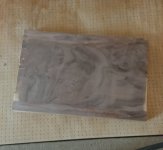
Thanks for all the comments chaps. To clarify a bit more - I have a 0.6mm walnut veneer stuck to 12mm birch ply, giving me 12.6mm in total. On running this through the sander, I have gone through the veneer (so sanded more than 0.6mm thickness) at the start and end of the workpiece, which is approx 20cm long. The first photo below shows the board

Veneer 1.JPG

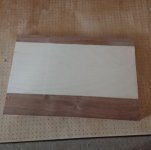
The substrate is actually a piece of birch ply with walnut strips attached so I could cut through these and have the lid look as if it is solid walnut, from the back this looks as follows:

Veneer 2.JPG

It is difficult to see, but on the first pic, the veneer has also been sanded away on one of the long edges, but it has solid walnut below it so it is not obvious in a photo. It is this that I think is due to the drum not being exactly level/parallel with the bed.

Based on the comments above, I suspect I have been turning the wheel too far between passes and I could back this off to get a better finish. I was hoping to get a near 'finish ready' surface off the drum sander rather than having to move to a card scraper each time, but this may also be unrealistic and/or dependent on the veneer being used. I will have a further play next weekend and see what I can do but walnut veneer is expensive so do not want to waste too much getting settings right. Any further comments welcome, especially if the photo's demonstrate some glaring error I am making. I do not have that much time for woodwork currently so it is very frustrating when things do not work as envisaged!
 
StevieB":32qouy8y said:
.... I was hoping to get a near 'finish ready' surface off the drum sander rather than having to move to a card scraper each time, but this may also be unrealistic and/or dependent on the veneer being used...
I think you've nailed it; if you're sanding commercial, wafer thin 0.6mm veneer, realistically, you don't actually need a drum sander! There's so little 'meat' that all I ever do to finish this stuff is to give the surface a couple of passes with 240/320g papers and the jobs a gud'n; perhaps a light scrape prior to the sandpaper if needed - Rob
Edit - the birch ply may not have been dead flat. It may have been slightly warped or not an even thickness (it does vary 'cos my old boss tested some mdf and ply years ago)
 
And...

Did you check the thickness of the ply or assume it is the specified thickness? The tolerance on ply less than 3/4" thick is plus or minus 0.4mm. This could really eat into your veneer if it is thin.
 
AJB Temple":12yny7ga said:
And...

Did you check the thickness of the ply or assume it is the specified thickness? The tolerance on ply less than 3/4" thick is plus or minus 0.4mm. This could really eat into your veneer if it is thin.

Good point. I guess one option (hindsight is brilliant!) would have been to lightly sand the substrate first before applying the veneer.

Or use a handheld Mirka dooberry. Much better control IMO for this sort of application.
 
Thanks - must admit I did not check the ply substrate thickness was even, didn't even occur to me - I was clearly too eager to have a play!

RogerS":3qk5dl4c said:
Or use a handheld Mirka dooberry. Much better control IMO for this sort of application

Hmm, I recall a recent thread in which you had trouble getting Mirka sanding sheets - is that still an issue? Not really got the notes for another purchase currently unless I sell something else, but worth bearing in mind, thanks.

I suspect user error on my part more than the machine, which came from a commercial operation closing down due to retirement of the owner. It has been used but not abused and I saw it working before purchase as well as some of the product produced. I will continue to fiddle for now and maybe try some plain veneer rather than run through my stock of burl walnut, as well as some solid timber and use a micrometer to see if I can detect where the issue lies.
 
Back
Top