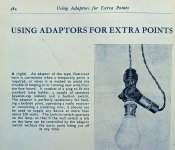
I don't often wander over into this section of the forum, but yesterday I was using what must be my oldest power tool. I realised I didn't know much about it, so I did a bit of searching. I think I have answered my own questions, but I'll share the story here in case anyone can add any more details.
Our plastic water butt was leaking through a little split in its bottom. (No sniggering at the back of the class please!) I thought I'd read that it was possible to weld HDPE, so I had a go with my heavy duty soldering iron. I don't need it often, but sometimes it seems just the right thing.
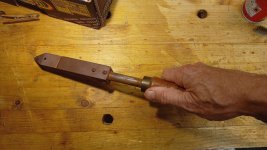
It's a big heavy lump, with the copper tip an inch square:
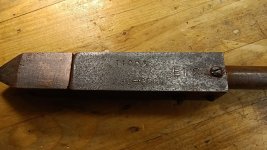
Here's a close-up of some not very informative info:
I had previously found something looking very similar in my 1935 Buck and Hickman catalogue:
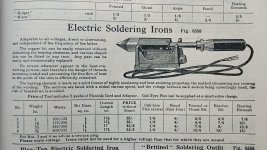
but I couldn't be certain if mine matched. The numbers on mine don't appear in the chart. The tip of mine is an inch square, but the range jumps from 7/8" square to 1 1/4" square.
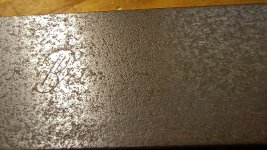
Frustratingly, mine does have a Brand name marked on it, but old rust has made it impossible to read. This is as clear as I could photograph it - all I could be sure of is that the name, in a flowery script, starts with a capital B, and underneath it probably says "REGISTERED DESIGN".
I've noticed that old Buck and Hickman catalogues often left out brand names, but they did relent a bit over the years. If you are lucky/sensible/weird enough to have several to refer to, it's worth flicking through to the future and seeing what came next.
Here's the equivalent entry from 1953, alongside a wider range of electric soldering irons, from Solon and Wolf. You may notice that there's no reference to needing a proper plug on the high power options now. Electric sockets had become easier to find and the need to plug your tools into the electric light socket was fading away.
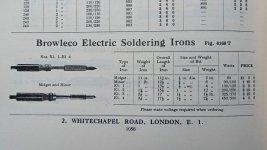
But now we have a brand name. And I can see that my 1" square model is indeed the EI.2. It really is quite powerful, at 200-250W and it cost a lot - two pounds fifteen shillings.
For comparison purposes, the same catalogue lists a Stanley no 7 jointer plane at £2 19s; B&H's top of the range 28" handsaw (5 screws, skew back, taper ground) was £1 16s and a No 4 Woden mechanic's vice (4 1/2" jaws) was £2 17s.
Now that I had the brand name, it was easy to find the trade mark in an eBay listing, which looks like a later model
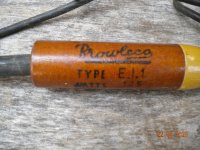
so now, squinting carefully at the illegible marks on mine, I can convince myself that that script matches mine and it's the same London company.
After that, it was easy to find that Browleco soldering irons were made by the Brownings Electric Company, who started in 1919 and are still in business.
The Internet Archive texts collection showed my adverts for smaller soldering irons in "Radio and Electronics" magazines from the 1940s.
The ever-useful Grace's Guide has an entry on them which includes an ad for very similar looking electric soldering irons from 1921!
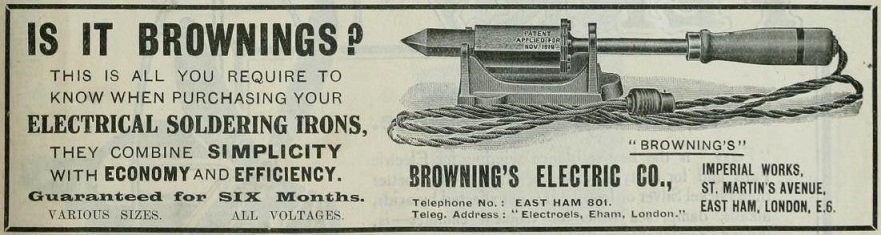
So, although it was nice to track down a mystery tool, I was a bit disappointed to see that Brownings only guaranteed their products for six months. Now, probably 50 - 70 years since mine was made, and with the benefit of hindsight, I think they should have had a bit more faith in their work!
Our plastic water butt was leaking through a little split in its bottom. (No sniggering at the back of the class please!) I thought I'd read that it was possible to weld HDPE, so I had a go with my heavy duty soldering iron. I don't need it often, but sometimes it seems just the right thing.
It's a big heavy lump, with the copper tip an inch square:
Here's a close-up of some not very informative info:
I had previously found something looking very similar in my 1935 Buck and Hickman catalogue:
but I couldn't be certain if mine matched. The numbers on mine don't appear in the chart. The tip of mine is an inch square, but the range jumps from 7/8" square to 1 1/4" square.
Frustratingly, mine does have a Brand name marked on it, but old rust has made it impossible to read. This is as clear as I could photograph it - all I could be sure of is that the name, in a flowery script, starts with a capital B, and underneath it probably says "REGISTERED DESIGN".
I've noticed that old Buck and Hickman catalogues often left out brand names, but they did relent a bit over the years. If you are lucky/sensible/weird enough to have several to refer to, it's worth flicking through to the future and seeing what came next.
Here's the equivalent entry from 1953, alongside a wider range of electric soldering irons, from Solon and Wolf. You may notice that there's no reference to needing a proper plug on the high power options now. Electric sockets had become easier to find and the need to plug your tools into the electric light socket was fading away.
But now we have a brand name. And I can see that my 1" square model is indeed the EI.2. It really is quite powerful, at 200-250W and it cost a lot - two pounds fifteen shillings.
For comparison purposes, the same catalogue lists a Stanley no 7 jointer plane at £2 19s; B&H's top of the range 28" handsaw (5 screws, skew back, taper ground) was £1 16s and a No 4 Woden mechanic's vice (4 1/2" jaws) was £2 17s.
Now that I had the brand name, it was easy to find the trade mark in an eBay listing, which looks like a later model
so now, squinting carefully at the illegible marks on mine, I can convince myself that that script matches mine and it's the same London company.
After that, it was easy to find that Browleco soldering irons were made by the Brownings Electric Company, who started in 1919 and are still in business.
The Internet Archive texts collection showed my adverts for smaller soldering irons in "Radio and Electronics" magazines from the 1940s.
The ever-useful Grace's Guide has an entry on them which includes an ad for very similar looking electric soldering irons from 1921!
So, although it was nice to track down a mystery tool, I was a bit disappointed to see that Brownings only guaranteed their products for six months. Now, probably 50 - 70 years since mine was made, and with the benefit of hindsight, I think they should have had a bit more faith in their work!