-
Hi all and welcome to TheWoodHaven2 brought into the 21st Century, kicking and screaming! We all have Alasdair to thank for the vast bulk of the heavy lifting to get us here, no more so than me because he's taken away a huge burden of responsibility from my shoulders and brought us to this new shiny home, with all your previous content (hopefully) still intact! Please peruse and feed back. There is still plenty to do, like changing the colour scheme, adding the banner graphic, tweaking the odd setting here and there so I have added a new thread in the 'Technical Issues, Bugs and Feature Requests' forum for you to add any issues you find, any missing settings or just anything you'd like to see added/removed from the feature set that Xenforo offers. We will get to everything over the coming weeks so please be patient, but add anything at all to the thread I mention above and we promise to get to them over the next few days/weeks/months. In the meantime, please enjoy!
You are using an out of date browser. It may not display this or other websites correctly.
You should upgrade or use an alternative browser.
You should upgrade or use an alternative browser.
Now for the Chairs
- Thread starter PAC1
- Start date
NickM
Old Oak
I agree with Mike that extending the mortise shouldn't make a big difference to the strength of the leg.
The question is whether a full width tenon is significantly stronger than a haunched tenon. If the tenon breaks it will be shear stress.
I remain torn between the two. In the joinery world haunches are common in furniture less so.
I have another week to think about it before I have to commit.
I remain torn between the two. In the joinery world haunches are common in furniture less so.
I have another week to think about it before I have to commit.
NickM
Old Oak
here's an example I found in an article:
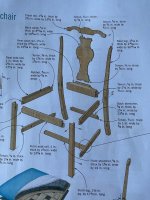
It takes a similar approach to the one I'm taking. No haunches. Small shoulder on the bottom of the tenon (6mm in my case). Larger shoulder on the top to avoid the rebate in the rail.
It takes a similar approach to the one I'm taking. No haunches. Small shoulder on the bottom of the tenon (6mm in my case). Larger shoulder on the top to avoid the rebate in the rail.
More normally known, I believe, as a sloped or sloping haunch. Haunches, sloped or square have only three purposes.A tapered haunch would start at zero at the top of the rail and increase over its length to 10mm or 5mm as you suggest. It reduces the shear the same as a normal haunch but is not visible from the top (not an issue here).
Thanks for the comments.
1. Filling a groove in, for example, a panelled architectural door.
2. Maintaining the alignment on the outside face of M&Td parts where those outside faces are flush, e.g., to resist cupping of the tenoned member. If the outside face of the tenoned rail is inset from the outside face of the morticed leg, for example, a haunch is pointless for that purpose.
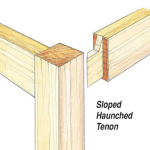
3. Additional joint strength as might be implied by the image of a sloped haunch M&T below (image lifted from Rockler.com). This is the least compelling reason for including a haunch, whether square or sloped. The additional glue strength is minimal, and in the case below, the outside faces of the rail is inset a mm or so from the outside face of the leg so the haunch has no alignment purpose.
Regarding the chairs under discussion there is no good technical reason I can see to include a haunch, but it would be harmless to do so, maybe just for the fun of doing the work. Slainte.
NickM
Old Oak
That's helpful. On my chairs, the joinery is flush and I am a bit concerned about cupping. For that reason, I am considering. Adding a small dowel in the joints next to the rebates in the side and front rails.

Mike G
Petrified Pine
More normally known, I believe, as a sloped or sloping haunch. Haunches, sloped or square have only three purposes.
1. Filling a groove in, for example, a panelled architectural door.
2. Maintaining the alignment on the outside face of M&Td parts where those outside faces are flush, e.g., to resist cupping of the tenoned member. If the outside face of the tenoned rail is inset from the outside face of the morticed leg, for example, a haunch is pointless for that purpose.
3. Additional joint strength as might be implied by the image of a sloped haunch M&T below (image lifted from Rockler.com). This is the least compelling reason for including a haunch, whether square or sloped. The additional glue strength is minimal, and in the case below, the outside faces of the rail is inset a mm or so from the outside face of the leg so the haunch has no alignment purpose.
I'd suggest a 4th: to prevent a mortice from coming too close to the end of a post, stile, or leg, whilst trying to achieve 2. or 3. above. Obviously a mortice too close to end grain leaves the piece very susceptible to splitting.
Thanks Richard and Nick. I understand that the haunch improves the shear strength of the tenon, as Mike said. The shear zone is at the shoulder. A haunch increases the square area of the tenon and the tenons width. The short length of the haunch must also help resist shear.
Mike G
Petrified Pine
I'm not sure I'd go as deep as 10mm with the haunches, though. I'd say 5 or 6mm was more than enough. Their sole structural job is to take the shear forces off the tenon, although they have an aesthetic function as well.
We were talking at cross purposes. I thought you were describing a joint like this:
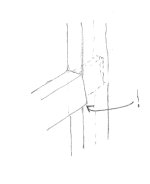
Mike. Thanks for the clarification. I have seen that type of joint used in timber framing where a highly loaded beam has to transfer the load to a column. Or a variation of it called a gunstock joint where for instance a door transitions from rebated to no rebate and you cut a taper from square to rebate.
I am thinking of the style Richard described but for the rear leg/ side seat rail joint. The current design has a 20mm shoulder at the top edge of the rail. I am yet to cut the rails so I can change it to either a full through tenon, a haunched tenon or leave it as it is.
I see the haunch as a compromise between tenon strength and reducing the leg strength.
The leg is not vertical it slopes out at the top, only 4 degrees but the mortice is not parallel to the leg. From the photo yesterday you can see the bottom of the mortice is only about 12mm from the outside edge of the leg. Lengthening the mortice to 70mm full depth might weaken the leg. A haunch might not. But might not add anything either. It is a concern and now is the time to act if I need to.
I may be over worrying about the loss of strength in the leg.
I am thinking of the style Richard described but for the rear leg/ side seat rail joint. The current design has a 20mm shoulder at the top edge of the rail. I am yet to cut the rails so I can change it to either a full through tenon, a haunched tenon or leave it as it is.
I see the haunch as a compromise between tenon strength and reducing the leg strength.
The leg is not vertical it slopes out at the top, only 4 degrees but the mortice is not parallel to the leg. From the photo yesterday you can see the bottom of the mortice is only about 12mm from the outside edge of the leg. Lengthening the mortice to 70mm full depth might weaken the leg. A haunch might not. But might not add anything either. It is a concern and now is the time to act if I need to.
I may be over worrying about the loss of strength in the leg.
That's already covered by the rule of thirds guidance for setting out M&T proportions used in corner joints, e.g., where the top rail meets a door stile. The rule of thirds suggests that only approximately two thirds of a tenoned member's width should be taken up by the tenon. For example the guidance suggests where a 120 mm wide top rail meets a 110 mm wide architectural door stile the tenon should be ~80-90 mm wide leaving roughly 30-40 mm of the top end of the stile not morticed. The inclusion of a haunch in that situation is driven by other factors, e.g., to fill a panel groove.I'd suggest a 4th: to prevent a mortice from coming too close to the end of a post, stile, or leg, whilst trying to achieve 2. or 3. above. Obviously a mortice too close to end grain leaves the piece very susceptible to splitting.
Similar calculations can be used to guide the width of forked tenons, e.g., at the bottom corner of architectural doors where the rail might be anything up to maybe 250 mm.
In the end though the rule of thirds guidance, also sometimes applicable for the two members thickness, is only a guide, and not an unbreakable rule. Slainte.
Last edited:
NickM
Old Oak
Sorry, I hadn't appreciated that your legs are tilted. As you say, if the mortise is not parallel to the grain direction (i.e. your mortise is cut on an angle), then I agree that lengthening the mortise would weaken the leg because you have less continuous grain through the leg.The leg is not vertical it slopes out at the top, only 4 degrees but the mortice is not parallel to the leg. From the photo yesterday you can see the bottom of the mortice is only about 12mm from the outside edge of the leg. Lengthening the mortice to 70mm full depth might weaken the leg. A haunch might not. But might not add anything either. It is a concern and now is the time to act if I need to.
I may be over worrying about the loss of strength in the leg.
That's one of the reasons why I decided to angle the tenon. The other reason is that I thought the visible bit of the through tenon might look better if it's parallel to the leg.
I don't think angling the tenon in that direction weakens it at all, because the grain still runs straight through the tenon. It doesn't create any grain run out.
As it happens, I'm also angling my tenons in the other direction to allow for the taper of the seat. That does create some grain run out, but I've decided it's quite minor and plenty of chairs seem to have been made that way.
Chairs are complicated aren't they! So may options with different pros and cons
Nick they are very complicated in reality but we have hundreds of years experience to refer to!
Mine an even more complicated because I started them 27 years ago and cut the mortices in the front and rear legs, thereby committing me to my ideas at the time and 70mm tall side rails. If only I could remember why I made some of the choices. Also 27 more years of experience does change how things are done.
Mine an even more complicated because I started them 27 years ago and cut the mortices in the front and rear legs, thereby committing me to my ideas at the time and 70mm tall side rails. If only I could remember why I made some of the choices. Also 27 more years of experience does change how things are done.
NickM
Old Oak
I can't remember what I did yesterday!
I'm sure they'll be fine whatever you choose to do. These sound like fairly marginal decision where there probably isn't a "right" or "wrong" answer.
I'm sure they'll be fine whatever you choose to do. These sound like fairly marginal decision where there probably isn't a "right" or "wrong" answer.
I think you could increase the length of the mortice to nearly the width of the rail without weakening the leg too much. The outer mortice cheek is, after all, angling away from the outer face of the leg so at that point the wood is gaining strength. If your design includes a rebate in the rail to accommodate a drop in seat you'd need to narrow the width of the tenon to allow for that. Overall, I still see no need to include a haunch, but there's seems to be no harm in including one if you want.The leg is not vertical it slopes out at the top, only 4 degrees but the mortice is not parallel to the leg. From the photo yesterday you can see the bottom of the mortice is only about 12mm from the outside edge of the leg. Lengthening the mortice to 70mm full depth might weaken the leg. A haunch might not. But might not add anything either. It is a concern and now is the time to act if I need to.
I may be over worrying about the loss of strength in the leg.
What puzzles me a bit is why your side rail, and presumably front rail, is 70 mm wide? It does seem to be a bit over-the-top and I wonder if it will make your chair a little heavy visually. You may, of course, have good reason for this, and I must admit I haven't spent significant time looking at your design development earlier in the thread. It was the talk of haunches that caught my eye and prompted me to say something.
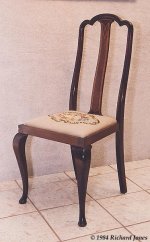
As an example of relative delicacy in the chair below the side and front rails are 40 X 20mm with a 10 mm rebate for a drop in seat; this means the tenons are a maximum of 30mm wide. The chairs are all still hanging together with no joint failures (except one where a rear leg meets the crown rail) after more than forty years. Incidentally, don't be fooled by the date on the photo; the chairs were made two or three years before that. Slainte.
Mike G
Petrified Pine
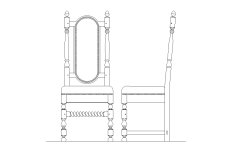
Just by way of comparison, my side rails are currently planned to be 90mm wide. My chairs aren't meant to look lightweight, and won't be:
I don't have any fears about the strength of the joints.
I don't have any fears about the strength of the joints.
Richard, the design I am loosely following (see first page of this thread) has the front and side rails 120mm deep. I reduced them to 70mm because the rest was largely cut away from 120 to 70mm. So my rails are 70 and I will add blocks in the corners to create the same effect.
Okay, got what you're aiming for. Slainte.Richard, the design I am loosely following (see first page of this thread) has the front and side rails 120mm deep. I reduced them to 70mm because the rest was largely cut away from 120 to 70mm. So my rails are 70 and I will add blocks in the corners to create the same effect.
Yes, some of those chair styles from around the mid-1500s to the late 1600s could be quite chunky. As you say you shouldn't have much to worry about regarding joinery strength. Slainte.Just by way of comparison, my side rails are currently planned to be 90mm wide. My chairs aren't meant to look lightweight, and won't be:
I don't have any fears about the strength of the joints.
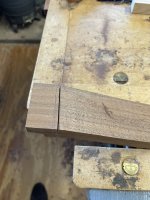
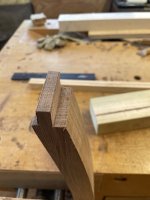
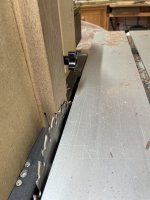
I found a few hours this morning and cut the tenons for the side rails. The front joint is not parallel to the rail but I found the tilt on the saw was the right way (The photo was taken after the real cut was made without guard so you can see what is happening). The top of the blade was 5mm below the shoulder so the feathering does not impact the finished shoulder.I will fit the joints next time.
Cabinetman
Sequoia
- Joined
- Oct 11, 2020
- Messages
- 5,782
- Reaction score
- 1,440
- Location
- Lincolnshire Wolds + Massachusetts
- Name
- Ian
Must say I’ve never liked that way of cutting tenons on a Tablesaw and have done them (up to a stop) on the Bandsaw, with an angled fence I think you could still get the angle.
With a pre-prepared piece of wood against the fence for the first cut, then removed for the second cut the exact thickness of tenon will be produced that matches the mortice. I’ve forgotten, is it a set of six chairs? That’s a Lot of work!
With a pre-prepared piece of wood against the fence for the first cut, then removed for the second cut the exact thickness of tenon will be produced that matches the mortice. I’ve forgotten, is it a set of six chairs? That’s a Lot of work!
Ian, I do both. I chose the table saw based upon the number of tenons to cut as there are 6 chairs and 8 tenons per chair for the seat rails (48). I also have the bandsaw set up for curved work and did not want to change the blade.Must say I’ve never liked that way of cutting tenons on a Tablesaw and have done them (up to a stop) on the Bandsaw, with an angled fence I think you could still get the angle.
With a pre-prepared piece of wood against the fence for the first cut, then removed for the second cut the exact thickness of tenon will be produced that matches the mortice. I’ve forgotten, is it a set of six chairs? That’s a Lot of work!
I am making serious progress today. To start a couple of points for other chair makers. First colour code each chair and identify each part. Second make a template for the side rails, it saves loads of time.
Here is mine:
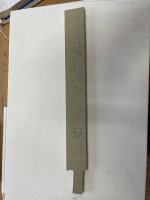
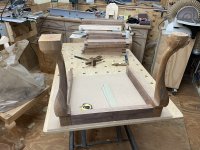
A few photos of progress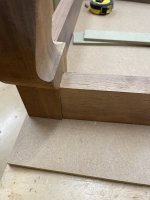
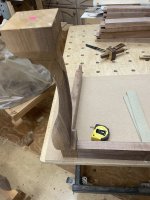
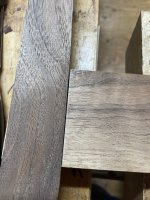
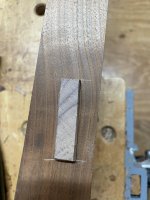
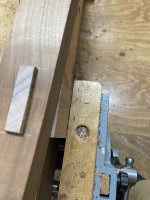
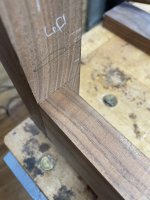
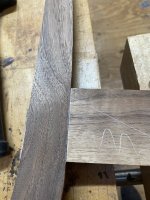
Here is mine:
A few photos of progress
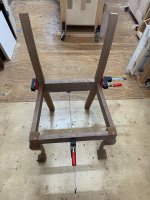
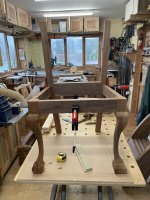
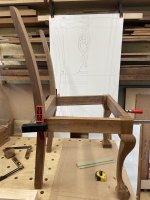
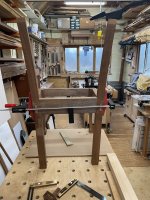
NickM
Old Oak
Looks great.

AJB Temple
Sequoia
- Joined
- Apr 15, 2019
- Messages
- 7,828
- Reaction score
- 1,294
Nice work. They look robust.
duke
Old Oak
Impressive and I like the ball and claw feet.
The seat side rail joinery is complex because all the shoulders are angled in plan. I am very glad that I designed the rear leg seat rail joint to be 90 degrees in side elevation. The thought of the joint being angled in both directions would be a serious challenge.
I should get the seat rail joinery finished tomorrow and then it will be on to the crest rails next time.
I should get the seat rail joinery finished tomorrow and then it will be on to the crest rails next time.
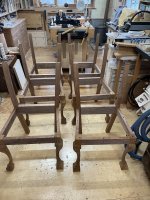
Mike G
Petrified Pine
I really quite enjoy that stage, where you stick all the loose bits together in a dry fit. Firstly, you get confirmation that you've counted right, and got everything handed correctly, and marked correctly. Secondly it goes from being a pile to being X number of finished-size 3D objects. And finally, you can kid yourself into thinking you've nearly finished. 

There is no kidding yet. There is a lot to do. All the carving, the splat and the crest rails.I really quite enjoy that stage, where you stick all the loose bits together in a dry fit. Firstly, you get confirmation that you've counted right, and got everything handed correctly, and marked correctly. Secondly it goes from being a pile to being X number of finished-size 3D objects. And finally, you can kid yourself into thinking you've nearly finished.
The crest rail has a special place in the difficulty stakes as there is only 1 reference point on the rear leg. There after it is about finding a line and then somehow setting out the tenons on the 3D model without square edges..
Just in case it's relevant, I mentioned a chairmaking technique back here that might helpThere after it is about finding a line and then somehow setting out the tenons on the 3D model without square edges..

Jacobean style oak dining table & chairs.
This winter's major project is a new dining suite. It will be a big oak pedestal table and 10 chairs (8 side chairs and 2 carvers), designed for 8 place settings without extensions, and 10 or 12 with extensions. Here is the table: It's not a very enlightening image because it shows stuff on...
 www.thewoodhaven2.co.uk
Thanks Andy that might be very good for the crest rails tenons on the legs. But it might take me longer to make the jig than to cut the tenons. I will sleep on it.Just in case it's relevant, I mentioned a chairmaking technique back here that might help
Jacobean style oak dining table & chairs.
This winter's major project is a new dining suite. It will be a big oak pedestal table and 10 chairs (8 side chairs and 2 carvers), designed for 8 place settings without extensions, and 10 or 12 with extensions. Here is the table: It's not a very enlightening image because it shows stuff on...
The problem is the leg curves back and slopes out. The jig would need to have all of the angles and curves.
I do have a flat surface at the back that I deliberately maintained knowing this was going to be very difficult.
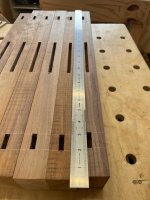
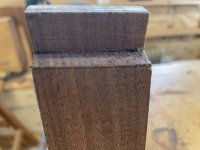
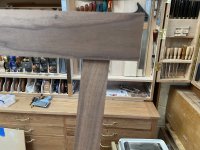
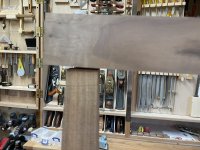
Here are some photographs of the problem with the crest rail rear leg joint. A level line can be produced with a rule
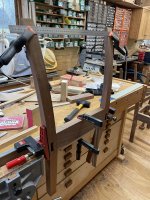
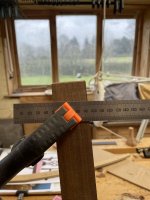
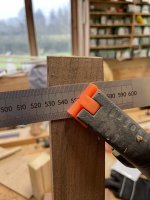
Thereafter it gets hard
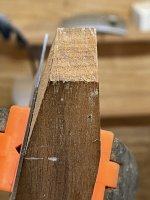
You can see the flat surface I deliberately kept. The tenons are parallel to it.
Then the pattern in place
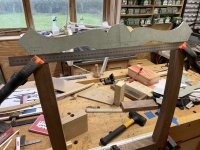
Thereafter it gets hard
You can see the flat surface I deliberately kept. The tenons are parallel to it.
Then the pattern in place
Having thought further, I am going to cut the tenons by hand to the ruled lines. The reason is that the crest rails before carving is simply a piece of 70mm x45mm walnut so the important thing is that the shoulders on the rear legs are straight and level to match the flat surface of the crest rails before carving. That is achieved by the ruler clamped across both legs and a line scribing. The jig could introduce a different alignment. I can set my rule parallel to the back rail and scribe a line then square the line across from my flat reference surface on the back of the leg and set my tenon width using the flat reference surface.Thanks Andy that might be very good for the crest rails tenons on the legs. But it might take me longer to make the jig than to cut the tenons. I will sleep on it.
The problem is the leg curves back and slopes out. The jig would need to have all of the angles and curves.
I do have a flat surface at the back that I deliberately maintained knowing this was going to be very difficult.