• Hi all and welcome to TheWoodHaven2 brought into the 21st Century, kicking and screaming! We all have Alasdair to thank for the vast bulk of the heavy lifting to get us here, no more so than me because he's taken away a huge burden of responsibility from my shoulders and brought us to this new shiny home, with all your previous content (hopefully) still intact! Please peruse and feed back. There is still plenty to do, like changing the colour scheme, adding the banner graphic, tweaking the odd setting here and there so I have added a new thread in the 'Technical Issues, Bugs and Feature Requests' forum for you to add any issues you find, any missing settings or just anything you'd like to see added/removed from the feature set that Xenforo offers. We will get to everything over the coming weeks so please be patient, but add anything at all to the thread I mention above and we promise to get to them over the next few days/weeks/months. In the meantime, please enjoy!

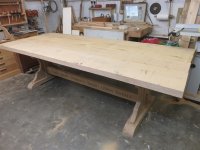
Oak dining table build (complete, and inside)

As always a wonderful WIP from you 👏 (y)

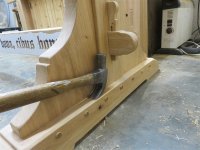
Personally Mike I would leave out the wedge withdrawal wedge in favour of a less obvious solution.
To me it looks like something is missing/fell out.

Alternative A (not easily actioned by subsequent generations)
Suitable pivot point on the floor with a stout timber positioned atop with its end under the wedge tip and press.
It may lift the table but a quick clout on the timber should jolt it out.

Alternative B (easily actioned by subsequent generations if they knew it was tucked under the table)
Make a broad wedge to fit between the foot of the leg and the tip of the wedge.

Cheers, Andy
 
You guys are overthinking this. Tables get knocked down once in a blue moon. When that time comes, lift the end a put a block, brick, big book under. Clout wedge from beneath with a mallet. Keep it simple.
 
You guys are overthinking this. Tables get knocked down once in a blue moon. When that time comes, lift the end a put a block, brick, big book under. Clout wedge from beneath with a mallet. Keep it simple.
Nothing to do with that, Mike's already said it's the protrusion of the foot vs the gap between top of foot/bottom of wedge, that makes getting a hammer in there more difficult. Nothing to do with floor to bottom of wedge height.
 
Surely a couple of little wooden stops under the middle of the table, with a turn-button of some kind to hold it in place is the answer. That way it stays with the table and doesn't disappear into a drawer or just disappear...
It might actually get to serve another function, in keeping an extension in place. Obviously that would be its primary function (if it happens), and the wedge-removal thing would be a once-in-a-blue-moon job for it. I'm still thinking about how the extension is going to work.
 
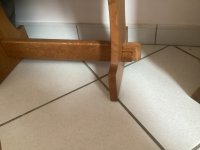
I’m trying to understand if an horizontal wedge is any less efficient than vertical. Obviously doesn’t solve Mike’s conundrum of course, just curious.
IMG_4572.jpeg
 
I’m trying to understand if an horizontal wedge is any less efficient than vertical. Obviously doesn’t solve Mike’s conundrum of course, just curious.

It would overhang the central "post" either side if horizontal, and being vertical, it is another vertical face restricting racking of the table. If horizontal, it would actually become a pivot point. So I'm pretty confident that vertical is the stronger of the options.
 
I've sorted it. There'll be 4 of those wedges. Their main job will be to lock extensions in place at either end of the table, and their Saturday job will be wedge removal.
You might need to mark the wedges explaining intended use. I can see someone many moons down the line standing scratching his head. ;)
 
Last edited:
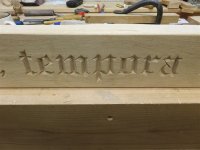
I was carving the stretcher, last time I posted........

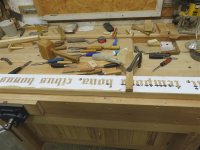
On the first side, I did all the lower parts of the letters one way up, then turned the wood around and finished off with the words upside down:
IMG_8711.jpg

It's a long slow job, but gently speeding up:
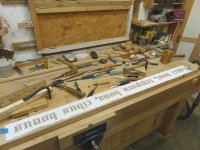
IMG_8712.jpg

The paper has to be well stuck down with Pritstick, so removing it is a bit tedious. I found a card scraper works best:
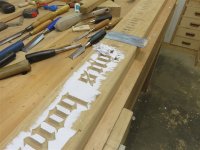
IMG_8713.jpg

After removing the paper, you get to see all the stuff which needs tidying up. That takes a while. The net result looks OK to me, though:
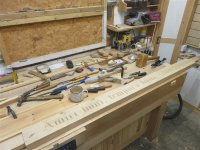
IMG_8714.jpg

Actually, that makes a point. You can't read that as there is no contrast. However, stand it up and you get shadows:
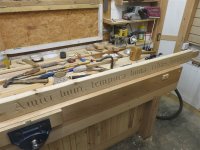
IMG_8715.jpg

A close up of a random section:

IMG_8716.jpg

........which if course showed up some more cleaning up!! It's done now.

I had also glued up the second pedestal one evening. Here it is with the pegs un-trimmed, and chalk indicating glue squeeze-out for cleaning up:
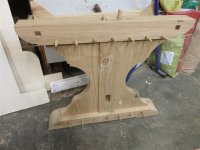
IMG_8717.jpg

Here's that pesky knot after being filled and cleaned up:
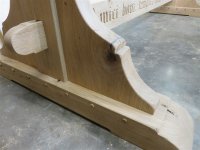
IMG_8719.jpg

I assembled the two pedestals, and checked for squareness etc:
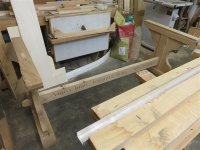
IMG_8718.jpg

On to carving the other side of the stretcher. I had done the last few letters of the other side a bit differently, and it proved a lot quicker and neater. Let's show you a close up of the process. Focus on the "O":
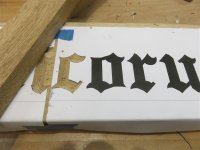
IMG_8720.jpg

The previous letter looks scruffy, but it isn't. That's just carving detritus, and managing that is important. You quite quickly can't see what you're doing. So, back to the "O". I chop out the big straight bits first, with a 1" chisel:
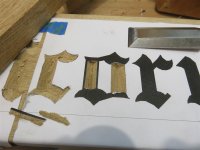
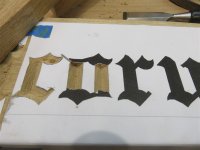
IMG_8721.jpg

IMG_8722.jpg

Then I take a V gouge and come in from all the points, and down any (future) valleys:
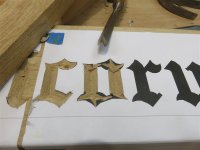
IMG_8724.jpg

Then the mallet goes down, and the rest of the job is just paring. First with a 1/4" chisel:
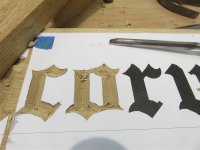
IMG_8725.jpg

Next I go down the valleys again with the V gouge:
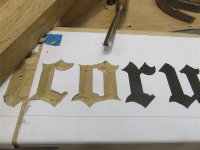
IMG_8726.jpg

Then I do all the curves with this incredibly useful extra-shallow gouge with a thumbnail grind:
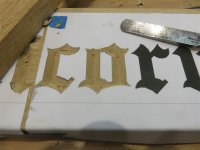
IMG_8727.jpg

You can do a curve of virtually any radius with the tool. Its disadvantage is it doesn't get into any points, so it can only go so far down any slope. You've now got the shape fully formed, and it is just a question of refining and cleaning up, with whatever works:
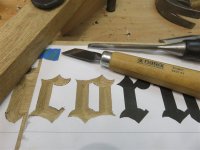
IMG_8728.jpg

ONce I had finished the whole side, I stood it up so the light showed up any issues, and then spend an hour working along the length tidying up all the tools marks etc. I'm thrilled with the result:
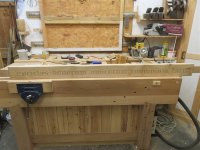
IMG_8729.jpg

Taking it inside for grown-up show-and-tell is an important stage:
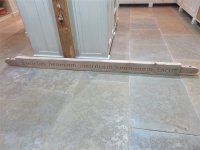
IMG_8730.jpg

All in I reckon there was 15 to 20 hours work in carving both sides. It gave me awful neck-ache. However, I am really pleased that I bothered, as it is going to make this table quite distinctive.

If I hadn't had to go and listen to my wife's choir give a christmas concert, I would have started the top. I mean, I suggested that as I went last year I didn't need to go this, but that didn't help my cause.......
 
Last edited:
Will you paint the letters or leave them natural?
 
They won't be painted. They'll be stained along with the rest of the table (and later the chairs). Staining shows up end-grain darker than long grain, so will have the effect of highlighting the carving a bit.
 
That's really impressive & looks really neat.
Top job. My neck is twinging at just thinking of spending 15-20 hours carving!
 
Most impressed Mike, incised deeper than imagined it would be, but that’s probably due to the size and width of the letters?
That's entirely arbitrary Ian. If you go too shallow, the really narrow bits would barely be more than a scratch.
 
Very nice.

I use pritt-stick too but agree it's a pain to remove. I've wondered if there's a better alternative. Something like they use on post-its would be good.
 
Very, very nice!

I like the knot repair too. I had a gut feeling it would come out better like this. I think it will get even better when finished. I rather feel you made the right call by doing it this way.
 
The paper has to be well stuck down with Pritstick, so removing it is a bit tedious.

I have tried my hand at carving only once, so maybe what I am suggesting is a bit daft. I used paper with the same stuff on the back as you would find on old-fashioned stamps and envelopes. Gum it is I think? Anyway, that worked like a charm. I had to wet it a little and it stayed put until I made it wet again. It left no adhesive on the wood after removing at all.

The paper went through the laser printer without any issue.
 
...... I used paper with the same stuff on the back as you would find on old-fashioned stamps and envelopes. Gum it is I think? Anyway, that worked like a charm. I had to wet it a little and it stayed put until I made it wet again. It left no adhesive on the wood after removing at all.
The paper went through the laser printer without any issue.

I wonder what that was/ is. I've never heard of pre-gummed paper sheets. The other factor is that I was using A3 paper. Even that was a bit of a pain to line up properly. Doing it on A4 sheets would have added a whole other layer of complexity.

I might drop Jack Badger a note and ask what they use.
 
Another approach to semi-sticking paper: blue tape (painter's tape) on the wood, blue tape on the paper back, then glue faces of the tapes to each other with CA or any other glue. Peels right off.
 
Another approach to semi-sticking paper: blue tape (painter's tape) on the wood, blue tape on the paper back, then glue faces of the tapes to each other with CA or any other glue. Peels right off.
The problem with that, Gary, is that the entirety of the paper needs to be stuck down to the wood. You cut it up so much that all the bits of it would move it it wasn't stuck down fully. So, doing that all over would not only be time-consuming (and difficult to line up), but would also mean you have to carve through 3 layers. That would get a bit spongy, when you actually need absolute firmness in tool placement.
 
Ah yes, I see. How about a "repositionable" spray adhesive? I believe that is the stuff on Post-It notes.

Or, try the washi paper trick used for shojii screens: rice paste glue. Boil some rice, drain the water, mash it up or run it through a blender until it is a paste. Glue the paper down with that. When time to remove, spray with water. It dissolves easily and comes right up.

Any other starch (potato, wheat, maize/corn) works the same way.
 
Very impressive. I shall bookmark the description of the process in case I'm ever ambitious enough to attempt carving text.
 
The problem with that, Gary, is that the entirety of the paper needs to be stuck down to the wood. You cut it up so much that all the bits of it would move it it wasn't stuck down fully. So, doing that all over would not only be time-consuming (and difficult to line up), but would also mean you have to carve through 3 layers. That would get a bit spongy, when you actually need absolute firmness in tool placement.

The last time I did it Mike, was to use wide masking tape, print off the lettering then transfer it to the tape using carbon paper. It sounds a faff but was remarkably quick and then I just carved through the tape.
I'm certainly not suggesting thats a better way but it worked for me and as I already had the tape and masses of carbon paper it seemed logical to me at the time.
 
Last edited:
Would anything Like This be a suitable adhesive for stencils. One of several that came up in a search.

Edit:- The reason for my searches:-

In the 1950's I spent many hours fascinated by a commercial artist who made his own 'post-it' type adhesive for his masking papers, grease proof paper covered in what he called 'Gold Size' but whatever the base was it peeled off the photographic prints without leaving any residue on the surface and could be repositioned several times, which regular recipes for Gold Size that I could find would not do.
 
Last edited:
I also use Scotch Photo Mount repositional spray adhesive on scroll saw patterns. In my experience any repositioning needs to happen before the glue dries hard. Once dry it can need scraping off. I think I used white spirit last time to soften it.
 
I wonder what that was/ is. I've never heard of pre-gummed paper sheets.

I tried to find the original receipt for you, but I couldn't find it. But that did make me remember what is was called. It translates to "gummed kraft tape" (Kraftpapierband in German). I have rolls of 70mm wide white tape. I know there are wider versions, but the price increases quickly then. I opted to just tape 2 strips next to each other. If I remember correctly it was about 10 Euros for a roll of 50 meters. Hope that helps.
 
I used to use photo mount but now I use hide glue (as I use it for furniture glue ups, it is to hand) I am finding it very good as it washes off so clean up is quick. The only down side is it is a tad slippery to start gluing the paper down. It soon gets sticky so maybe I need to be patient and wait before attaching paper to the wood.
 
Mike fed me the carving bug unfortunately so I've done quite a bit now. Maybe I'm more old school than you guys, but I prefer to draw on the wood directly rather than using paper templates. I do a layout on the computer first, but then I create a grid on the wood in soft pencil, using dividers. I suspect my carving method may be unconventional though as I tend not to carve a whole letter in one go - typically I do all the straight cuts, then all the curved cuts, then all the corner ends and details.

I've got a few things to in stone as well when I get chance.

Very nice work Mike.
 
I know some of you good people think I work fairly fast. Here's the reality.

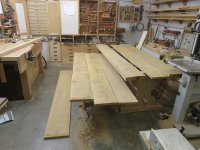
I got out to the workshop around mid-day today, and started work on the top. The first job was to lay out the available boards, and decide which ones I'm going to use:

IMG_8731.jpg

The third board from the left has a bit of that yellow stain we talked about a few days ago. I decided to use it, mainly because it was a nice board with some knots. This table will be stained quite dark, so the yellow will disappear.

I ripped the two central boards to width:

IMG_8732.jpg

This gave me a chance to look at the table at it's approximate finished size:

IMG_8733.jpg

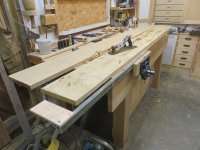
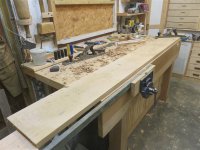
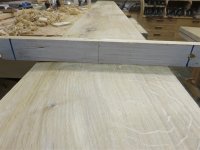
The two central boards are 27mm thick, roughly, and the outer two are 54mm. The 1" boards are now just narrow enough to go through the planer thicknesser, but the 2" ones are way too wide. However, I am really keen to not have a perfectly flat table top, and to have an undulating hand-planed feel to the finished item. So, out with the bench planes, and on with work to the 1" boards.

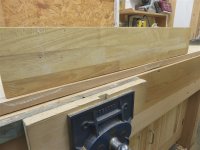
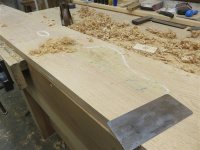
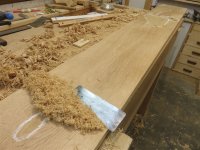
My strategy was to flatten the backs enough to be able to then pass the back of the boards over the planer, and then hand plane and scrape the top. There were a few knots in the boards, and lots of waviness, so I scrub planed at 45 degrees to remove material I didn't want:

IMG_8734.jpg

IMG_8735.jpg

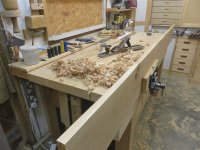
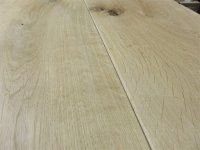
Having taken out cupping and wind, I could then let the machine do the flattening of the bulk. Having got the backs flat, I used short scrub planes on the top, so as not to flatten the boards too much. I hope this shows that the surface remains undulating:

IMG_8736.jpg

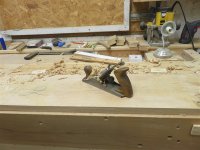
I retrieved my old number 4 from the teardrop, sharpened it, and used it to scrub, and then rough out along the grain:

IMG_8737.jpg

This board is all over the place:

IMG_8738.jpg

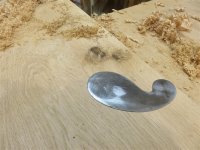
Plodding along with two number 4s, one set to take the finest of shavings with a tight-set cap-iron, reduced the un-reachable areas to a minimum, and then I worked seemikngly forever with card scrapers:

IMG_8739.jpg

IMG_8740.jpg

IMG_8741.jpg

The curved one did a great job of the knots. Eventually, I finished a board:

IMG_8742.jpg

So, I just went and did exactly the same thing to the other one:

IMG_8745.jpg

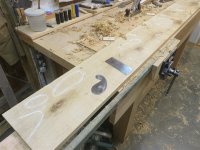
I really wasn't aiming for flatness:

IMG_8746.jpg

I called my wife out to discuss how undulating the table top could be. "So long as it's flatter than Stephen's"..........that's good enough for me. My friend's elm table is legendary. It can take 3 or 4 attempts to put a tea cup down without spilling the contents.

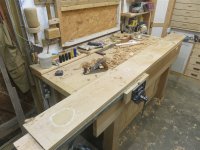
Doing the edges gave me a chance to use the number 7, but even so, it took forever:

IMG_8747.jpg

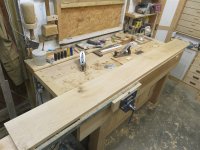
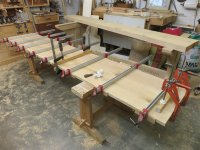
Eventually, it was down to removing the arrises, and gluing up:

IMG_8748.jpg

IMG_8749.jpg

There. I'm shattered, and 6 hours plus of work has only got 2 boards flat enough, and glued. I can't see the table being done for the revised deadline of next Sunday.
 
Last edited:
...... typically I do all the straight cuts, then all the curved cuts, then all the corner ends and details.....

Yes, that how I did most of the first side. I found I was more physically comfortable doing one letter at a time, though.
 
I can only dream of getting 6 hrs uninterrupted to do anything, although I doubt I have neither strength nor stamina for that amount of planing.
 
Back
Top