• Hi all and welcome to TheWoodHaven2 brought into the 21st Century, kicking and screaming! We all have Alasdair to thank for the vast bulk of the heavy lifting to get us here, no more so than me because he's taken away a huge burden of responsibility from my shoulders and brought us to this new shiny home, with all your previous content (hopefully) still intact! Please peruse and feed back. There is still plenty to do, like changing the colour scheme, adding the banner graphic, tweaking the odd setting here and there so I have added a new thread in the 'Technical Issues, Bugs and Feature Requests' forum for you to add any issues you find, any missing settings or just anything you'd like to see added/removed from the feature set that Xenforo offers. We will get to everything over the coming weeks so please be patient, but add anything at all to the thread I mention above and we promise to get to them over the next few days/weeks/months. In the meantime, please enjoy!

Oak dining table build (complete, and inside)

I can't see the table being done for the revised deadline of next Sunday.
I can see it completed as far as a 'User' though, so perhaps time for some realism in somebody's expectation 😈 (I'm far enough away not to be bothered by the explosion)
 
I can see it completed as far as a 'User' though, so perhaps time for some realism in somebody's expectation 😈 (I'm far enough away not to be bothered by the explosion)
Oh, no, explosions aren't my wife's way. She understands. I think the aim is to have the undercarriage inside, and the table top in the workshop for any party-goers who are interested.
 
A someone with a wonky table top can I make a suggestion that you flatten the areas where you expect each place setting to be? Trying to use knife and fork on a plate which is wobbling isn't an enjoyable experience 😆
 
Can't you use a table cloth temporarily, perhaps with a waterproof protector underneath?
The top will likely only have had 2 coats of jollop on it by then, and will need 4 or 5 altogether. I'm not carrying it in (or out) more than once, and I can't apply the finish inside because it stinks, apparently. The pedestals are easy to carry in and out, so they can go back out to be properly finished.
 
A someone with a wonky table top can I make a suggestion that you flatten the areas where you expect each place setting to be? Trying to use knife and fork on a plate which is wobbling isn't an enjoyable experience 😆
I'm doing those bits now, and they're much much flatter. The 2" boards are almost blemish-free, so flattening is easy.
 
Might have missed it, but am I correct in saying you'll have 2" breadboard end so the table has the appearance of all being 2"?
 
Might have missed it, but am I correct in saying you'll have 2" breadboard end so the table has the appearance of all being 2"?
Yes, exactly that, Matt. With any luck, and if the phone doesn't ring, I'll tackle those tomorrow.
 
Sod it. Clients can wait (I'm trying to retire, anyway). I spent most of the day in the workshop. Although it went well, it went slowly.

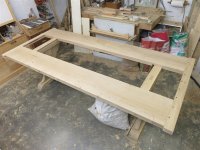
I had intended to crack straight on with the breadboard ends, but I realised that I have 3 loose boards, so trying to do shoulders etc.....well, it's a bit too much of a moveable feast. So, I decided to do the joints between the 2 inch boards and the tops of the pedestals. I cut the boards to length, then carefully laid them out in their final position. I noted how much had to be removed at each end of each board, and marked out underneath:

IMG_8750.jpg

IMG_8751.jpg

I these joints are going to be wedged, and half of them have to deal with a dovetail rebate on one side of the top of the pedestals. So working out the stuff to remove took a few minutes thought:

IMG_8752.jpg

I started by hogging out the bulk of the waste on the pillar drill. That's easier said than done, because it meant props (roller stands) either side:

IMG_8753.jpg

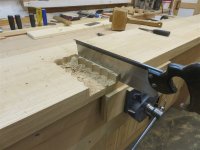
Note the mortice taken to the line at the far end. This gives room for a tenon saw, so I could then saw the side of the dovetail. It's more accurate in my view than trying to chisel an under-cut face:

IMG_8754.jpg

IMG_8755.jpg

IMG_8756.jpg

Note the tolerance I allowed between my depth mark, and where I actually finished. I wanted to offer up and check before committing to full depth. The joint at the other end of the board has both walls dovetailed:

IMG_8757.jpg

I offered up, adjusted, and offered up again:

IMG_8758.jpg

Spot on. So, I did the other board:

IMG_8759.jpg

The chalk is additional planing required. It took me ages to get the wedges right:

IMG_8760.jpg

IMG_8761.jpg

The wedge has a different slope on each face, and my theory is that as you whack it home it will pull the table top down tight to the pedestal. I daren't whack it home yet, as it's a pig to get out.

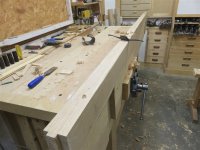
Anyway, now that the boards can be fixed in their final location, I moved on the breadboard ends. They're about 80mm wide, and 50 deep (high):

IMG_8762.jpg

They're going to be locked in a permanent arm-wrestle with the timbers of the top, so need to be pretty strong. The bulk of the work they do is done by a tenon in a groove. I'd got this far without using the screaming monster, so I got out a plough plane (well, combination plane, really), and ploughed a groove or two:

IMG_8763.jpg

IMG_8764.jpg

IMG_8765.jpg

The eccentric location of the groove is to cope with the two 1" boards in the middle. Don't worry, I have a cunning plan......

I spent a few minutes working out the peg locations and the mortices:

IMG_8766.jpg

.....and more than a few minutes marking out and drilling (from both sides) the peg holes:

IMG_8767.jpg

Once they were done, it was back to the pillar drill to hog out for the breadboard end mortices:

IMG_8768.jpg

I'm now miles behind where I wanted to be.
 
Last edited:
I know very little about older furniture but is the top construction common approach? If I've understood it, the boards won't be connected to each other down their length just by the breadboard ends, is there a chance of movement or is that just part of the aesthetic? Before installing the ends you put the top onto the pedestals and fix in place with sliding dovetails and wedges?
 
I know very little about older furniture but is the top construction common approach? If I've understood it, the boards won't be connected to each other down their length just by the breadboard ends, is there a chance of movement or is that just part of the aesthetic? Before installing the ends you put the top onto the pedestals and fix in place with sliding dovetails and wedges?
No, the boards ARE glued to each other, or at least, will be (the centre 2 boards already are). The breadboard ends are mainly to resist cupping or twisting, but I've exploited their existence by using them to hide 1" boards in the middle of the table. The allowance for movement is designed such that the boards are fixed in the middle of the table, and the outer edges can drift in or out. Obviously any movement will show at the junction with the ends of the breadboard ends. The table top will therefore be one complete entity, and will be dropped onto the base, and wedged tight. Wedging the top on is a bit of a game, really, because I wanted to avoid using any metal fixings. Otherwise, I would have done buttons.
 
While I am sure that Mike will have worked out an effective way of fixing his table top, the discussion here left me wondering how big old trestle tables were joined together back in the fifteenth or sixteenth century.

Frustratingly, although I have a couple of books that show historic construction, they leave out this detail. Maybe museum curators don't like anyone trying to dismantle their exhibits.

I did find one answer, in Furniture in England, The Age of the Joiner, by Wolsey and Luff, published 1968.

It says that the planks might be joined along their length by tongueing and grooving, or by fixing with dowels or large nails. Or by cross battens, or by grooving the edges for 3" wide tongues, pegged with dowels on either side of the join.

It goes on to say that the tops could be just laid loose on the trestles or else be drilled for large vertical dowels or tongues fixed in the trestles.

Apparently gravity did enough, but the authors do refer at this point to tops up to 6" thick. 😏
 
While I am sure that Mike will have worked out an effective way of fixing his table top, the discussion here left me wondering how big old trestle tables were joined together back in the fifteenth or sixteenth century.

Frustratingly, although I have a couple of books that show historic construction, they leave out this detail. Maybe museum curators don't like anyone trying to dismantle their exhibits.

I did find one answer, in Furniture in England, The Age of the Joiner, by Wolsey and Luff, published 1968.

It says that the planks might be joined along their length by tongueing and grooving, or by fixing with dowels or large nails. Or by cross battens, or by grooving the edges for 3" wide tongues, pegged with dowels on either side of the join.

It goes on to say that the tops could be just laid loose on the trestles or else be drilled for large vertical dowels or tongues fixed in the trestles.

Apparently gravity did enough, but the authors do refer at this point to tops up to 6" thick. 😏
Ours from somewhere * around mid 1500's has three rather roughly chamfered planks underneath at 90 degrees to the top and these are nailed on with ginormous nails from top and bottom. There is no t&g in the boards so there are gaps and all three boards are a different width. The top is very thick and too heavy for my wife to lift one end (bear in mind she is used to helping me with oak framing so she's a tough cookie).

T&G was known at that time as we have a large coffer from the same period (in fact from the same house) that I believe has rather rudimentary t&g in the bottom boards (but not the back).

* although we have good provenance, that shows it in a house inventory on a death in 1582, we don't know when it was made. Presumably some years before, but furniture was built to last back then.
 
In the last instalment I made the breadboard ends. In this one, I fit them.

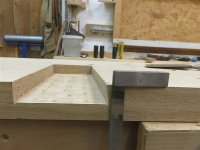
I can tell you it's a big moment when you put a straight edge across your work, and run a knife along it. You're a bit committed then!

IMG_8769.jpg

Note the piece of aluminum to give me a reference. The edge of the board hadn't been straighted, so there was no reliable line anwhere on the outside of the table top.

IMG_8770.jpg

Because the top hadn't yet be joined, I could work on individual boards. This probably made things easier:

IMG_8771.jpg

IMG_8772.jpg

IMG_8773.jpg

The outer 2" boards had got a reliable flat top, which I could use for reference. I couldn't use my router plane, because the drop below the sole was too much for it, so I use my old favourite, the screw-through-a-batten:

IMG_8774.jpg

IMG_8775.jpg

That trick didn't work on the underside, which was a very long way from flat (I'd not even tried). So, a marking gauage and calipers helped me plane down to a reliably parallel tenon, which I then marked up for cutting:

IMG_8776.jpg

The for hours on end it was a question of repeating all that, and sneaking up on a good fit, one board at a time:

IMG_8777.jpg

That's good enough. Feeler gauges were much in use, and very useful:

IMG_8778.jpg

I did the outer 2" boards first:

IMG_8780.jpg

The two cnetral 1" boards, you'll recall, were already glued together. This made the length of the cut for the shoulder dauntingly long. I sacrificed a little accuracy by sawing alongside a clamped-on straight edge:

IMG_8781.jpg

IMG_8782.jpg

You can only get so far before the saw handle fouls the guide:

IMG_8783.jpg

By then, your line is established and the danger of hopping out of the cut and doing some damage is much reduced:

IMG_8784.jpg

Then it was just chiseling and planing in the normal way:

IMG_8785.jpg

IMG_8786.jpg

The problem with these central boards, though, is that they are a long way from flat, so it was a job to know where the top face of the tenon was supposed to be (the bottom is bare-faced). What I decided to do was of leave them 2 or 3mm higher than I reckoned they need to be, but ensure that both ends were parallel:

IMG_8787.jpg

In that photo, the far tenon has been done, and the level on the near one has been packed up to line through with it. I could then scribe a line with a marking gauge from the top of the level.

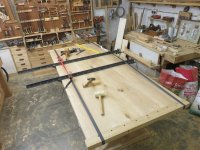
Eventually, all the tenons were done, and it was time for a trial assembly. I was rather relying on my long ratchet straps to pull it all together:

IMG_8788.jpg

Ooops!
 
No, the boards ARE glued to each other, or at least, will be (the centre 2 boards already are). The breadboard ends are mainly to resist cupping or twisting, but I've exploited their existence by using them to hide 1" boards in the middle of the table. The allowance for movement is designed such that the boards are fixed in the middle of the table, and the outer edges can drift in or out. Obviously any movement will show at the junction with the ends of the breadboard ends. The table top will therefore be one complete entity, and will be dropped onto the base, and wedged tight. Wedging the top on is a bit of a game, really, because I wanted to avoid using any metal fixings. Otherwise, I would have done buttons.
I might have missed something but why the 1"boards for the middle two planks?
Would it not be simpler to use 2" boards across width?
 
I had to cobble something together:

IMG_8791.jpg

I then spent a long time doing micro adjustments of shoulders, tenon depths, central tenon heights, and so on. Getting the top shoulders of the tenons right was the critical thing:

IMG_8789.jpg

Adjusting those underneath was a complete pain, and generally involved working "blind". Eventually, both ends were spot on, and I could mark up for the peg holes:

IMG_8792.jpg

Which were obviously offset for the draw-bore effect. A central point to your drill bit is essential for this step, so with pegs this size your choice is brace and bit, or a spade bit:

IMG_8793.jpg

We're on the home straight now. I cleaned up and rounded over all of the edges, mainly with a spokeshave. They went from not-very-straight to very-not-straight:

IMG_8794.jpg

I trimmed the breadboards ends to length (well, a gnat's over, for planing to a final fit tomorrow). I then rounded the corners (grandkids' eyes, and all that):

IMG_8795.jpg

IMG_8796.jpg

I made a few more pegs, and then some little pieces which will guide the "legs" of the etension leaves into place:

IMG_8797.jpg

IMG_8798.jpg

Remember these things? Well, I strill have a couple, and they can be very useful:

IMG_8799.jpg

This is obviously on the underside of the table-top, on the 2" outer boards, both ends. These little guide will take the pressure of a wedge, so I thought it best to inset them:

IMG_8800.jpg

There are some jobs which it would be just plain stubborn to not use the router for (sheesh, my English!!). Out came the screaming monster for its first visit to the job:

IMG_8801.jpg

IMG_8802.jpg

I thought I'd got a photo of them "clamped" in place with a temporary screw into a small piece of ply over the top of the guides. Sorry.

And apologies too for not having any photos of gluing everything together. It was a bit fraught, but actually went really well. I'm using one of the white glues, with a 20 minutes open time. This is a big piece, with lots of parts, and everything needed coating prior to assembly, so I really was up against it. The pegs made it so much easier than it would have been otherwise. It goes down as another successful glue-up, but if you'd have knocked on my workshop door at any stage during the process I'd have chewed your ear off!!! Anyway, here's the obligatory clamped-up photo:

IMG_8803.jpg

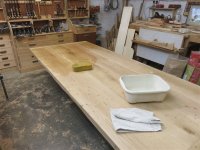
The breadboard ends came up a real treat:

IMG_8804.jpg

I had moved the base into the house at lunch break, so that our party guests tomorrow can have an idea of what I'm doing:

IMG_8805.jpg

It's carnage in there at the moment, with a party to prepare for, and the decorations boxes strewn everywhere. I'll have time to de-clamp tomorrow morning, but that's about it.
 

Attachments

  • IMG_8790.jpg
    IMG_8790.jpg
    167.9 KB · Views: 11
Last edited:
I might have missed something but why the 1"boards for the middle two planks?
Would it not be simpler to use 2" boards across width?

Mainly the weight. It's already massively heavy, and I've got to rope some friends in to carry it into the house in due course. But also cost. No point buying wood you'll never see.
 
Mainly the weight. It's already massively heavy, and I've got to rope some friends in to carry it into the house in due course. But also cost. No point buying wood you'll never see.
I quite agree, pls remember when I wip my bench.
I can’t quite get my head around the recessed wedges but I’m sure all will be apparent soon. Which is more than I can say as to what you’ve been using the egg lift for in this build haha!
Edit, yes I understand it now.
 
I quite agree, pls remember when I wip my bench.
I can’t quite get my head around the recessed wedges but I’m sure all will be apparent soon. Which is more than I can say as to what you’ve been using the egg lift for in this build haha!
Edit, yes I understand it now.
Egg lift?
 
Enjoyable as ever to follow. Are you pleased?
With a top as heavy as that I wonder if it actually needs fixing. My table top, nowhere near as heavy, has been floating since day one and never caused a problem.
 
Enjoyable as ever to follow. Are you pleased?
With a top as heavy as that I wonder if it actually needs fixing. My table top, nowhere near as heavy, has been floating since day one and never caused a problem.
Pleased? Yes, I think so. I'll be pleased when the finish is done, because I always worry about finishing.

Yes, I could have just put some dowels in, I guess, as locating pins. The reason I wanted to wedge the top was to augment the racking resistance coming from the wedged stretcher. I always have in mind the possibility of an escaped baby elephant crashing into it, or a drunken sumo wrestler using it for practice....
 
I don't want to sound like I'm complaining, when so much impressive work has been done in such a short time, but the current thread title says "woodwork finished" and we haven't seen the cunning extension pieces.

I only mention this in case a crowd of admiring Woodhaven members converge on your house and swell the number around the table to its maximum capacity.... 😀
 
What nice and educational thread! Lots of things to remember and lots of things to enjoy. Thanks for taking the time to document your journey. I always hate taking photo's during a project, because I want to be focused on what I am doing. I appreciate it when someone is willing to make that effort.
 
Thanks guys...much appreciated.

I find photographing the whole thing an interesting discipline, and now and then it forces me to do things properly, or better, because I think "the guys one the forum will see that......"

The extensions, Andy, might have to wait a week or three, because the wood I had set aside for them isn't good enough. I'll have to buy some more in the new year. I am going to have to do something cunning, though, to align the dowels with the holes I will have to drill tomorrow, prior to staining, so there will be some work on the extensions in the next instalment.
 
I have never understood flush cut saws. Why would you ever want to cut something flush? I used a piece of cardboard, and a saw....then a few strokes of a block plane, to deal with the pegs of the breadboard end:

IMG_8806.jpg

Then I spent a while truing everything up, and doing a final smoothing:

IMG_8807.jpg

I should have done the round-overs on the board edges a little bigger, because where I planed down to adjust for little differences I then had to try to re-instate the round-overs any way that worked. This proved to be the best method:

IMG_8808.jpg

The top is bloody heavy, so handling was kept to a minimum. Once I had sorted the top, I stood it up on each edge to to the top edges, particularly plaing the end grain of the breadboard ends:

IMG_8809.jpg

IMG_8810.jpg

Where the 1" boards went into the too-big-mortice, I glued in 4 little wedges, then a cover piece:

IMG_8811.jpg

IMG_8812.jpg

The other end was a bit tidier, so you get to see the photo of that one:

IMG_8814.jpg

With the table on edge the lights showed up oone or two areas on the table top requiring attention. After everything was done and I'd had a final check around, it was time to start the finishing process. Take a deep breath.......

I started by raising the grain, just with some clean water:

IMG_8815.jpg

That was all over everything, top and bottom. Whilst the wood was drying and the grain starting to stand to attention, I built a little jig out of MDF to help me locate some holes for dowels for the extensions on either end. I essentially knocked pins through the MDF, taking care to keep them vertical, and then nipped the heads off. With some little locating pieces to the top edge, this jig could then be used on the table ends, and later, when I make the extensions, it will locate the dowels which will sit into those holes:

IMG_8816.jpg

IMG_8817.jpg

IMG_8818.jpg

IMG_8819.jpg

Again, the brace and bit seemed like the best way of ensuring accuracy.

The following day, the table had dried, and I spent quite a while with some fine sandpaper taking down the raised grain. I think the trick is not to be too vigorous, otherwise you risk exposing some "virgin" grain which will then raise itsel;f when the stain is applied. That's why I sanded rather than scraped:

IMG_8820.jpg

Having swept up all the dust, I decided to go through the process all over again, but on the table top only. I soon discovered I hadn't really swept up all the dust, no matter haow assiduous I'd been:

IMG_8821.jpg
 
After sanding the top again, I mixed up some van Dyck crystals and did a trial piece:

IMG_8822.jpg

IMG_8823.jpg

Not dark enough. I added another 20 grammes, and decided with a little help that this was about right. Bear in mind that I will be matching some chairs to this table in a years time, so I was incredibly careful with accuracy, to ensure repeatability, and I made a note:

IMG_8829.jpg

It's quite a moment in the build when you start slapping this stuff on:

IMG_8824.jpg

IMG_8825.jpg

Don't worry, that's a very long way from the final colour!

I stuck rigidly to the Fourth Commandment of woodworking, and did the underside too (note the 6" nails holding the top up in the air):

IMG_8826.jpg

I rather enjoyed the effect of staining the carving:

IMG_8827.jpg

And now we sit and wait 24 hours for that to dry:

IMG_8828.jpg
 
Back
Top