• Hi all and welcome to TheWoodHaven2 brought into the 21st Century, kicking and screaming! We all have Alasdair to thank for the vast bulk of the heavy lifting to get us here, no more so than me because he's taken away a huge burden of responsibility from my shoulders and brought us to this new shiny home, with all your previous content (hopefully) still intact! Please peruse and feed back. There is still plenty to do, like changing the colour scheme, adding the banner graphic, tweaking the odd setting here and there so I have added a new thread in the 'Technical Issues, Bugs and Feature Requests' forum for you to add any issues you find, any missing settings or just anything you'd like to see added/removed from the feature set that Xenforo offers. We will get to everything over the coming weeks so please be patient, but add anything at all to the thread I mention above and we promise to get to them over the next few days/weeks/months. In the meantime, please enjoy!

Outside door frame - finished

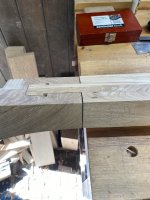
For interest, here is the joint on the old door frame (this is the good side).

IMG_4530.jpeg

IMG_4529.jpeg

As you can see, it's just a pegged tenon (no hammerhead).

That joint held up pretty well. I think the other side failed partly because the wood rotted a bit (although it's more a case of losing its strength over time rather than proper rot - it has that "polystyrene" feel to it now) but also because the iron fixings in the wall came loose. The door closing on the loose jamb kept working that joint.

I think the wedged hammerhead will be fine.

In the meantime, I've shaped some templates for the arched head components. I thought it was a good opportunity to get the compass plan out of the cupboard. I don't think making green dust is its forte(!), but I'll try to use it on the real thing too.

IMG_4531.jpeg
 
I've been cracking on with this. I'm not doing a full WIP but have included some photos below of the "hammerhead" tenon joint.

To get to this point I have:
  • been to the timber yard and bought some air dried oak (which has been good but a little bit gnarly in places - wandering grain etc.),
  • flattened, thicknessed and dimensioned the long pieces for the jambs - the thickest finished pieces were 50mm which I had to get out of 54mm boards so I flattened one side by hand so I didn't inadvertently machine off too much (I've been there before...)
  • did the same for the arch components, bandsawed roughly to shape and finished the inside of the curve with a compass plane and spokeshave. I left a "flat" section on the arch components that join the jambs to help with the joinery. That will be removed, and the outside of the curve finished, later on.
  • glued up the jambs - there are two lengths which are glued up and which form the rebate. I added a few dominos to help with alignment.
  • glued up the sections of the arch which meet the jambs.
To make the joint, I started by marking out the tenons. I made the tenon a little bit wider than I originally envisaged so that the straight part is just under a third of the width of the jamb.

IMG_4579.jpeg

IMG_4580.jpeg

The angled line on the second photo is to create a sloped surface for the wedges to act on - see phots below.

I didn't take photos of cutting the tenons, but it was mainly just a case of sawing to the lines. The only trickyish bit was doing the cheeks of the straight section of tenon. It's too deep for a router plane so, after bashing out most of the waste with a chisel, I pared it as carefully as I could.

That left this:

IMG_4581.jpeg

You can see why it's called a hammerhead tenon. (13 year old me would probably have come up with a different name but this is a family show so we won't go there...)

The components are quite big and heavy so transferring the tenon to the arch is a bit awkward. I put the parts on their side like this:

IMG_4592.jpeg

It's partly hanging off the bench so that I could get access underneath.

I then knifed around the tenon.

IMG_4593.jpeg

Cutting the mortise was quite hard work. I did the first one by drilling out most of the waste. That worked OK, but I think I overheated one of my bits and it didn't want to cut very well second time around. That was annoying as I was aware of the risk and was trying to keep the bit cool by plunging it in water. I tried using a brace with an auger bit which was a bit too much like hard work! For the second one, I drilled some holes in the hammer head part and then managed to saw the cheeks of the straight part.

IMG_4594.jpeg

This was the first trial fit:

IMG_4584.jpeg

IMG_4585.jpeg

It had a pretty even gap all around. I then just spent some time tweaking here are there until I got the gap to close up enough (not 100% perfect but fine for a door in a garden wall!). I also had to "blend in" some slight misalignment issues!

IMG_4590.jpeg

IMG_4591.jpeg

I haven't glued it up yet, but it feels really strong with the wedges in.

The second one is at the trial fit stage so I'll fettle that tomorrow. After that, I think I need to glue up the rest of the arch and then see how it fits in the wall before I glue anything.
 
Brilliant! I thought you would enjoy doing it that way and you have certainly risen to the challenge.
 
Patchy progress on this, but I've now got the arched head fully glued up.

The two layers of overlapping segments are face glued and also have dominos in the end grain.

IMG_4598.jpeg

I did it in a number of goes. The clamps near either end are just to bring everything up to the same level.

IMG_4602.jpeg

I've also removed the 'flats' at the ends. They were quite useful for helping get the joint together properly, but they've got to go so I can offer the head up into the wall and measure how long the jambs need to be.

I'm going to lay a line of bricks in the ground as a sort of 'sill'. Once I've done that, I can measure and cut the jambs to length and think about putting it all together.
 
Bearing in mind the door which will be attached to this is very heavy, what's the best way of attaching this to the wall? Is it screws (stainless) and plugs? What sort of length and size of screw would be suitable? Thanks!
 
Good question, I think if you were to put the hinge side in the vice just to stop it falling over with both bottoms on the floor, and attached the door it wouldn’t move at all, most impressed with how that arch has turned out! So I personally wouldn’t worry too much, stainless screws into a good plug that’s into the bricks will be fine.
Ian
Edit about 1 1/2” to 2” into the bricks should do it.
 
I have resin-anchored threaded rod into brick piers before now, and then fixed the frame onto that with a nut in a hole, which is then plugged. Whatever you choose to do, put your fixings into the middle of bricks (ie not near the mortar courses horizontal or vertical), and use more of them than you think is necessary. Beware of stainless screws....they're very much weaker than ordinary ones, and it's very easy to wring their heads off,
 
Nick my go to fixing would be concrete screws, https://ebay.us/m/XD9eL6
They are 7 or 8 mm thick so super sturdy and a small head.
I would pack between the frame and brickwork with plastic to avoid seasonal movement. Fix into brickwork as Mike suggest using resin or my go to are Fisher fixings.
 
Nicely done. Trying a joint like that is on my list. For fun, here is a comparison with a Japanese version. This one doesn't have wedges, just sloping shoulder on the wide end of the male head and the matching female surface.

Screenshot 2026-04-03 at 3.49.42 PM.JPG
 
Bearing in mind the door which will be attached to this is very heavy, what's the best way of attaching this to the wall? Is it screws (stainless) and plugs? What sort of length and size of screw would be suitable? Thanks!
I would recommend stainless fixings for this although your oak is probably well seasoned I'd still worry about some reaction with steel for the part going through oak. I would second using more fixings than you think necessary. Although stainless is definitely more brittle, I've never sheared a head off larger stainless bolts or screws but the secret is to make sure your pilot is wide and long enough and clear out all the waste from the hole and then check it again. The best thing would be to tighten by hand if you're worried. I also put the tiniest smudge of vaseline on the thread of large bolts when going into oak but make sure there's no dust left in the pilot hole (I've removed the same bolts years later without issue). Go for a stainless coach screw with a hex head and you can use a socket wrench which is nice and controlable and less likely to damage the head of the fixing.
 
I've been slowly progressing with this.

I laid a line of bricks as a threshold. There was actually a really nice brick herringbone pattern foundation underneath the soil and gravel. I'd like to have kept it exposed but the levels were all wrong. My bricks are laid on a weak lime mortar so aren't glued to the foundation so it can be exposed again in the future.

IMG_4610.jpeg

I clamped the head in position so I could measure up for the length of the jambs.

I then dry assembled everything to make sure it fits.

IMG_4611.jpeg

I also checked that door still fits in the frame which it does! This is just loosely plonked in position. It needs to be a few cm higher.

I disassembled the frame and cut the mortises for the splines.


IMG_4615.jpeg

I also drilled and counterbored the holes for the fixings whilst the frame was disassembled.

This morning I've glued the whole thing together.


IMG_4616.jpeg
 
Coming together really nicely. The door is aging beautifully. I'm interested in that herringbone brick foundation: sounds like a real find. Was it a previous path or floor to an old building? Could it be incorporated somehow?
 
Coming together really nicely. The door is aging beautifully. I'm interested in that herringbone brick foundation: sounds like a real find. Was it a previous path or floor to an old building? Could it be incorporated somehow?
Stupidly I didn't take a photo.

I hoped I'd found an old path but it was only the thickness of the wall. I guess it's possible (likely?) that it was just the old threshold for the door, when the general ground level was lower, rather than a foundation.
 
I left the clamps on for about 4 hours or so but eventually got impatient (am I the only one who does that?) and cleaned up the joints and dealt with a few finishing touches.

There are a few gaps showing on the back, but the visible bits came out pretty well.

(Sorry first photo is out of focus.)

IMG_4618.jpeg

IMG_4619.jpeg

I epoxied the end grain on the bottom of the jambs and gave the whole thing a coat of Osmo base coat (supposed to add a bit of rot/insect resistance). Although I oiled the door when I made it, it has now weathered a lot, so I'm not going to oil the frame.

I put the frame in position and marked and drilled the holes for the fixings.

I kept going and fixed it in place and then decided I even had time to hang the door before it got dark.

IMG_4621.jpeg

It looks fine but the fit of the door isn't great to be honest (but is the same as the original frame). Rather than copy the original frame, I should have made it with a wider rebate. The door is also quite twisted so the top right sits forward a fair bit. Let's just say that it has character!

Anyway, it's done and I enjoyed doing it.

@AndyT thanks for suggesting the hammerhead tenon. It was fun to try something new and it was definitely the right joint for the job. Maybe someone (hopefully not me!) will see it one day.
 
Congratulations on a well made job that will doubtless last for many years. I'm very pleased that you did enjoy the challenge - though I didn't doubt that you would succeed, having seen the quality of your other projects.
 
Back
Top