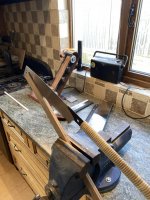
I missed the post that came between my posts. In terms of ripping that with a hand saw, it's something I would guess would take about two minutes plus whatever time it took to mark it.
However, if you set up your bandsaw and you have 20 of those to do for a project that all have to be identical thickness, obviously you're probably going to take about five minutes and I'm going to take 40 (and probably not do all at once, either).
https://i.imgur.com/RzFOQiB.jpg
https://i.imgur.com/EORH1YU.jpg
I have a biased view about bandsaws because my jet was not as accurate as it should have been. I never measured why until I sold it, and then I gave the guy who bought it a break.
so out of fear of ruining good stock when something is important, if it is, I have hand sawn it since giving up on the bandsaw.
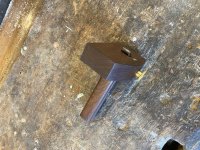
the thing above is a rosewood guitar neck blank. so that I can make the neck look like it's one piece after applying finish, I like to buy blanks and then resaw the fingerboard off of the blank. This sounds great, the sawing isn't an issue - usually when cut, the fingerboard will twist a little. that wasn't worth mentioning, I guess, because it has nothing to do with cutting!!
I do not remember the length of time that cut took, but I know it wouldn't have been possible with the ryoba, at least not with being certain that I would have enough for a fingerboard. Why doesn't this go on a tablesaw? The blanks that I can get often are just at the limit of being able to provide the neck and fingerboard - they come imported at the thickness shown assuming you'll machine down the blank and just come up with a neck.
Even the handsaw is pushing it, but it comes out OK on fender style necks. My bandsaw had it been made right would've handled this. As it was, the wheel was out of round and never addressed and it would've sanded both sides of the cut and been worse than the handsaw.
Years ago, I went through the entire array of ripping options, starting with disposable japanese saws (because that's most of what I had - they are an instant success draw, but not suitable for heavy work). the whole escapade went as far as having stan covington make two custom saws intended for US hardwoods. They were a kataba style, but between thin and maebiki (the saw that we got to test was not insubstantial) with teeth like a western rip saw. the japanese users in japan were faster with it than a disston saw, and I was much faster with a disston saw (and less sore, but what a custom sawmaker came up with when charged with matching stan's disston 12 was vastly different - and a combination of both capable and not the least bit fragile).
I came up with the challenge to stan after realizing how much better a disston rip saw was than anything in disposable japanese saws, no matter how big, and stan came up with said saw. He already had an in to low volume makers back then and the cost of having two saws made (he knew he'd keep one, the second came to me and then since I made the challenge in public hoping he could prove me wrong, several other people stood up and said "I'll take it the US saw if Dave doesn't want it".
Which was good. The cost to have two custom hand made saws made was $1500. I really liked the saw, it was novel, and in contrast to what's made now mostly for crosscut and small vise work. But I couldn't justify spending $750 on a saw no matter how special it was.
I went on later to buy a bunch of stuff directly from japan, which includes some very good saws - the nondisposable later saws can be inexpensive if you look at the right used listings. I managed to get ten coarse crosscut saws that will outcut anything with disposable blades for $18 ($50 including proxy costs to the US), and I've got a pair of maebiki.
I think in the end, if someone is not going to get a dedicated good rip saw (not an expensive saw, just any disston D8 pattern type saw from any decent maker if that's what one can find for a few pounds), this venture always ends in failure.
For me on day to day work, figure cherry is the subject, the cut rate with a sustainable pace ripping in 4/4 cherry is about 2-3 feet per minute, and 6/4-8/4 is 1-2 feet a minute, but it is blissful.
For resawing the maebiki are a no go used vertical - they are heavy and the basic setup is not designed for the teeth to be parallel to the floor. A disappointment, but they were also cheap gotten from japan (about $40 each) and at some point, I will find a log.
there is definitely nothing special about my sawing skill (looking at the neck blank sawn above against a straight edge). I think if we all worked this way, all of us would saw like that routine. But if someone doesnt' like to do it, it's pointless to create some illusion that it should be learned. It sure makes joinery sawing easier, without doing much joinery, though. And sawing things out of metal, etc, it's all stored in the same neurons.