• Hi all and welcome to TheWoodHaven2 brought into the 21st Century, kicking and screaming! We all have Alasdair to thank for the vast bulk of the heavy lifting to get us here, no more so than me because he's taken away a huge burden of responsibility from my shoulders and brought us to this new shiny home, with all your previous content (hopefully) still intact! Please peruse and feed back. There is still plenty to do, like changing the colour scheme, adding the banner graphic, tweaking the odd setting here and there so I have added a new thread in the 'Technical Issues, Bugs and Feature Requests' forum for you to add any issues you find, any missing settings or just anything you'd like to see added/removed from the feature set that Xenforo offers. We will get to everything over the coming weeks so please be patient, but add anything at all to the thread I mention above and we promise to get to them over the next few days/weeks/months. In the meantime, please enjoy!

Rip Sawing - A Cunning Alternative

Andy Kev.

Nordic Pine
Joined
Jan 4, 2021
Messages
716
Reaction score
58
In the past I've made no secret of the degree of incompetence I display when attempting rip sawing. Last night I wanted to rip down a 5" wide board into 2 x 2 1/2" pieces. I started off with my back saw, stayed bang on line for the first 3", then started to drift off to the right as usual. I went to the other end and the same happened. I couldn't afford to lose loads of the wood, then the light went on and the solution, while absolutely disgraceful and no doubt some of you won't know whether to cringe or laugh, lost me only 1/8".

I switched from the saw to the plough plane and it worked a treat. Incompetent I may be but there is a way of getting there in the end.
 
A back saw is the wrong tool for the job - its teeth will be too small. With any saw, if there is so much sawdust that the gullets fill up, and the saw can't shift the sawdust out from under it, you're going to drift off the line.

For ripping wood 2" thick, I'd be looking for a handsaw at least 22" long and with no more than 8 tpi. Better still if longer and coarser.

Used rip saws are much less common than crosscut saws (it's a long time since carpenters or joiners needed to rip by hand) but refiling a crosscut to rip is quite easy to do.

As for ploughing out some of the depth, Richard Arnold reckons this used to be a common practice. Many old plough planes have the narrowest iron used up a lot, though there was never much need for narrow grooves in most work.
 
Means to an end Andy, nowt wrong with that. I can imagine the pile of shavings at the end, they make great fire starters.
 
AndyT":28lnnqma said:
A back saw is the wrong tool for the job - its teeth will be too small. With any saw, if there is so much sawdust that the gullets fill up, and the saw can't shift the sawdust out from under it, you're going to drift off the line.

For ripping wood 2" thick, I'd be looking for a handsaw at least 22" long and with no more than 8 tpi. Better still if longer and coarser.

Used rip saws are much less common than crosscut saws (it's a long time since carpenters or joiners needed to rip by hand) but refiling a crosscut to rip is quite easy to do.

As for ploughing out some of the depth, Richard Arnold reckons this used to be a common practice. Many old plough planes have the narrowest iron used up a lot, though there was never much need for narrow grooves in most work.

Agreed that the backsaw is not the tool. The problem is that I'm even more inaccurate with a full-blown rip saw! With the backsaw I can usually start well and then I switch, usually to one of those Japanese things which is rip on one side and cross on the other. The problem was that this time, I was drifting before I'd even finished with the backsaw. FWIW the wood was only 3/4" thick.

I think I've just got a chronic bias to drift to the right, although I am better than I used to be.
 
Lurker":3irbpni9 said:
Is it the set on the saw.
Is it sharpened to rip?

Anyway whatever works for you is fine.


Yeah, it was the right saw for the job: rip.
 
Bear with me here....
Just trying to think through something that I do without much thought when ripping materials.
Generally I use Bahco hardpoint as my workhorses but as long as it's not trashed and with a modicum of set to the teeth ought will do.
On thinner stock like you are using my eyes watch the line and the steering is by me thinking I need to adjust, this is done subconsciously using the very bottom of my hand where it holds the handle grip.
Not sure how you go about teaching this though and perhaps it was my need to scribe many many architraves when I was second fixing during the primary years of my employment that gave me the necessary "muscle memory" ?
What I'm saying here is the need to steer the cut was primary to following the line and thus straight cutting should follow with ease as long as you watch what the saw is doing with each stroke.
Could it be summed up by saying you need to make the saw go straight rather than allowing it to go straight?

Hope this rambling makes sense?
Cheers, Andy
 
toolsntat":35edqi5e said:
Bear with me here....
Just trying to think through something that I do without much thought when ripping materials.
Generally I use Bahco hardpoint as my workhorses but as long as it's not trashed and with a modicum of set to the teeth ought will do.
On thinner stock like you are using my eyes watch the line and the steering is by me thinking I need to adjust, this is done subconsciously using the very bottom of my hand where it holds the handle grip.
Not sure how you go about teaching this though and perhaps it was my need to scribe many many architraves when I was second fixing during the primary years of my employment that gave me the necessary "muscle memory" ?
What I'm saying here is the need to steer the cut was primary to following the line and thus straight cutting should follow with ease as long as you watch what the saw is doing with each stroke.
Could it be summed up by saying you need to make the saw go straight rather than allowing it to go straight?

Hope this rambling makes sense?
Cheers, Andy

Andy,

that is very interesting and it is the first thing on the subject which I've seen in a long time which is new to me. I'm very careful to do all the other things correctly: basic stance etc.

Now you come to mention it, I'm moderately good at getting the first few inches done bang on the line. I came to believe that once you had got a straight cut established, the kerf would make sure that the saw stayed in line, but now you mention in that can't be true because if it were, the saw would be held so tightly that you could hardly move it. Therefore, I reckon that it's accumulated bits of wiggle room to the right that lead my saw off.

So the next time I have to do it, I will remember to go as slowly and carefully as I do for the first 3 or so inches. I think you may have cracked it for me.

Thanks,

Andy.
 
Supposing you were to use the plough plane to start off the cut from both sides. Would the saw be more likely to stay straight if it has a couple of grooves to follow?
 
You don't have a rip saw, so I'm not going to be the first to say "reach for a hardpoint". These so called throw-away saws have their uses, and, best of all, when they're blunt the plates make great scrapers. They don't rip quite as well as a proper old fashioned rip saw, but they rip a lot better than anything else.
 
Yep that’s what I think as well.
Just a thought, you should have the index finger of your saw hand sticking out and resting on the handle and not with the others curled around the handle, this is (I think) to help steer the saw which as Toolsnat said is something done without thinking.
 
Ploughing a groove all round does indeed help guide the saw somewhat IME.

Inspired by others discussing hand ripping (Andy T amongst others), I scoured eBay for a while and found a Roberts and Lee 28" 4 TPI rip saw - an old one, from the days before the brand was one of the many owned by Thomas Flinn. That really helped. Long strokes, plenty of space between the teeth to clear the dust.

Also, does the saw have sufficient, and symmetrical, set. Obviously it will follow a curve if not symmetrical. But also lack of set means the saw can't be much influenced - once it is on a trajectory it will go with the flow. Unless it decides to go with the grain !
 
Thanks for all the tips: a proper rip saw is the answer.

Something else occurred to me last night. Because it was a shortish (2 foot) piece of properly planed up wood that just needed halving in its width (as opposed to deeping/resawing), I placed it vertically in the vice, although at a sensible height, so that I was sawing down onto it. I probably ought to have got out my saw horses and done it that way. It's not as if they can only be exclusively used with rough-sawn timber, is it? I bet I would have had much less trouble staying in line then.
 
Sheffield Tony":5fvxt742 said:
Ploughing a groove all round does indeed help guide the saw somewhat IME.

Inspired by others discussing hand ripping (Andy T amongst others), I scoured eBay for a while and found a Roberts and Lee 28" 4 TPI rip saw - an old one, from the days before the brand was one of the many owned by Thomas Flinn. That really helped. Long strokes, plenty of space between the teeth to clear the dust.

Also, does the saw have sufficient, and symmetrical, set. Obviously it will follow a curve if not symmetrical. But also lack of set means the saw can't be much influenced - once it is on a trajectory it will go with the flow. Unless it decides to go with the grain !

Planing a groove does seem more sensible the longer the piece is. The narrowest iron I've got is 1/4". I'll try to find out if there is a 1/8" iron available for the Veritas plough. It would probably be ideal.
 
If you find you're wandering from the straight and narrow, you might try lowering the angle of the saw so more of the teeth are engaged. Straight saw should equal straight line (one hopes!) Ripping vertically precludes that as an option though, unless you're a contortionist. Other than that, as already said: correct tool for the job and ensure the set is even. Chris Schwarz did a load of good advice about hand sawing technique some years ago, although I can't recall if it was on his blog or in print. As a good journalist, I'm sure he'll have recycled it onto the blog by now anyway. :D

Having said all of which, if it was me and looking to buy a saw for the job, I'd buy a bandsaw. ;)
 
Most of the books I’ve read in sawing state to look down on the saw, but not really explain why or what it does, or how to look down on it. It’s something someone who is used to hand sawing normally does, or develops a muscle memory of what to do. However, after a bit of experimenting a long number of years ago I finally for me worked it out. The brain likes thing equal and symmetrical. You can detect the slightest hint of out of vertical or level to incredible tolerances just by eye. So, unconsciously you prefer and try to make everything symmetrical. If you look down exactly on top of the saw and sight the line down either side of the saw equally not only will you saw straight but also vertically. If you look slightly more from the left of the saw (usually to ‘see the teeth cutting to the line), which is typical of a right handed person, the brain will try to make the saw look symmetrical and you will unconsciously tilt the saw towards you and start sawing off to the right. Equally if you try looking slightly more to the right hand side, typical of a lefty you will drift off to the left.

Now, I might have got the reasons not exactly right, but I’ve shown a number of people how to saw straight, and everyone who couldn’t saw to line as if by magic is suddenly able to when I give them this explanation. Hope it helps.
 
Deema":3o6d30ia said:
........The brain likes thing equal and symmetrical. You can detect the slightest hint of out of vertical or level to incredible tolerances just by eye.......

My wife has just cut a large rectangular cake in half by eye. When one half was placed on top of the other, the tapering half-inch plus overhangs suggest this isn't a universal skill. :lol:
 
Mike G":2gvctyvq said:
Deema":2gvctyvq said:
........The brain likes thing equal and symmetrical. You can detect the slightest hint of out of vertical or level to incredible tolerances just by eye.......

My wife has just cut a large rectangular cake in half by eye. When one half was placed on top of the other, the tapering half-inch plus overhangs suggest this isn't a universal skill. :lol:
May one take it that you're going to get her a cross cut knife for her birthday? :D
 
PeteW":1kfxz02l said:
Isn't this the perfect use-case for a kerfing saw?

I've had one on my to-do list for ages, but a quick web search turned up this useful instruction:
https://www.cgtk.co.uk/woodwork/handtools/kerfingsaw

I made a slightly better (but arguably less pretty) one as well, but haven't got round to publishing the page in the index on my website.

https://www.cgtk.co.uk/woodwork/handtools/kerfingsawmk2

PeteW":1kfxz02l said:
Bloke over there seems to know what he's doing :lol:

I definitely disagree with that :lol:
 
Mike G":294kgpgs said:
Deema":294kgpgs said:
........The brain likes thing equal and symmetrical. You can detect the slightest hint of out of vertical or level to incredible tolerances just by eye.......

My wife has just cut a large rectangular cake in half by eye. When one half was placed on top of the other, the tapering half-inch plus overhangs suggest this isn't a universal skill. :lol:
That can be solved easily by the rule that says one partner cuts the other decides which half they want
 
I had to rip another piece last night: 14" x 2" x 1 1/2" in order to get two thinner pieces of 14" x 2".

Beforehand I read through all the tips on here again, tried to get them into one whole picture in my head and did my best to apply them. It was surprisingly successful so thank you all very much indeed.

I kicked it off with a backsaw at each end (I know, I know but I am moderately good with the backsaw and I cut better than usual due to the advice) and then finished it off in the middle with the old Japanese Sudoku or Harikiri or whatever it's called. I can never remember the names but it usefully has rip on one side and cross cut on the other.

The proof of the pudding was that I had to do relatively little planing of the two rough surfaces to get thicker than expected pieces. The worst deviation from the line was more like 1/32" than 1/16".

So thanks again.

PS I just stumbled on the sainted Richard Maguire's thoughts on the subject.

https://www.theenglishwoodworker.com/be ... hick-rips/

As keen on hand tools as I am, I agree with him about the bandsaw. I had to laugh at the frame saw. I tried one once and am fairly sure that I could never have a realistic chance of becoming competent with one.
 
I'm not in the same country as you, but I think what you need is for someone to give you a rip saw that is known straight tracking to use for a little bit and that's it. I sold my bandsaw about 8 years ago (I think) and have hand ripped and resawn everything since. There were a few lumps at first, but not many. The bandsaw that I had (18x jet saw) was OK, but it was riskier than resawing by hand.

I think it's difficult to figure out if it's you or the saw and this is the place where $30 back and forth with some charitable individual (who trusts they'll get their saw back) would be well spent.

once this clicks, it's easy - you mark both sides of a board or stick or whatever and cut it. Before it clicks, I guess it's sometimes maddening to find the "click button".

if the issue is the setup of saws, you'll never be able to manhandle the saw reasonably to counter it.

This is not really a shot at Richard, because I didn't go and look further to see why he said something about a bandsaw, but a lot of the people teaching hand tools cap their expectations based on students, not based on what can fairly easily be done. The simple reason for that is most students don't get competent even on a basic skill set and if you're buttering your bread and 75% of the class is just looking to imagine or be entertained, you have to cater to them.

I ruined so much exotic wood with blade wander, etc, on my bandsaw that I decided I'd give it up (caveat, I sometimes resaw wide stuff, up to 16" - but with a frame saw - narrower stuff still with a hand saw. If there's something untoward about the wood, I can feel it and address it. With the bandsaw, by the time something went odd in the cut, even on 8" material, all was lost).
 
Re wifely activities: It drives me bonkers that my exceptionally perfect wife cannot cut a loaf of bread with anything resembling a vertical cut. She ruins my loaves :lol:

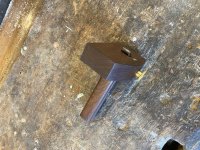
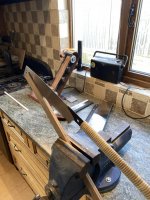
This cutting stuff with hand saws is, frankly, daft. I've tried it so I know :D Yesterday I needed to cut two 35mm, wide by 10mm thick pieces of oak into two strips cutting all along the thin side. I accept this is not the easiest job. They were 1.2m long. I marked with a really superb knife marker (secret santa present from elsewhere - I still don't know who made it) Pictures: (edit the rotation hack is not working)

IMG_3854.jpeg

FFFE681D-004D-443A-9344-BA34C8DAE14F.jpeg


I got about a foot down the marked line, using a Japanese rip saw (I needed a thin cut) checking frequently to make sure I stayed straight, and that took about 20 minutes. So I thought "blow this for a game of soldiers" and traipsed up to the proper workshop and did both pieces on the band saw in about 3 minutes, and popped them through the PT to clean off. Band saws do not get tired or bored. 8-)
 
At the risk of outing myself as having skill only because I was stupid enough to spend money on every way that doesn't work that well either initially or in volume once you're ready to put it to work -

....I think you'll find the kataba to be a hand numbing and arthritis inducing tool in the longer term, and it will dull (for ripping purposes) faster than you'd expect. You can actually touch up the teeth pretty easily with a light touch from a cheap chinese "feather" shaped diamond file.

But with some volume, it becomes a torture device due to the light weight and need to influence it, and it will have more tracking problems than a good western rip saw.

the japanese saws traditionally used (I've bought a few) for ripping cabinet sized stock are about twice as thick in the plate, twice as tall and with a handle that's closer to the hang of the part you hold on a western saw.

Translation, it's worth figuring this out with a western rip saw, you'll be faster and more accurate with it.

(re: the sharpening comment - rip saws are more like planes. they are highly dependent on being sharpened often since they're chiseling off a width of material. the sharpening can be light because it's done often (like five minutes, and setting perhaps once every four or five sharpenings) - crosscut saws are working at a point to sever, and even when they dull a little bit and rasp, they'll still work. Any rounding on the tip of a rip saw is a nefarious thief of your time and efforts).

I experimented at one point sharpening disposable saws when I thought they were getting "a little dull". What I found out was that they actually took twice as many strokes (even the crosscut saws) and I wasn't nearly done with them at that point in the chase of "getting my money's worth out of them" and using them much further. I sharpen them now, too, as I have a couple at the bench for convenience on ripping or crosscutting really small things.
 
What DW said got me thinking that it could be your hand saw is making you wander from the line, I always, as I have said, use a Spear and Jackson hard tip very inexpensive, about £7 but so sharp if you lightly rest your finger on the teeth you will get a line of punctures, but also sharpened evenly, suggest you try one, I think it was you was cutting with a Japanese one earlier and it had taken you an hour, that is no way to carry on lol. Other makes are not as good! Stick to a S/J.
Ian
 
I missed the post that came between my posts. In terms of ripping that with a hand saw, it's something I would guess would take about two minutes plus whatever time it took to mark it.

However, if you set up your bandsaw and you have 20 of those to do for a project that all have to be identical thickness, obviously you're probably going to take about five minutes and I'm going to take 40 (and probably not do all at once, either).

https://i.imgur.com/RzFOQiB.jpg

https://i.imgur.com/EORH1YU.jpg

I have a biased view about bandsaws because my jet was not as accurate as it should have been. I never measured why until I sold it, and then I gave the guy who bought it a break.

so out of fear of ruining good stock when something is important, if it is, I have hand sawn it since giving up on the bandsaw.

the thing above is a rosewood guitar neck blank. so that I can make the neck look like it's one piece after applying finish, I like to buy blanks and then resaw the fingerboard off of the blank. This sounds great, the sawing isn't an issue - usually when cut, the fingerboard will twist a little. that wasn't worth mentioning, I guess, because it has nothing to do with cutting!!

I do not remember the length of time that cut took, but I know it wouldn't have been possible with the ryoba, at least not with being certain that I would have enough for a fingerboard. Why doesn't this go on a tablesaw? The blanks that I can get often are just at the limit of being able to provide the neck and fingerboard - they come imported at the thickness shown assuming you'll machine down the blank and just come up with a neck.

Even the handsaw is pushing it, but it comes out OK on fender style necks. My bandsaw had it been made right would've handled this. As it was, the wheel was out of round and never addressed and it would've sanded both sides of the cut and been worse than the handsaw.

Years ago, I went through the entire array of ripping options, starting with disposable japanese saws (because that's most of what I had - they are an instant success draw, but not suitable for heavy work). the whole escapade went as far as having stan covington make two custom saws intended for US hardwoods. They were a kataba style, but between thin and maebiki (the saw that we got to test was not insubstantial) with teeth like a western rip saw. the japanese users in japan were faster with it than a disston saw, and I was much faster with a disston saw (and less sore, but what a custom sawmaker came up with when charged with matching stan's disston 12 was vastly different - and a combination of both capable and not the least bit fragile).

I came up with the challenge to stan after realizing how much better a disston rip saw was than anything in disposable japanese saws, no matter how big, and stan came up with said saw. He already had an in to low volume makers back then and the cost of having two saws made (he knew he'd keep one, the second came to me and then since I made the challenge in public hoping he could prove me wrong, several other people stood up and said "I'll take it the US saw if Dave doesn't want it".

Which was good. The cost to have two custom hand made saws made was $1500. I really liked the saw, it was novel, and in contrast to what's made now mostly for crosscut and small vise work. But I couldn't justify spending $750 on a saw no matter how special it was.

I went on later to buy a bunch of stuff directly from japan, which includes some very good saws - the nondisposable later saws can be inexpensive if you look at the right used listings. I managed to get ten coarse crosscut saws that will outcut anything with disposable blades for $18 ($50 including proxy costs to the US), and I've got a pair of maebiki.

I think in the end, if someone is not going to get a dedicated good rip saw (not an expensive saw, just any disston D8 pattern type saw from any decent maker if that's what one can find for a few pounds), this venture always ends in failure.

For me on day to day work, figure cherry is the subject, the cut rate with a sustainable pace ripping in 4/4 cherry is about 2-3 feet per minute, and 6/4-8/4 is 1-2 feet a minute, but it is blissful.

For resawing the maebiki are a no go used vertical - they are heavy and the basic setup is not designed for the teeth to be parallel to the floor. A disappointment, but they were also cheap gotten from japan (about $40 each) and at some point, I will find a log.

there is definitely nothing special about my sawing skill (looking at the neck blank sawn above against a straight edge). I think if we all worked this way, all of us would saw like that routine. But if someone doesnt' like to do it, it's pointless to create some illusion that it should be learned. It sure makes joinery sawing easier, without doing much joinery, though. And sawing things out of metal, etc, it's all stored in the same neurons.
 
Back
Top