• Hi all and welcome to TheWoodHaven2 brought into the 21st Century, kicking and screaming! We all have Alasdair to thank for the vast bulk of the heavy lifting to get us here, no more so than me because he's taken away a huge burden of responsibility from my shoulders and brought us to this new shiny home, with all your previous content (hopefully) still intact! Please peruse and feed back. There is still plenty to do, like changing the colour scheme, adding the banner graphic, tweaking the odd setting here and there so I have added a new thread in the 'Technical Issues, Bugs and Feature Requests' forum for you to add any issues you find, any missing settings or just anything you'd like to see added/removed from the feature set that Xenforo offers. We will get to everything over the coming weeks so please be patient, but add anything at all to the thread I mention above and we promise to get to them over the next few days/weeks/months. In the meantime, please enjoy!

Secondary glazing

Looks great and love the black hardware.
Me too. There is a small downside to those handles though: the design allows the end of the handle to contact the glass so have to be somewhat careful when moving the windows about. Not a big deal, just something to be aware of.
 
Last night was cold enough for other single glazed windows here to get condensation. But it looks like the new secondary glazing prevented it. No condensation on inner and outer panes. I’m very pleased.
 
Next up, I need to work out some sort of stay to keep the window in place while it’s open. I had the faint hope that the hinges were going to be stiff enough that a stay wouldn’t be necessary, but this was always wishful thinking given the wind gusts we get here.

Possibilities include some kind of fixing on the left wall (which would only be useful for keeping the window fully open at ~90°) or some kind of stay bar on the interior of the casement close to the hinge that could be recessed into the casement and frame.

Whatever we decide to do, I’m going to want to attach the stay without taking the window apart again.

Seen any interesting strategies or specific hardware for stays on inward opening windows?
 
Great job. (y)

Some of those fitments, e.g. turn buckles, handles etc. would have been simple if you had a 3D printer. Just saying in case you need a reason. :ROFLMAO:
 
Inward opening windows are the norm here, both a blessing and a curse.
My simple approach is a simple hook and eye. Not elegant but on the single casement windows in our bedrooms does the job.

20250418_094947_resized.jpeg
 
Do you have another hook and eye elsewhere if you want to hold the window wide open Andy?
No. But I guess a longer hook would work. If we want to leave the windows wide open we just have to be very careful. As I said inward openers are a blessing and a curse!
 
To create a larger fixed opening one could of course have the hook and eye on the top of the frame and towards the hinges on the window but I feel that would look very inelegant in your situation and you would have to move the hook out of the way as you closed the window.
There must be a better solution.
 
Hi, I know that this idea is too late as already built. Couple of ideas for next time ...
Make the extra glazing frame as a twin pane with a hinge in middle, like window shutters. This would enable the opening frame to not swing into the room as much. Also gives options to have this hinged glazing held at various openings.
Second option would be two sliding frames, infinite opening adjustment. Upper track rebated enough to allow easy removal of either window.

Alex.
 
To create a larger fixed opening one could of course have the hook and eye on the top of the frame and towards the hinges on the window but I feel that would look very inelegant in your situation and you would have to move the hook out of the way as you closed the window.
There must be a better solution.
I’m thinking I could have a hook in a recess on the hinge side of the casement at the bottom and an eye attached to the stop (since the flyscreen isn’t as deep as the stop so there’s space in front of it). Wouldn’t be visible with the window closed. I’ll have to check that my wife will be able to reach it though.
 
Hi, I know that this idea is too late as already built. Couple of ideas for next time ...
Make the extra glazing frame as a twin pane with a hinge in middle, like window shutters. This would enable the opening frame to not swing into the room as much. Also gives options to have this hinged glazing held at various openings.
Second option would be two sliding frames, infinite opening adjustment. Upper track rebated enough to allow easy removal of either window.

Alex.
Thanks Alex. All good suggestions. We gave them some consideration before starting. The main reasons we ended up at a single pane were concerns about sight lines and ease of construction.
 
Can you fix a conventional window stay on the inside between the two windows, or would the fly screen get in the way?
Like this
 
Can you fix a conventional window stay on the inside between the two windows, or would the fly screen get in the way?
Like this
There might be enough room to put the hardware in, but in the closed position it would have to be arranged so that the pins don’t go in the holes of the bar (otherwise no way to get it open) and in the open position the distance from the end of the bar to the first hole would be too great for the flyscreen.

There are sliding versions including ones that go on the room side of an inwards opening window though.
 
Will a magnet stick to the handle, if so, open the window to the left wall make a mark where the handle touches then stick a rare earth magnet on the wall.
Maybe the magnate can be painted the wall colour.
 
Last edited:
There are sliding versions including ones that go on the room side of an inwards opening window though.
Thanks for that. I have never seen those before and I can see a use for them here. A bit awkward on our double casements though as one window on its own cannot be fixed closed.
 
Thanks for that. I have never seen those before and I can see a use for them here. A bit awkward on our double casements though as one window on its own cannot be fixed closed.
Yeah, they’re new to me too. I’m still thinking a hidden mechanism would be more fun.
 
One thing I had meant to talk about in more detail earlier is the profile of the moulding.

The Wickes site shows a silhouette that looks like this:

IMG_3440.jpeg

I almost didn’t get it because of that curve at the top. But of course, it doesn’t really look like that. Here’s what it actually looks like:

IMG_3439.jpeg

There’s a fairly crisp angle between the curve and the vertical so you get the lines you’d expect.
 
One thing I had meant to talk about in more detail earlier is the profile of the moulding.

The Wickes site shows a silhouette that looks like this:

View attachment 33107

I almost didn’t get it because of that curve at the top. But of course, it doesn’t really look like that. Here’s what it actually looks like:

View attachment 33109

There’s a fairly crisp angle between the curve and the vertical so you get the lines you’d expect.
It's so frustrating when suppliers' websites are as careless as that! They got the proportions wrong as well. Very poor.
 
Going back to holding the window open, I’ve decided to follow the path suggested by Duke and use a magnet attached to the wall. I have some of these:

IMG_3441.jpeg

I’m going to glue some wood on top to cushion the contact between magnet and handle and attach to the wall.
 
One advantage of applying wood over the top of a magnet is that it can be shaved to a certain depth to give fine control over the strength of the magnet. I’ll wait to adjust the depth until after the brown gorilla glue dries.

IMG_3445.jpeg
 
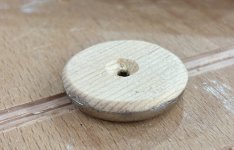
I chiseled the wood I glued to the magnet, drilled the centre, sanded it and ended up with a magnet with a wooden bumper:
IMG_3450.jpeg

I attached the magnet to the wall with a 3.5 x 30 mm screw, yellow 24 mm wall plug, and a hole drilled with a 5 mm bit.

The magnet will get painted the same colour as the wall (which is also getting painted).

As far as I’m concerned the secondary glazing for this window is done.
 
Looks like this experiment has been officially declared a success so I’m going to be repeating it on a larger scale. Next up is two sets of double casements. One set is entirely fixed and the other has an opening window. The interior glazing that I’ll make will have two opening casements for each set.

Only the exterior opening one will get the flyscreen. I won’t bother with stays for the inner casements of the non-openers. They’ll only be open briefly for cleaning. The opening window will need a stay because we use it for airing out.

Here’s the non-opening set from the outside. The other set is the same size.

At some point I’ll be rehabbing the outside too and will get to fix the interesting putty work. It annoys me literally every day, but I probably won’t get to that until next year.

IMG_3452.jpeg
 
Each casement will get its own liner and there’ll be a vertical moulded piece to cover the gap where the mullion is, and some noggins in there too.

The first question I need to answer is whether the top and bottom of the liners should be individual sections for each casement or one piece of wood that spans both casements.

The other question on my mind is whether I need to find better quality wood for the liners. The 2x2s I got stayed nice and straight, but the thinner, wider wood for the liner kept moving. Not enough to derail things completely, but an upgrade would probably help.
 
I think the casement for the opening window is going to need parliament hinges so that it can open across its pair and be held flat. That window will be left open a lot for airing and there’s not enough room for it to open into the room the other way. I’m seeing a fair number of 4” parliament hinges, but no 3” ones so far. Anyone got a good source for smaller parliament hinges? If I can’t get 3” ones, I guess I’ll just do the bigger hinges on both casements in that room.
 
A few more changes for this version of the secondary glazing:

1. I’m going to mitre the rebate ends instead of butting them. This makes the frame ends the same for vertical and horizontal pieces until the bridle joint is cut which appeals to my sense of symmetry.

2. I’m going to use face pieces for the mullion and the outside edges so that nowhere am I dependent on the thickness of my liner material for appearance or hardware attachments.

3. I’m going to get serious about validating all my dimensions and producing a parts list and order of operations. I took a low process approach last time. This time I’m writing some code to do my calculations and ensure consistency. This should allow me to, for example, specify the size of my glass so that I can order it before construction and avoid silly mistakes like sizing the flyscreen incorrectly so I had to cut all the edges off.

The process of writing the code for the project is progressing well.
 
I’ve got my process down to taking 1 vertical and 4 horizontal measurements off the existing windows then calculating all the parts for the secondary glazing based on the measurements and the materials.

The only interesting part of the calculation is getting the interior glass to “line up” with the exterior glass when the dimensions of the frame make that impossible. The approach I’m taking is that the interior glass lines up with the exterior opening when possible or the exterior glass when not possible (with a suitable fallback if that fails too). This maximises the view of the outside while minimising partial views of the woodwork and maintaining structural integrity.

Because I have also decided that the interior casements will all be the same width, the middle casement in a run of three doesn’t get the same alignment benefits as the outer ones, so I generate a quick diagram that shows where the exterior glass and openings fall in relation to the interior glass to check it makes sense.
 
Last edited:
The secondary glazing calculator is gradually seeing improvements as I find time between jobs. One thing I added is a check to see whether the secondary glazing openings qualify as egress windows. If they don’t, a diagnostic message will show up right at the bottom of the data dump section.

 
I’ve started making. I’m trying for hand tools only this time. One useful reminder for myself: don’t try to chisel a 19 mm housing/dado/trench with a 20 mm chisel particularly when it’s close to the end of a board. I did this and broke off the end. Doesn’t actually matter because it won’t be seen once put together, so I’m just ignoring it, but better to do it right I suppose.
 
All very good indeed.
Here in France, all our windows are inward opening, because most houses have external shutters of one kind or another (although, sadly, all ours have been removed).
I've yet to decide whether I love them or hate them.
S
 
Before cutting the housings, I first made a block from an offcut at half the height of the material to use as a gauge. To create the gauge block, I marked half the thickness, cut slightly short of the mark with the saw, used the gauge block to chisel a second offcut, put the pieces together to see how far off from halfway the first block was, pared a fraction off my gauge block with the chisel, used the gauge block to reduce the depth of the second offcut, and repeated until I had two blocks each exactly half the height of the original material.

To cut the housings themselves, I marked up the edges of them with square and pencil in both top and bottom pieces at the same time to ensure that the trenches would be aligned. I marked the depth using a pencil against my gauge block - ensuring that the pencil mark would be slightly short of full depth. I cut the edges with a ryoba near to depth and then with a flush cut saw to final depth (I find it easier to judge exactly where the flush cut is cutting because the edges of the blade are parallel to the handle). Then using a chisel and the gauge block, I chiseled out the trenches to match the depth defined by my gauge block. As necessary, I used the flush cut saw to deepen the walls a fraction to match the actual required depth.
IMG_3597.jpeg
 
Last edited:
The faces for the jambs and mullion required 1.3 m long rips. Marked the length and ends using square and pencil, sliding along the length. Started cutting on the close end, cut in about 12” then reversed the board so I was cutting towards myself most of the way. I do it this way so I can see two sides to start the cut. Once I turn the board around, I can only see the top line so trust and reflections carry me through to keep the cut vertical.

Used the rip teeth on the ryoba obvs.

My approach to ripping:

1. Start off straight
2. Keep the line clear of saw dust so I can see what I’m doing
3. Keep saw handle close to parallel to board. In a 20 mm board that means that the top of the cut is about about 2/3 saw blade length ahead of the bottom of the cut. This means there’s plenty of support to the saw blade to keep it travelling in the same direction.

No problems with these cuts. Feel like I’m getting the hang of this.

This was the first operation on this set of windows where I would have been able to do this quicker with the track saw, but it wasn’t particularly onerous so still feeling good about hand tool only.

IMG_3599.jpeg

You can see that I just clamped the board to the side of my bench and used another clamp and a couple of pieces of wood to stop the cut piece dropping.
 
A quick mention for a recent upgrade to my marking game: a Shinwa saddle square. It’s a luxury upgrade honestly - it’s not like I’m completely incapable of extending a line around a corner - but this is just nice to use; a marginally better result with a lot less care. Love it.

It’s got some 15 mm features that are useful for Japanese carpentry I guess, but i mainly use it to extend a line from face to edge and it certainly helps me do that.

IMG_3600.jpeg
 
I'd never thought of clamping bits of scrap to the two boards to stop the cut piece from dropping - that's a great idea.
I’ve been thinking of making a split bench for a while with a nice ripping gap like you’re talking about in your thread, but I just can’t seem to find the time so this is the poorer relative. Sometimes I just put clamps right on both ends over the cut line without bothering with the scrap (which works even with small clamps) or I dig out clamps with a longer reach so I don’t have to use scrap. I just use whatever’s to hand. I’m quite envious of the people with enough coordination to hold or catch the loose piece with their hand, but I’m too slow - mentally and physically - and too cautious for that.
 
DON’T: measure & mark the waste distance assuming the whole board is a consistent width.

DO: measure & mark based on the material you want to end up with so you don’t have to make assumptions

Derp.
 
While my early ripping experiences are still in my mind, here are some things I tried that weren’t at all useful:

1. I used to try and watch the whole blade while ripping. This is pointless. Now I only watch the close part of the blade that is extending the cut towards me. All the rest of the blade is irrelevant. Its fate has already been determined. Just keep the nearest part of the blade that’s contacting the wood close to the line.

2. I used to try to rush extending the cut towards me by making really long, shallow cuts. I thought that I’d concentrate on that surface cut to make it follow the line and then deeper cuts would follow that surface cut. But this is harder than just doing the full depth cut. A shallow cut is more likely to curve the blade or skitter across the surface. A deep cut is already being guided by the cut behind it. It will follow that path.

3. Sometimes I would be careless with the angle of the saw on the push stroke. It’s possible to accidentally extend the cut towards you on the push, but this is very undesirable. The cut you make could be with a curved blade and is otherwise not closely related to the cut you’ve already made. I now raise the handle slightly on the push to ensure I don’t do this.

4. I used to overcorrect. Now I trust. When you’re cutting on the waste side of the line, it’s quite tempting to see the front of the cut next to the line and feel like you’re veering off course. Now I know that it’s a false impression. There’s supposed to be a slightly larger gap between the line and the cut at the point closest to you than there seems to be further back in the cut. Perhaps this is because of set and only one tooth has made that front part of the cut or perhaps it’s an optical illusion. Trust.
 
Last edited:
One of the pieces I cut yesterday had a weird knot in it and cutting through it released the tension in the board and it curled like a banana. Fortunately the replacement piece I cut today stayed straight. Here’s the end of the cut which started at the other end of the 1.3 m board as it actually happened. Perfect.

IMG_3601.jpeg
 
One weird thing I did today when screwing the frame together was space out when drilling the pilot and countersink. The countersinks ended up way deeper than necessary and I’m just hoping that I actually left enough wood to hold the screw. It seems like it’s going to be OK, but it was pretty stupid.

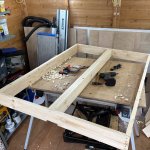
Putting the frame together was a bit challenging due to lack of space. My bench isn’t actually big enough for this task, but I managed to make it work by clamping everything to the bench so that it wouldn’t fall off even if the other end was unsupported.

IMG_3602.jpeg

Got some gaps to hide. The long one at the top left of the picture is the result of measuring the waste instead of the keep.
 
Back
Top