• Hi all and welcome to TheWoodHaven2 brought into the 21st Century, kicking and screaming! We all have Alasdair to thank for the vast bulk of the heavy lifting to get us here, no more so than me because he's taken away a huge burden of responsibility from my shoulders and brought us to this new shiny home, with all your previous content (hopefully) still intact! Please peruse and feed back. There is still plenty to do, like changing the colour scheme, adding the banner graphic, tweaking the odd setting here and there so I have added a new thread in the 'Technical Issues, Bugs and Feature Requests' forum for you to add any issues you find, any missing settings or just anything you'd like to see added/removed from the feature set that Xenforo offers. We will get to everything over the coming weeks so please be patient, but add anything at all to the thread I mention above and we promise to get to them over the next few days/weeks/months. In the meantime, please enjoy!

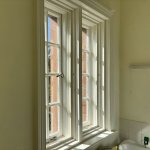
Secondary glazing

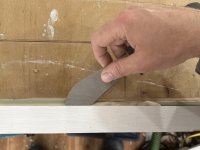
Attaching the stops the right way: glue a standing flyscreen stop to the edge of a sleeping window stop, mitre the end, then pin through the window stop to the liner.

What I actually did: something different that we don’t need to talk about.

Note that the flyscreen stops don’t have to be used only for flyscreens. They can also be used for other window coverings/shades so they’re still useful even for the non-opening windows.
 
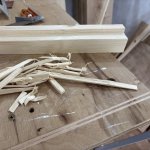
Over the last while I primed and painted the casement and started on the fly screens. Still unpowered. My little flush cut saw got a lot of use cutting the laps for the fly screens.

In a change from my usual approach of using a pencil for marking, I used the pin from a combination square for the very first time. Didn’t have any effect on the result.

Today I shoved the casement in the opening. Sinking the screws too deep turned out to be somewhat useful as I had to plane the top a touch to get it to fit and I could do this without hitting the screws thanks to my earlier mistake.

Next up is caulking and finishing a screen so I can actually use the screen this summer to keep out the midges. After that, it’s back to flooring, so the glass won’t go on this window for a couple of months.

IMG_3643.jpeg
 
Last edited:
The secondary got caulked and have been using it with just a screen for a couple of weeks. External window hasn’t been closed in all that time and we’ve had a lot of midges to contend with, so I’m pretty confident in the seal. The fly screen is just held flush against the stops with simple loose wedges jammed into holes at the left, right, and bottom edges of the frame. Don’t think I’ll bother with magnets in the flyscreen this time because this window is more accessible. (The other one was over the stairs so the magnets help hold the screen until the fasteners are in place. With this one it’s easy enough to support the screen with your spare hand while popping in the first wedge.)

IMG_3681.jpeg

Turning my attention to building the casements to hold the glass, I’ve cut the lengths and now have to do the rebates. With only non-powered tools and no rebate plane, it looks like I’m going to saw at least one edge of the rebate then either saw or chisel the other. Slightly concerned about stopping the saw cut at the right depth, but I guess I’ll draw a line on the ryoba blade as a guide or perhaps clip something to it?
 
It sounds to me like you have all the excuses you need to buy whatever sort of rebate plane takes your fancy!
Yes, I can probably justify it. I just remembered that it’s possible that I might already have a wooden one though. I better have a look. I got some moulding planes a couple of years ago and there were a few random extras so it’s possible I have a rebate plane here after all.

I did cut one rebate so far mostly with the ryoba and a bit of chiselling. I was almost able to do it with just the saw, but it turns out that my saw won’t clear the sawdust once the depth is too much. Maybe I need another saw too.

IMG_3683.jpeg
 
Typically here, in France, the windows are set on the inside of the reveal flush to the internal walls which makes secondary glazing difficult.
That is interesting, Andy, ours are not like that.
Our house has UPVC glazing. Badly made (in the UK) and even more badly fitted. We're having it all replaced. But the frames are set about halfway between the outside and inside faces of the walls.
S
 
I agree that inward-opening windows are a PITA when it comes to trying to fit a second window. Especially when you live with someone who believes that window ledges are there to stash piles and piles of Stuff Wot Doesn't Have Anywhere Else To Go. Aaaarrrggghhh!
 
The question of what to do with stuff that normally gets stored on window ledges has also been raised here. There’s no good answer really.

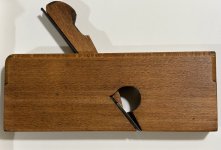
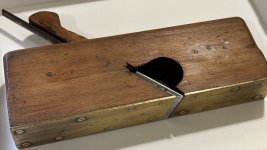
Turns out I do have a plane for rebates; this wooden skew:

IMG_3684.jpeg
 
Last edited:
I tried the plane today. I was able to adjust the blade and get some decent shavings. The problem I had was that a knot in the rebate was stronger than the holding power of the wedge and the cutting power of the blade. I’d hit the knot and all progress would stop as the blade retreated behind the base of the plane like a snail pulling its head into its shell. I had the wedge firmly seated (so that I had trouble moving it when I wanted to make adjustments), but it still wasn’t enough to hold the blade after impact with the knot.

Maybe you’re not supposed to whack planes into knots? I don’t normally do unpowered planing so have no clue about it.

I probably should have cut out the knot with a chisel before planing some more, but I just went back to using a chisel. What with the faff of making adjustments to the position of the plane blade and having to reach for the chisel anyway, the chisel just seemed easier.
 
Knots in softwood can be really hard - many old books include the not always practical advice that you should only use nice clear straight-grained stock for a job like this. I'd have chiselled as well.
 
Clear straight-grained stock is not what I got. LOL. But it’s only a few knots and the grain isn’t that bad so it’ll do for indoors.

I’ve just got one rebate left to cut so I’m going to time myself doing it, but that’ll probably be tomorrow; The Meg 2 won’t watch itself.
 
Back to the cursed project.

If you have followed my other recent posts, you will know that when working on the casements, I made a mistake with the rebates and had to recreate one of them. You will also know that I’d made the decision to fit the frame to the opening before the casements were finished. This was to get the benefit of the insect screens over the summer.

That decision paid off in terms of using the screen, but it has also made fitting the casements to the frames just that bit more complicated as I had to do it in the vertical. Next time, I’ll complete both frames and casements before install to make my life easier.

It turned out that one of the casements wasn’t quite as square as I might have liked and fitting it to the frame showed that its direction was in opposition to the direction that the frame was out. The discrepancy was not ignorable so I decided to square up the front of the casement.

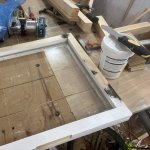
I clamped the hinge side of the casement to the deck, leaving the top corner a little up from the surface due to the squint in the casement. I put a wedge under that corner, arranged some scrap around the sides to create a level surface above the level of the casement, then resting the router on the higher surface dropped the cutter to touch the midpoint of the long side. Everything would then be levelled to that point. Routing was fairly straightforward and left a nice surface except where I tilted the router and gouged it. Some lovely dark filler will soon be covered by paint. Here’s the result.

IMG_3769.jpeg
 
I now have the glass (as you may be able to tell from the previous picture). Two panes of 392 x 1242 x 4 mm toughened glass for £48 including VAT taking about 10 days from order to pick up.
 
As with the previous window, these ones are getting a 2-3 mm back bed of putty then wooden glazing beads on the front of bare glass.

This is what I did for the puttying:

First I dump small putty worms all round the edge of the rebate
Then I smooth it until there’s about 2-3 mm depth of putty
I place the glass and jostle it to get decent contact with the putty, but I don’t worry too much about it because more pressure will be applied shortly.
The main goal is to get the glass centred in the casement.
The next step is to fill the gaps around the glass, so more putty worms then putting the straight edge of the putty knife against the edge of the rebate and drawing the knife horizontally with some downward pressure fills the gaps. I clean the extra putty off the underside of the knife as I go.
At the end of this process, I’ve got a couple of mm under the glass and a few mm next to the glass and a nice clean top.

IMG_3771.jpeg
The putty pushed out the other side gets cleaned up once the pins and beading are in place and the window can be turned over.
 
This time I coped the beading instead of mitre cuts. I used a combo of saw and chisel. I installed the short, horizontal beads flat and coped the ends of the long, vertical beads. I wonder if less risky to cope the short beads - if you mess up the 2nd corner of a short bead, there’s less waste than if you do the same on a long one. Definitely a good idea to cope one end of a bead before cutting to length in case of a mistake. As it turned out, it went fairly smoothly.
 
I know its a bit late for this now, but if anyone is thinking about making their own wooden windows from scratch and comes across this thread, there is an excellent treatise on the subject by Patrick Hislop. It used to be a free download from TRADA (I mean legitimately free, not a pirate copy) but now they charge for it. Both Amazon and Abe are out of stock, unfortunately. But well worth adding to your library if you come across a copy:
 
I just wrote a long, detailed message on secondary glazing vs exterior windows, but it’s disappeared. The summary - for people happening across this thread from a web search - is:
1. Don’t use my construction technique for exterior windows. Secondary and exterior windows each have different design requirements.
2. If you’re interested in making exterior windows, take a look at Bradshaw Joinery on YT. A wealth of excellent window-related content.

Everyone, feel free to post more general wood window links and info to this thread if the mood takes you. I’m a wood window enthusiast and the more good info people have access to, the better.
 
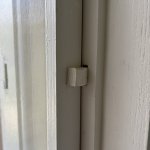
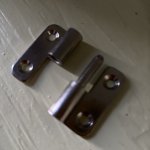
Both casements in this set have their hinges on the right. I’ve used parliament hinges so that the left casement can open flat over the right one.

My preference would be to hinge a pair on their outside edges (left hinged on the left, right hinged on the right), but in this case, the left will be open frequently for airing & the room is small so it’s better to hinge it so that it’s out of the way when open.

One detail left to decide is how to prevent opening the left casement from breaking the right pane; the first point of contact when opening the left casement is its handle against the glass of the right casement. I need some kind of stay or bumper to prevent the handle hitting the glass.
 
It’s almost the season for window making as I continue the secondary glazing project, so this thread is getting revived. Next up is a pair almost identical to the ones I put in the shower room.

First a few notes to remind myself of things I questioned during the last build.

1. The mullion between the windows was created using a flat front piece butted and nailed from the front on to the sides. No mitres or anything fancy. I was slightly concerned that I would see the fixings or that the line between the front and sides would become more visible as wood moved. Neither happened so I’m happy with this approach to the construction and will repeat for the new windows. With this construction, the join between front and sides is hidden by the windows when closed so even if it were to become visible, it’s not a disaster.

2. The next window set is going in the living room, so I’m going to take more care with the finishing to ensure a smooth result. The wood I’m using is supposedly pre-planed, but it became apparent during the last build that one of the four sides is usually rougher than the others. For this window, I’m going to take more time sanding, filling, and painting since this set is on display in the living room.

3. Last time I used tight tolerances on my measurements so that when it came time to fitting the frame in to the opening, it was a real squeeze and it ended up pushing the new frame slightly out of square. This time I’m going to make sure that there is room to slide the frame in easily and take my time using caulk or shims as necessary for gap filling and levelling to keep everything absolutely square.

4. Attaching the secondary stops was a pain last time. I think I’d decided to attach primary stop to secondary stop before attaching to the frame this time.

5. On the previous build, I created the frame and flyscreen and installed before building the casements and attaching the hardware. This was a PITA. Much easier to do everything at the bench so that’s what’s happening this time.

Parts list calculator:
 
Last edited:
Great WIP posting @Windows -'wish the Internet and such forums had been available back in the early 1980s...

We moved up to a derelict farmhouse on the West Yorkshire moors on my 30th birthday of all things... I'll not go through the ups and downs of such a move from Bath to such a place. All I'll say is I had to make ALL new windows for the place, glaze and paint - and fit. Hadn't heard of double glazing back then...

Never attempted such a project prior to doing so but it was certainly a big learning curve to go through to make seven casement frames. Sadly no photos of the then WIP... hindsight is a wonderful thing.
 
Back
Top