• Hi all and welcome to TheWoodHaven2 brought into the 21st Century, kicking and screaming! We all have Alasdair to thank for the vast bulk of the heavy lifting to get us here, no more so than me because he's taken away a huge burden of responsibility from my shoulders and brought us to this new shiny home, with all your previous content (hopefully) still intact! Please peruse and feed back. There is still plenty to do, like changing the colour scheme, adding the banner graphic, tweaking the odd setting here and there so I have added a new thread in the 'Technical Issues, Bugs and Feature Requests' forum for you to add any issues you find, any missing settings or just anything you'd like to see added/removed from the feature set that Xenforo offers. We will get to everything over the coming weeks so please be patient, but add anything at all to the thread I mention above and we promise to get to them over the next few days/weeks/months. In the meantime, please enjoy!

VFD to run 3-Phase on Single phase supply

CMax

Seedling
Joined
Jul 28, 2022
Messages
29
Reaction score
4
Location
Thurrock, Essex
Name
Colin
Hi all,

In a previous thread, I raised the idea of getting some used machinery, and one thing I've noticed is that on eBay and suchlike, there seems to be a surplus of 3-phase machines at good prices. Now, I've never used these kinds of things and know very little about electrics. That said, some initial googling seems to suggest that it's fairly trivial to use a VFD to run a 3-phase machine (apparently it has to be an induction motor, is that correct?)

Has anyone done this, and is it as simple as it seems, or am I woefully informed and clutching the wrong end of the stick?
 
I've done it for my metalworking lathe and also on my woodturning lathe (which is home-made, but uses a three-phase motor I bought on ebay) and in both cases it was very straightforward.

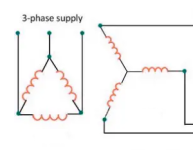
For a three-phase induction motor, they typically come star-wound, like the diagram on the right here:

1784094992186.png
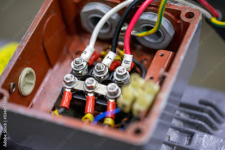
That'll mean they're expecting 415 V three phase. A lot of motors have the six connections (either end of the coils) coming out to screw terminals in a terminal box on the top of the motor. This one is star wound (I can tell as there are three wire ends that are connected together):

1784095309289.png

If that's the case, you can disconnect the windings and re-connect them as delta-wound (left diagram at the top). You now have a three-phase 230 V motor.

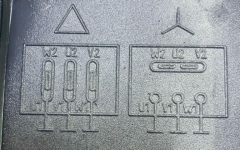
Sometimes motors even come with wiring diagrams embossed into the body showing how to do delta (left) and star (right):

1784095423997.png

Once you've got it wound in delta form, you buy a cheap inverter (aka variable speed drive or VSD, aka variable frequency drive or VFD), wire it up and configure it as per the manual and you're away.

If the motor on your machine isn't rewireable to the delta arrangement, you'll need a more expensive inverter that also scales the voltage up to 415 V. These are readily available, they just cost about twice as much.
 
As per Dr Al -check motor configuration first
It can be magically simple - or not
My experience of them is they need rating well above the intended device and the cheap ones are a gamble in the quality of the build (and also the documentation if you need more than simple on/off/speed)
 
Last edited:
Yep, I agree with all that Martin has said. If the motor is a 1.5 kW one and you're getting a cheap inverter, go for a 3+ kW inverter.

The one I bought for my metalworking lathe (from a decent brand, a Jaguar Cub or something like that if memory serves me correctly) came with a small book for a manual.

The cheap (< £50) one I bought from amazon for the woodturning lathe had a single sheet of paper for a manual and it included several things that turned out to be incorrect (including simple stuff like the output voltage for the control signals, which was listed as 10 V but was actually 5 V).
 
I’ve had a couple of inverters over the last 20 years the first was on an old Wadkin planer, I couldn’t re-wire the motor to Delta & found the cheaper option was to put another 3 phase motor on it that could be wire in delta & wired that through a VFD.

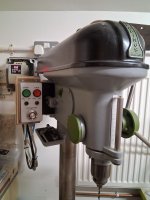
The second was on my Meddings pillar drill, this could be wired delta. I bought a station with the VFD & this made setting it up a breeze as I didn’t have to setup any parameters, just wired the motor & station to the VFD & switch on.
The station gave me stop/start, reverse & speed control in one unit

20260715_072939.jpeg
 
If you want a bit more guidance than the excellent answers above, I'd like to mention that this forum used to have a resident motor expert, Bob "9fingers" Minchin. He wrote a guide to motors which covers three phase to single and inverters.

It's in a Dropbox, linked to from the forum.

Use the three line menu to go to Resources, then Machine Manuals, then Induction Motors issue 3.

You don't need to install Dropbox so dismiss any prompts/ads if you don't want it.
 
Thanks everyone, I really appreciate the information. I worry it's beyond my ability to fully understand it all when it comes to actually doing it, but this at least gives me a good start to work from.

That's a real shame about Bob. I remember him from my previous time on the other forum. He was always very helpful and generally lovely. I'm glad we still have access to his information, and I'll take a read.
 
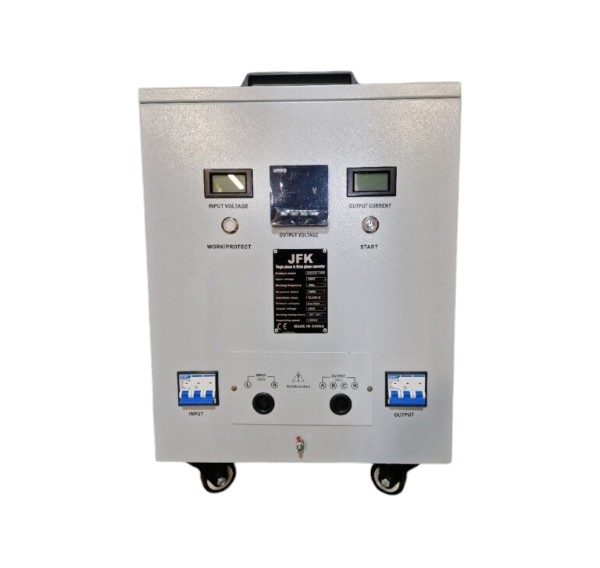
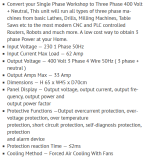
I would like to suggest that a Digital phase converter is the best solution. It generates true 415V, 3 phase which enables you simply plug your machine into it without having to tinker with its wiring. A single DFC can be sized to run any / all of the machines you eventually collect.
 
The machine I use needs adjustable speed control,and programmable acceleration ramp is very useful too- so V F D was the choice.
Horses for courses
 
A DFC has virtually all of the same features as a VFD, so you can regulate speed, have soft start and braking, but it doesn’t need to be directly wired to the motor. You can use one without modifying your machine at all. If you intend to buy a few machines it’s often the most economical solution.
 
We’ve previously wired a DPC up to multiple 3 phase outlets, then you use one machine, the DFC has the same dial on the front as a VFD to reduce / increase the speed. You can if it’s powerful enough start up multiple machines at the same time, adjusting the speed control adjusts all machines speed. If your on your own, you will only be operating one machine at a time.
So for instance some machines have multiple motors, a Sedgwick MB planer thicknesser has two motors within it, one for the spindle and the other for the thicknesser motor. A Multico tenoner has two motors, one for each spindle. You would need two VFDs to power up the machines, or a single DPC.
 
I would like to suggest that a Digital phase converter is the best solution. It generates true 415V, 3 phase which enables you simply plug your machine into it without having to tinker with its wiring. A single DFC can be sized to run any / all of the machines you eventually collect.
This sounds like a better option for me. Thank you for the suggestion!
 
A DFC has virtually all of the same features as a VFD, so you can regulate speed, have soft start and braking........
You just use the normal start stop buttons on the machine.

No good for my needs as the machine has no original control buttons of its own.
Its still a case of horses for courses.
Ill stick with VFD but thanks for the intrigue!
 
Back
Top