
-
Hi all and welcome to TheWoodHaven2 brought into the 21st Century, kicking and screaming! We all have Alasdair to thank for the vast bulk of the heavy lifting to get us here, no more so than me because he's taken away a huge burden of responsibility from my shoulders and brought us to this new shiny home, with all your previous content (hopefully) still intact! Please peruse and feed back. There is still plenty to do, like changing the colour scheme, adding the banner graphic, tweaking the odd setting here and there so I have added a new thread in the 'Technical Issues, Bugs and Feature Requests' forum for you to add any issues you find, any missing settings or just anything you'd like to see added/removed from the feature set that Xenforo offers. We will get to everything over the coming weeks so please be patient, but add anything at all to the thread I mention above and we promise to get to them over the next few days/weeks/months. In the meantime, please enjoy!
You are using an out of date browser. It may not display this or other websites correctly.
You should upgrade or use an alternative browser.
You should upgrade or use an alternative browser.
What size chisels do you use the most?
- Thread starter SteveMP
- Start date

12mm, 19mm, 6mm, in that order.If you had to get a MINIMUM set of chisels, which 3-4 would you get and why?
It's a while back, but I think that's what I did. I think the first one was about 50p, new, from a tool shop, naturally.

The logic was that the 12mm was small enough for ordinary through dovetails in common softwood and I didn't get on to finer work until later.

Woodbloke
Sequoia
Yes, I think a 25mm chisel would have been my fourth one.Agree with wot @AndyT said above but I quite often reach for wider ones (25mm and up) when cleaning out a corner(s) for say glass or a panel as the wider blade gives a bearing surface and enables a straighter line to be pared - Rob

Mike G
Petrified Pine
1/4", 1/2", 3/4", and 1". The French hadn't invented the metric system when I bought my first chisels. When I sold my first piece of furniture, I treated myself to a 1-1/2" , and it's still an absolutely joy to pick it up. I've since added a 10mm and a 15mm to that collection, and unless you really are into some speciality work, that's all you'll ever need.
Woodbloke
Sequoia
1/4", 1/2", 3/4", and 1". The French hadn't invented the metric system when I bought my first chisels. When I sold my first piece of furniture, I treated myself to a 1-1/2" , and it's still an absolutely joy to pick it up. I've since added a 10mm and a 15mm to that collection, and unless you really are into some speciality work, that's all you'll ever need.
'France first passed a law adopting the metric system on April 7, 1795, and later officially established the finalized platinum standards as legal measures on December 10, 1799'.
Are you sure you've got your dates right Mike?
 - Rob
- RobSteveMP
New Shoots
- Joined
- Jun 18, 2026
- Messages
- 166
- Reaction score
- 200
- Name
- Steve
- LOCATION
- San Diego
Funny that you say in that order. The past month or two I have been using a 12mm Japanese chisel for probably 85% of the stuff i have been doing,12mm, 19mm, 6mm, in that order.
It's a while back, but I think that's what I did. I think the first one was about 50p, new, from a tool shop, naturally.
The logic was that the 12mm was small enough for ordinary through dovetails in common softwood and I didn't get on to finer work until later.

Blackswanwood
Old Oak
I agree with all of the above. An 1/8” (or metric equivalent) is extremely useful when fitting jewellery box locks though.
Cabinetman
Sequoia
- Joined
- Oct 11, 2020
- Messages
- 5,659
- Reaction score
- 1,342
- Location
- Lincolnshire Wolds + Massachusetts
- Name
- Ian
The one I pick up for most work is a 3/4” followed by 1” maybe it’s as Rob says about it’s wider surface.

Dr.Al
Old Oak
I think it depends on what I'm expecting to do. Boxes would want narrower chisels (3 mm or even 2 mm), furniture would likely need wider ones (25 mm plus).
My 18 mm (just under 3/4") is probably my most used one, followed by the 12 mm and then the 3 mm. My skewed end chisels come out quite a lot too.
Ignoring the skewed ones for a moment, after those three widths it would be a toss-up between 6 mm and 25 mm - the former is better for cleaning up pins/tails that are wide enough that the chisel would fit (but not wide enough for the 12 mm one) and the latter is good for long shoulders etc.
Thinking more, I'd probably be most happy with 18 mm (for most work), 3 mm (for narrow pin sockets), something somewhere in between (8, 10 or 12) & a skewed end one for getting into half-lap dovetail corners. However, I'd be missing lots of the other ones!
All that indecision is probably why I ended up with space for 9 chisels in my tool chest!
My 18 mm (just under 3/4") is probably my most used one, followed by the 12 mm and then the 3 mm. My skewed end chisels come out quite a lot too.
Ignoring the skewed ones for a moment, after those three widths it would be a toss-up between 6 mm and 25 mm - the former is better for cleaning up pins/tails that are wide enough that the chisel would fit (but not wide enough for the 12 mm one) and the latter is good for long shoulders etc.
Thinking more, I'd probably be most happy with 18 mm (for most work), 3 mm (for narrow pin sockets), something somewhere in between (8, 10 or 12) & a skewed end one for getting into half-lap dovetail corners. However, I'd be missing lots of the other ones!
All that indecision is probably why I ended up with space for 9 chisels in my tool chest!
Dr.Al
Old Oak
He's older than he looks & remarkably productive for a 250 year old'France first passed a law adopting the metric system on April 7, 1795, and later officially established the finalized platinum standards as legal measures on December 10, 1799'.
Are you sure you've got your dates right Mike?
Mike G
Petrified Pine
Are you sure you've got your dates right Mike?
Exaggeration-for-effect, Rob.

Doug
Old Oak
1 1/2”, 1” & 3/4” on site for sure as they are the ones that get sharpened the most, my 2” chisel gets used a lot in the workshop not just for chiselling but also marking out.
Dr.Al
Old Oak
I had another look at my tool chest chisel drawer when I got home.
I designed it so that it has 8 slots that will take almost any of my chisels, although only 2 will take the longest ones & the slots get a bit shorter as you go up.
Finally, it has a dedicated slot for the 3 mm one as I was certain that I'd always take that one, regardless of the other choices.
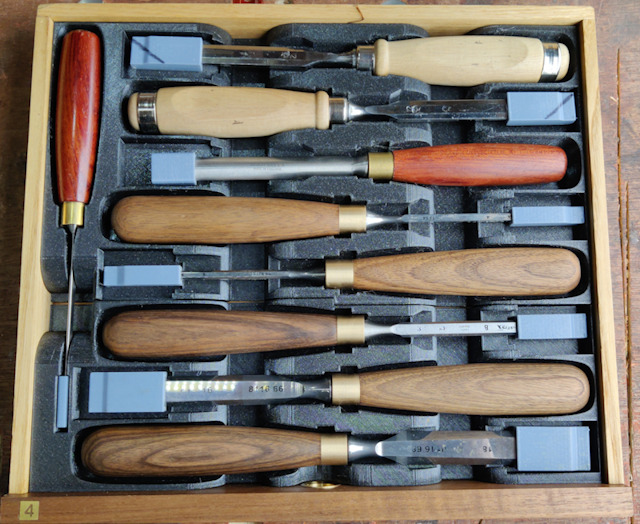
I guess the point I'm trying to make is that if this is for your tool chest, then designing in some flexibility is a good idea. Then you can always change your mind later about your favourite options.
I designed it so that it has 8 slots that will take almost any of my chisels, although only 2 will take the longest ones & the slots get a bit shorter as you go up.
Finally, it has a dedicated slot for the 3 mm one as I was certain that I'd always take that one, regardless of the other choices.
I guess the point I'm trying to make is that if this is for your tool chest, then designing in some flexibility is a good idea. Then you can always change your mind later about your favourite options.
SteveMP
New Shoots
- Joined
- Jun 18, 2026
- Messages
- 166
- Reaction score
- 200
- Name
- Steve
- LOCATION
- San Diego
Thanks for the photo. Its interesting to see what people use most. I do have a 3mm chisel that i mainly use to fine tune japanese plane bodies as the sides that hold the blade are very narrow. Also for kumiko work which I rarely do.I had another look at my tool chest chisel drawer when I got home.
I designed it so that it has 8 slots that will take almost any of my chisels, although only 2 will take the longest ones & the slots get a bit shorter as you go up.
Finally, it has a dedicated slot for the 3 mm one as I was certain that I'd always take that one, regardless of the other choices.
I guess the point I'm trying to make is that if this is for your tool chest, then designing in some flexibility is a good idea. Then you can always change your mind later about your favourite options.
While this is for the travel chest, I am hoping to buy say 3 or 4 chisels to just leave in there for the normal stuff. And if i know i need some others for a specific project i can grab a couple from the big wall chest. So the flexibility will be nice. No fancy 3d printer in my budget so about the highest tech i’ll get on this is kaizen foam.

Sheffield Tony
Nordic Pine
To state the obvious, it rather depends on what you plan to make. I think the first chisel I bought was a 1/4" mortice chisel, but I wanted to make a stool with M&T joints.
Rather than spend on expensive chisels, I would buy a means of grinding them first - then buy old chisels for small money in the knowledge that you can restore and maintain them.
Rather than spend on expensive chisels, I would buy a means of grinding them first - then buy old chisels for small money in the knowledge that you can restore and maintain them.

Lons
Old Oak
I'd agree with the sizes stated though my Richter 1/2" and 1" are the most used.
Like my planes I do however insist to my wife that every single chisel is used regularly and therefore indispensable.
Like my planes I do however insist to my wife that every single chisel is used regularly and therefore indispensable.
Last edited:
I bought mine as I needed them. As I mostly make small bits of furniture, those that I use most are 1/4", 3/8", 1/2" and 3/4". Then I added a 1 1/2" and 2" for cleaning the sides of mortices.
It is of course impossible to resist adding other sizes when you see what you think is a bargain.
FWIW I chose imperial sizes (from Veritas) because there is a physical relationship between the sizes, e.g. 3/8 is a half of 3/4 and so on. I don't care if I use imperial or metric on e.g. a square because I'm usually only measuring e.g. a distance from an edge and that's usually an absolute as opposed to a relative measure.
It is of course impossible to resist adding other sizes when you see what you think is a bargain.
FWIW I chose imperial sizes (from Veritas) because there is a physical relationship between the sizes, e.g. 3/8 is a half of 3/4 and so on. I don't care if I use imperial or metric on e.g. a square because I'm usually only measuring e.g. a distance from an edge and that's usually an absolute as opposed to a relative measure.