• Hi all and welcome to TheWoodHaven2 brought into the 21st Century, kicking and screaming! We all have Alasdair to thank for the vast bulk of the heavy lifting to get us here, no more so than me because he's taken away a huge burden of responsibility from my shoulders and brought us to this new shiny home, with all your previous content (hopefully) still intact! Please peruse and feed back. There is still plenty to do, like changing the colour scheme, adding the banner graphic, tweaking the odd setting here and there so I have added a new thread in the 'Technical Issues, Bugs and Feature Requests' forum for you to add any issues you find, any missing settings or just anything you'd like to see added/removed from the feature set that Xenforo offers. We will get to everything over the coming weeks so please be patient, but add anything at all to the thread I mention above and we promise to get to them over the next few days/weeks/months. In the meantime, please enjoy!

Wood Identification

Dr.Al

Old Oak
Joined
Dec 31, 2020
Messages
3,707
Reaction score
2,494
Location
Dursley, Gloucestershire
Name
Al
I came across what sounded like an interesting app a couple of days ago. I was rather sceptical that it would work, but I thought it was worth a try. (Spoiler alert: it was better than I expected, but still not great)

It's called "Wood ID" and is available for Android and (I think) iPhone as well. It's not free (there's a weekly/yearly subscription plan or a "lifetime purchase" for £26), but they offer a 3-day free trial. I figured that in the unlikely event it was very good, I'd be willing to pay the lifetime fee (but definitely not the subscription). According to something I read on-line somewhere, the lifetime thing might be a limited time offer, so I figured it was worth trying out sooner rather than later.

The idea is basically that you point your phone camera at a piece of wood and it tells you what that wood was. If it performed anywhere near as well as the "Merlin" bird identification app then I'd be very pleased. I planned to try this both with unfinished and finished wood, but I never got as far as finished.

All tests were done in daylight and with smoothly planed (except where mentioned) wood

Results from my test (in alphabetical order rather than the order I tried them):

What the wood actually isWhat Wood ID thought it was
American Black Walnut (Juglans nigra)American Black Walnut
Ash (Fraxinus excelsior)Ash
Beech (Fagus sylvatica) - rough sawnPine
Beech (Fagus sylvatica) - planedBeech
Birch (Betula of some sort) - plywoodNo idea
Cedar of Lebanon (Cedrus libani)Ash - first try; Pine - second try
Cherry (Prunus serotina)Cherry
Oak (Quercus robur)Oak
Padauk (Pterocarpus soyauxii)Padauk
Sapele (Entandrophragma cylindricum)African Mahogany
Sweet Chestnut (Castanea sativa)Oak - first try; White Oak - second try
Sycamore (Acer pseudoplatanus)Mahogany (!) - first try; "Basswood" (Lime) - second try
Wenge (Millettia laurentii)Wenge
Something unknown that I'd love to identifyAfrican Mahogany

All in all, that was a lot better than I expected if I'm honest. I can certainly forgive it the rough sawn Beech: the surface was awful with lots of dirt on it! Sweet Chestnut and Sycamore were rather disappointing (especially the first guess of Mahogany for Sycamore). The guesses for Cedar of Lebanon (which has a really distinctive grain) surprised me a lot.

Anyway, I won't be paying up beyond the end of the trial, but it was an interesting little exercise nonetheless. If anyone else fancies having a go (with the 3-day trial) and posting your results, I'd be very interested to see them.
 
What a teaser!
How about posting a picture Dr.Al?
Ah, sorry, I'd pretty much given up on getting a firm ID. I posted it a few years ago on the other place: https://www.ukworkshop.co.uk/threads/wood-identification.126383/ and the conclusion was "probably greenheart" but I've since mentioned it on here and been told "definitely not greenheart, maybe teak?" so it's firmly on the "who knows?!" pile.

There are some photos at the ukworkshop thread and some more here: https://www.thewoodhaven2.co.uk/threads/bookmarks.5359/

I took some more photos today and they came out all sorts of different colours depending on the light and none of the colours looked quite right, so I won't bother sharing them.

It's a lovely looking wood, especially with a finish applied. I don't have that much of it left so I expect it'll be one that I never figure out.
 
To play Devil's Advocate for a mo, calling Sapele "African Mahogany" is not too awful. My dad used to say that mahogany was made by Heinz, because there were 57 varieties.
S
 
Last edited:
To play Devil's Advocate for a mo, calling Sapele "African Mahogany" is not too awful. My dad used to say that mahogany was made by Heinz, because there were 57 varieties.
S
Yes, I agree. It was really the Cedar of Lebanon, Sycamore & Sweet Chestnut ones (which, purely by coincidence, were the first three I tried) that put me off the app.
 
Ah, sorry, I'd pretty much given up on getting a firm ID. I posted it a few years ago on the other place: https://www.ukworkshop.co.uk/threads/wood-identification.126383/ and the conclusion was "probably greenheart" but I've since mentioned it on here and been told "definitely not greenheart, maybe teak?" so it's firmly on the "who knows?!" pile.

There are some photos at the ukworkshop thread and some more here: https://www.thewoodhaven2.co.uk/threads/bookmarks.5359/

I took some more photos today and they came out all sorts of different colours depending on the light and none of the colours looked quite right, so I won't bother sharing them.

It's a lovely looking wood, especially with a finish applied. I don't have that much of it left so I expect it'll be one that I never figure out.
I am sure there is a tool out there somewhere for identifying wood by weight. Can’t of course find it now
 
it's a tricky one! There are hundreds, say, of these African type hardwoods that all look very similar but are in fact different, though they may be of the same botanical genus, one of which is 'African Mahogany' so called. However, it isn't as far as I'm aware a true mahogany as that genus originates in Central and South America.

Timber identification is always IMO 'difficult' and I wouldn't personally take much to the bank from an ap - Rob

Edit - as far as I'm aware Sapele is a different timber to African Mahogany....happy to be proved incorrect though :ROFLMAO:
 
I am sure there is a tool out there somewhere for identifying wood by weight. Can’t of course find it now
That sounds like a useful tool, although I'd imagine the variation with moisture content could be quite significant. In my case, I haven't got much of it left, so I'd probably have to talk nicely to my local drug dealer to get hold of some sufficiently accurate weighing scales :ROFLMAO:
 
Philippine mahogany AKA red meranti, is what my guess is based on those pictures.
Going by long grain pores, (what can be similar to iroko, though not that piece you have)... and colour.
If it's softer than iroko, and the colour is as red as this, then that would exclude anything else I've seen,
both online and from my scavengings of reddish stuff.

The next red stuff, what's most similar to this that I have, being sipo/utile,
though that has a characteristic fleck, (like with beech for example), which if so... would likely be identifiable
with a few shavings taken from the edge of the piece.

Not much else I can see what might be close to that, sapelle is brighter and often redder, harder, and quite fragrant when end grain shaved,
and the little amount of khaya I have, being golden by comparison.
That being most similar to the real Cuban/Honduran mahogany.

All the best
Tom
 
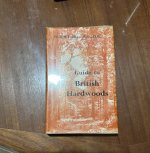
If you could get hold of an app on your phone that could identify a tree by either, or both the leaf and twig structure and/or a microscopic slide of an end grain slice would be an almost cast iron, 100% guaranteed way of identifying a species, bearing in mind that there are about 40,000 different types of tree on the face of the planet. First or second guessing from looking at the long grain or even the end grain of a bit of wood is usually totally inaccurate for unusual species. The only truly accurate way (most of the time) is an expert botanical analysis of the leaf n'twig structure of the tree and/or an expert analysis of an end grain slice under a microscope. This little book:

IMG_5464.jpeg

...has no nice pics of long grain samples, but it does have a plethora of twig n'leaf line drawings and other botanical info on British tree species - Rob
 
If you want to identify a piece of wood in your possession, you won't just look at its side grain.

You'll look at the end grain. You'll also assess its density, by picking it up. You'll probably cut it with a knife, chisel or plane, to find how hard it is and how well it works. You'll smell it when freshly cut. You'll think about where it came from and which species were commonly available there and then.

I think that's why so many wood ID threads end in uncertainty. I think your results show that it did ok for some easy species but failed when it ignored other information you'd have had by having the sample in your hand.
 
I work for a company that (in another division) makes Raman analysers. I'm not sure what response I'd get if I took a lump of wood from my workshop into them though!
I guessed, from a remark about a 3D printed steering wheel (?) you made some time back.
My neighbour used to be chummy with Sir David, and once had a demo of the Raman machine.
 
African mahogany (Khaya ivorensis) and American mahogany (Swietenia macrophylla) are both in the same Meliaceae family which does mean they are related and are both, I suppose, legitimately described as mahogany using the standard 'mahogany' nomenclature. Sapele (Entandrophragma cylindricum) too falls within the family Meliaceae but is never, in my experience, included in the mahogany descriptor. I'm not sure who or why it was decided what to include in the mahoganys and what to exclude. In my mind there's no such thing as Philipine mahogany, a description sometimes attached to one of the seventy odd Shorea genera found at timber merchants more properly described and sold, in my opinion, as variously described meranti and luaun.

As to wood ID threads ending in uncertainty I'd say that's mostly down to a mix of poor quality imagery and then lack of wood species experience of those viewing those crappy images, that is unless the wood species snapped usually out of focus is so bloody obvious it's unmistakeable. There are reasons I ignore 99.9% of wood ID help threads: I think I've just described the main one, ha, ha. Slainte.
 
Last edited:
This book is rather good


I’m sure you can find it cheaper than Amazon.
I remember pulling Nick’s leg about buying it for 1p plus p&p

Anyone know how he is?
 
Back
Top