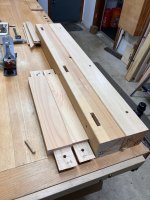
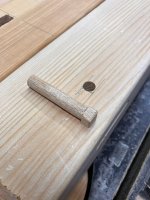
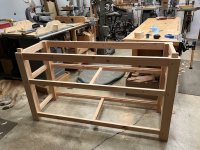
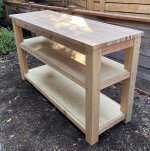
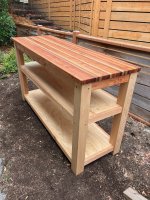
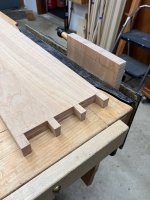
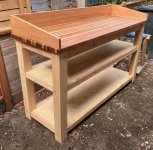
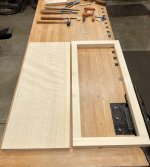
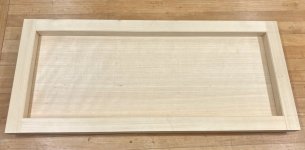
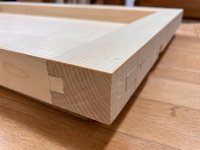
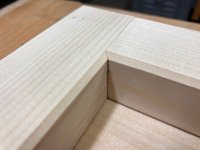
I got a couple of these wrong on the bench. I somehow missed drilling the tenon hole on one of the rails and didn't notice until the whole was assembled. I wondered why those two pegs just didn't want to go in! Not a huge mistake in this case since I just drilled through the mortice into the tenon. No draw but with all the other joints helping, not a tragedy.
Some folks glue the tenons in into their draw bored joints as well. I don't see the need. I guess the idea is "belt and braces," and the draw boring simply takes the place of clamping. But if properly fitted I think the peg should be plenty by itself, and gluing adds to the stress of assembly. Am I wrong?
I also think the pegs are best done with a wood at least as tough as the stock it will be pounded into, with no grain runout, and not likely to shatter or fray when struck with a mallet. I have read that some folks rive their pegs to assure no grain runout but I didn't do that.
Also, on another woodworking forum a member whom I respect greatly (classical furniture training and decades of experience) suggest this approach:
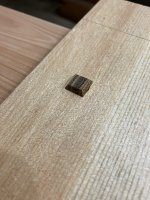
There's no need to spend time rounding those pegs, leaving the ends square, and cutting square mortises for their heads. A chorus of North Bennett Street grads are having a chuckle over that one. Make your pegs square, slightly less in width than the diameter of the hole. Knock the corners off the leading end to help start them in the hole, and drive them in. Their corners will get mostly rounded by driving them, but the corners will also square out the hole enough so that it will end up with a square peg showing.
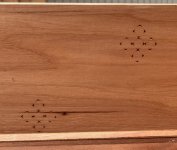
I had already chopped the mortices for the peg heads but I was intrigued by his suggested technique so I gave it a try on some scrap:
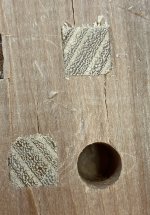
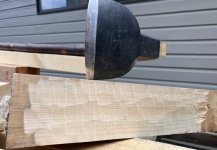
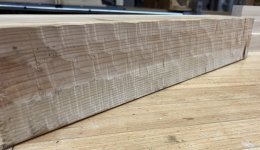
The one on the upper right was my first attempt. I didn't remove enough wood from the peg and the peg split the stock. The second attempt on the lower left went better but still some splitting. On a follow-up my friend replied that, yes, getting the peg whittled down the proper amount to fill the hole and making a square reveal without splitting the stock does take some practice and experience with the woods one is using. In this case the stock is very soft (western red cedar) and the pegs are very hard black locust. Maybe not the best combination.
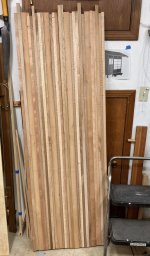
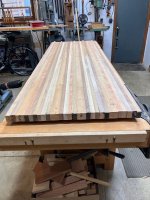
Yesterday I milled a bunch of boards leftover or rejected from other projects into strips about 40 mm x 21 mm x 1800 mm to laminate for the top. Today glued the strips into two halves. Each half a little less than 12" to pass over my jointer and planer. I'll do that tomorrow.
Madrona, white oak, butternut, cherry, and sycamore. The butternut I've had for over 40 years hauled across the country twice waiting for the right project. I guess this is the right project. The two assemblies side by side.