• Hi all and welcome to TheWoodHaven2 brought into the 21st Century, kicking and screaming! We all have Alasdair to thank for the vast bulk of the heavy lifting to get us here, no more so than me because he's taken away a huge burden of responsibility from my shoulders and brought us to this new shiny home, with all your previous content (hopefully) still intact! Please peruse and feed back. There is still plenty to do, like changing the colour scheme, adding the banner graphic, tweaking the odd setting here and there so I have added a new thread in the 'Technical Issues, Bugs and Feature Requests' forum for you to add any issues you find, any missing settings or just anything you'd like to see added/removed from the feature set that Xenforo offers. We will get to everything over the coming weeks so please be patient, but add anything at all to the thread I mention above and we promise to get to them over the next few days/weeks/months. In the meantime, please enjoy!

Old Glue - an experiment

Dr.Al

Old Oak
Joined
Dec 31, 2020
Messages
3,888
Reaction score
2,808
Location
Dursley, Gloucestershire
Name
Al
I'm going to be taking my travel tool chest for a little jaunt in the fairly near future and I've started thinking about which sort of glue to take with me. Most of the glue I have is rather old and I thought it would be quite interesting try to compare their efficacy. I've seen quite a few comparisons on-line trying to compare all sorts of different brands and types of glue but in every case they start with brand new bottles.

Since I started gluing dovetails in the David Charlesworth manner, I get through tiny amounts of glue on each box I make and hence a small bottle will last me a very long time.

I know there are things you can do to extend shelf life (like keeping the PVA glue in the fridge or superglue in the freezer) but there comes a point when the glue is just really really old and probably won't work that well.

To get at least a modicum of consistency in the process, I'm going to be gluing lollipop sticks together using spring clamps to hold the joint while the glue dries. The first batch includes, first of all, some modern glues:
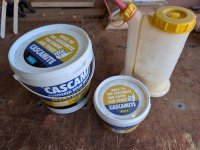
glue-test-modern-600.jpg

The Glubot thing has some Titebond 1 in it that I bought in 2020. Surprisingly, it still flows out of the bottle. My bottle of Titebond 3 from the same year got thrown away a year or two ago as it had solidified in the bottle. I've got a bottle of Titebond 3 from April 2025 so I may include that in the test as well. None of the glue has ever been in the fridge.

Both of the Cascamite tubs claim "Back to the Cascamite you know and trust" but one is labelled Polyvine and the other Ureka. As I understand it, Polyvine messed with the formula at some point and lost a lot of customers as a result. I don't know whether they went back to the original formula before Ureka took over the glue brand or whether it only happened after Ureka took over - the labelling on the tubs implies it was before but I have no idea: these two tubs are the only ones I've ever owned. The Polyvine one was bought in May 2021 and was used for an end grain chopping board that is still going strong so I have no reason to think there's a problem with its formulation. The Ureka one was a free sample sent to me in late 2023 (and was opened for the first time today).

I'm also going to try some protein glues:
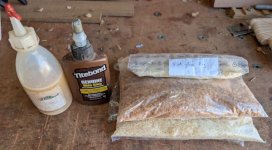
glue-test-protein-600.jpg

The bottle on the left is some liquid fish glue that I bought in late 2022. Annoyingly I can't find a record of when I bought the Titebond Liquid Hide Glue but I used it on the tool chest project in April 2023 so I'd guess it was bought at a similar time to the fish glue. The small bag of fish glue flakes was bought on ebay in April 2024. The paler coloured bag of hide glue flakes (which is still unopened :oops:) at the bottom was bought on ebay in October 2024; I'm not sure when I bought the darker hide glue flakes (from Axminster I think, but in person hence not having a record of the date). I've not really done much in the way of experimenting with the flaked protein glues so this is also an opportunity for me to learn a bit more about them.

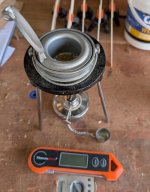
This is the what I'm using for the hide glue flakes:
hide-glue-set-up-top-view-600.jpg

The glue pot is the Lee Valley one, which is a nice size for the sort of jobs I do. It's sitting in an ebay tripod with an aluminium sleeve that I turned on the lathe to match the inside diameter (and taper) of the glue pot. The probe thermometer is used to check the temperature of the hide glue as I haven't used it enough to gain a feel for it. For this first go, I weighed out equal portions (about 10 g each) of water and hide glue and left it to soak for 30 minutes. I then heated it in the water bath to about 60 degrees with this little bioethanol/meths burner with an adjustable wick (I'm using bioethanol as it's less smelly):
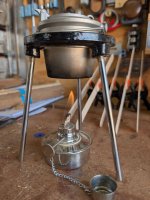
hide-glue-set-up-side-view-600.jpg

After gluing two pairs of lollipop sticks with the hide glue I'll leave the glue overnight and glue some more tomorrow (or the day after) to see how it lasts post-mix.

I haven't done the fish glue flakes yet but that process will be similar I think, just more soaking time and a lower temperature.

The next photo shows everything together and you can see the first five prepared joints (this photo was taken before I did the hide glue ones):
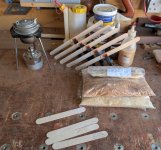
glue-test-all-together-600.jpg

I bought two packs of 100 lollipop sticks from amazon. On each one I mark a pencil line 40 mm from the end so that all the glue joints have the same amount of overlap. I then apply glue to both sticks using a paint brush and hold them together with a spring clamp. I've got six identical spring clamps so can prepare six pieces at a time (although I glued an extra hide glue joint and held it with a different clamp as I wanted to do more trials with that as I'm unfamiliar with it).

I haven't quite decided how to test the joint, although it'll probably involve a simple metal jig with a screw bearing on the wood. The main thing to decide is whether to test in shear (twisting the lollipop sticks in the plane of the glue joint) or to apply a peeling stress. Either way I probably won't worry too much about a calibrated force: I'll just see if the glue joint fails first or if the wood breaks.

It'll be interesting to see how the various glues compare. I'm particularly hoping the liquid fish glue works well: as you can see I've got a lot of the bottle left. I really like the long working time you get with fish glue: for me I think the ideal glue would be one with an infinite shelf life and a very long working time. Obviously a bit of strength is important to but most of the joint strength hopefully comes from geometry rather than glue function.

Fish glue doesn't seem to be a very easy thing to get hold of (especially in flake form) so I'm extra keen that the bottle I've got keeps going for as long as possible. Cascamite seems to be quite a promising option for the long shelf life (given that it's supplied dry) and long working time, although mixing it up is a bit of a faff so I think I still prefer the fish glue.
 
Last edited:
Yes.
Co-incidentally I've had problem with glue lately
I use a fair amount of Everbuild D4
It performs well in outdoor environment. and have never had any issue with it.
Last week I had cause to use it and found.the half full bottle had separated,curds and whey,with fluid at the top and cottage cheese at the bottom
I stopped short of tasting it and decided to chuck it,although it was still" in date"
I reordered and looked at the instructions on the new one- store between 15 and 23 °c
My shed has an uninsulated tin roof so I suppose that with the temps over the last few months it didn't stand a chance.
 
Last edited:
Thanks in anticipation Al, i like your approach to useful research.

In a less quantified way, I've just been to check, and I'm still using a bottle of Titebond liquid hide glue that i bought in November 2022. It was perfectly good on my recent bookcase (July).
 
Yes v interesting.
Just mention, and apologies for not saying it sooner that my suggestion a year? ago that squirty ketchup bottles worked well for PVA type glue, well they do and easy to use, but the glue goes off a lot more quickly, either the caps aren’t properly airtight or the plastic bottles are suspect. Sorry to all.
Ian
 
Yes v interesting.
Just mention, and apologies for not saying it sooner that my suggestion a year? ago that squirty ketchup bottles worked well for PVA type glue, well they do and easy to use, but the glue goes off a lot more quickly, either the caps aren’t properly airtight or the plastic bottles are suspect. Sorry to all.
Ian
One of the ways to keep them airtight is to put a bit of clingfilm on the bottle then screw on the cap over it, works for silicone tubes as well. You have to remember to take it off before using the glue next time DAMHIKT. :ROFLMAO: I haven't tried it with ketchup bottles as we don't use the stuff but plenty of other containers including paint tins.
 
this will be interesting, I have some titebond original from 2015 that seems okay, I bought a gallon of the stuff and have barely used it, I use HHG quite a lot now, it has become my favourite glue, you've got to be careful with temperature not to overcook it.
 
this will be interesting, I have some titebond original from 2015 that seems okay, I bought a gallon of the stuff and have barely used it, I use HHG quite a lot now, it has become my favourite glue, you've got to be careful with temperature not to overcook it.
This will be my first time using HHG so I may ask questions depending on how the joints seem to go. For the first attempt I mixed it in equal portions by weight with water, left it for 1/2 hour and then heated it up in the water bath. The glue temperature was about 55°C when I started using it and had reached 60°C by the time I finished (so I suspect the water was probably a little on the hot side - I probably could have lowered the flame a bit and been more patient with letting the glue heat).
 
This will be very interesting to see what you find with the glues you're testing.

I had an old 5lt container of wood glue, couldn't tell you the name of but it's PVA type/colour: white.

It was stock from a small pine factory that was closing down in/around 1998... 'ish - a few 5lt containers with no labels. I 'stored' it in the back area of my workshop which became, sadly, a bit of a dumping area after my mother passed away in 2005.

I came across it again around 2017~19... and used some - I forget what on. It was rather thick in consistency and had some green mould (?) on the top. I dug as much of it off as possible and attempted to 'decant' it into other containers. I also added some water to *some* it to thin it down... rightly or not!

I have used it for some *not too important* jobs and it's seemed OK and has held the bits together. Maybe I should attempt a similar experiment with some of what I have left...
 
Graham Vincent did a recent utube vid on his use of hide glue:

Thanks I'll check it out. To be honest I tend to avoid youtube tutorials on most things - I'd much rather read something well written than listen to someone describing it (it's much easier to go back and review an earlier paragraph than try to find the right bit of the video) but it would probably be good to learn a bit more.
 
this is very good write up about hide glue http://frets.com/pages/zlquzems/Ill-stick-with-hide-glue.php

and this: http://frets.com/pages/qux1xxor/Using-Hide-Glue.php

I have experimented with adding urea with 5-10% of the glue weight and didn't notice any issues, it increases the open time quite a bit, you'll get maybe 5-10 minutes instead of 30 - 45 seconds so it can be useful, I haven't noticed any compromises, and it still creeps less than PVA or titebond. I used it on a guitar top and it is still holding up amazingly well after 3 years with zero signs of any movement at all.
 
Last edited:
this is very good write up about hide glue http://frets.com/pages/zlquzems/Ill-stick-with-hide-glue.php

and this: http://frets.com/pages/qux1xxor/Using-Hide-Glue.php

I have experimented with adding urea with 5-10% of the glue weight and didn't notice any issues, it increases the open time quite a bit, you'll get maybe a 5-10 minutes instead of 30 - 45 seconds so it can be useful, I haven't noticed any compromises, and it still creeps less than PVA or titebond. I used it on a guitar top and it is still holding up amazingly well after 3 years with zero signs of any movement at all.
Frets.com was/is an amazing resource, I wish I'd got round to visiting Gryphon to thank Frank Ford in person, but sadly it's too late now.
 
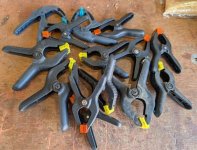
A small update on the process I'm using: I've decided to be slightly less rigorous in maintaining a consistent clamping force. I don't think it'll make a huge amount of difference and being less picky means I can use more spring clamps:

2026-08-24-more-clamps-600.jpg

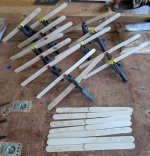
and hence make more samples in parallel:

2026-08-24-latest-batch-600.jpg

I'm making several with each different glue type to give me a few to experiment with. I've tried to spread the different clamp types across the glue types so each glue type has samples with each clamp type (although I'm not bothering to label them with which clamp was used).

So far I've got at least four each of liquid fish glue, old Titebond 1 and the first batch of hot hide glue. I've also got a few singles of a few other glues as I did one of each type yesterday. I'll do a batch each day so sometime over the weekend I can do some tests to see which ones stuck well.

There are a lot of variables that could come into play (e.g. ambient temperature, whether I apply glue to one or both faces, how long I leave it from pouring the glue into the tray before applying it etc etc etc) but I'll just try to be relatively consistent and hope that it gives me at least vaguely meaningful results.
 
Graham Vincent did a recent utube vid on his use of hide glue:


Following my slightly anti-youtube rant...

Thanks I'll check it out. To be honest I tend to avoid youtube tutorials on most things - I'd much rather read something well written than listen to someone describing it (it's much easier to go back and review an earlier paragraph than try to find the right bit of the video) but it would probably be good to learn a bit more.

... I thought I ought to say: I watched the video last night and have to say that it was excellent: clearly explained and very informative. Thanks @HOJ for sharing.
 
During the evenings of the last week, I've been doing quite a bit of gluing. Does anyone need any extra long lollipop sticks? I have quite a few:

2026-08-28-lots-of-glued-sticks-600.jpg

Most of those are piles of four although a few towards the left are just piles of two or three. In total I think I'm up to 62 glued joints and I'm planning to do a few more this evening and perhaps tomorrow as well. I'll probably come to regret having glued so many together when I come to testing the glue strength!

The glues I've used so far (along with some comments on what they were like to use) for anyone who's interested:
  • Ureka Cascamite (free sample sent to me in 2023 and unopened until this week). A bit time-consuming to get a good mix but not too bad.
  • Polyvine Cascamite (bought in May 2021). Interestingly, the Ureka stuff looked much more lumpy in the pot (vs the Polyvine stuff which is a fine powder) but the Polyvine stuff was much harder to mix into a smooth paste and was a slightly different colour after mixing.
  • Liquid Fish Glue (bought in late 2022). It still flows very nicely and was still amongst my favourite glues to apply.
  • Fish Glue Flakes (bought April 2024), two different mixes: 2:1 water to glue and a less measured one where I just chucked some water in until it looked right. Both soaked for at least 1/2 hour and then heated to 45 °C before application. Seemed very nice to apply.
  • Golden coloured hot hide glue (uncertain purchase date but definitely pre-2024). I've only done 1:1 water to glue so far but will do 2:1 as well. Soaked for 1/2 hour then heated to 60 °C. This one I also left in the glue pot for 24 hours and then reheated and used it again. It was a bit sticky to apply but I suspect that was down to the 1:1 mix and it would have been better with more water.
  • Pale coloured hot hide glue (bought October 2024). 2:1 water to glue, 1/2 hour soak, 60 °C heat. Seemed nice to apply.
  • Titebond Liquid Hide glue (probably bought late 2022). Not quite as nice to use as the liquid fish glue, especially without heating the bottle at all, but still flows well.
  • Titebond 3 (bought 2025 for my garden table project after the previous bottle, bought 2020 or 2021, was found to be solid).
  • Titebond 1 (bought 2020). Kept in a Glubot, which pulls glue from the bottom of the bottle rather than the top. I haven't investigated to see whether the top is solid!
  • Everbuild 501 Universal PVA Bond (not sure when Carolyn bought this, but it says manufactured 2020 and shelf life 12 months). The lid was gummed up so I couldn't use the pouring spout but the glue inside the bottle flowed fine.
  • Gorilla PU glue (bought earlier this year) - I just included this one for interest and only did two samples. Applied only to one piece with water on the other piece (as per the instructions).
  • Evostick Impact (contact adhesive; no idea when I bought it) - I just included this one for interest and only did three samples. Applied to both surfaces then left for five minutes before joining and clamping.
  • CA UK Medium Superglue (no idea when I bought it but it was definitely more than a year ago, perhaps two; the bottle is nearly empty; note that the bottle has been kept in the freezer). Applied to one side and then the joint was clamped.
  • CA UK Medium Superglue (same bottle). Applied to one side with activator sprayed on the other side. Squeezed briefly together with finger pressure and then left (not clamped).
There are a few more still in the "queue" as it were so that list will extend slightly.

I've also been thinking about how to test them. I think the information that I'll take as primary evidence will be whether the glue breaks or the wood breaks when I try to shear or peel them apart. However, I thought I'd apply a bit of pseudo-science to it by having some form of measurement alongside the intuitive feel of the test. I don't think this will be very rigorous but it might add something.

This is the set-up I've contrived:

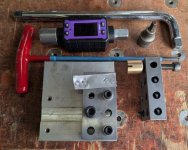
2026-08-28-test-kit-600.jpg

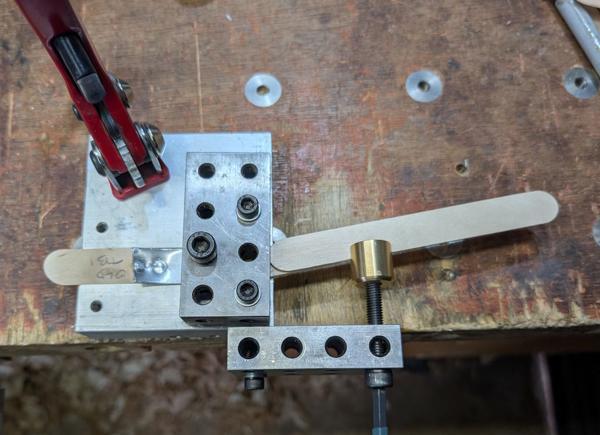
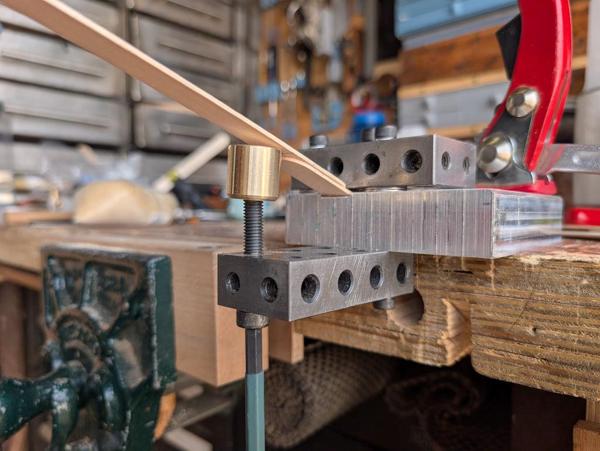
At the top is a 1/2" drive bar, a cheap (and probably not very accurate) digital torque gauge and a 1/2" drive 6 mm hex drive. Underneath that is the 5 mm Allen key for setting the jig up. The jig itself consists of a scrap of aluminium from a skip with a slot milled in it and some tapped holes. The two 20-40-80 blocks save me having to bother with complicated machining: they get screwed to the aluminium block with M6 cap screws and then M8 screws run in the threads built-in to the 20-40-80 blocks. The little scrap of aluminium shim goes on top of the lollipop stick so that the cap screw that holds the lollipop stick in place doesn't mash the wood into pulp. The M8 cap screw with the brass addition on its end is the pusher that will apply force to the lollipop stick.

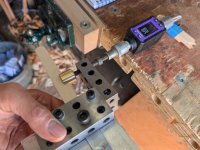
It can be used in two configurations. This is the first one:

2026-08-28-set-up-for-testing-shear-600.jpg

That's for testing the joints in shear. As the screw is turned it will try to push the lollipop stick away. At some point either the lollipop stick will break or the glue joint will fail (or perhaps the jig will snap but I think that somehow unlikely 😉).

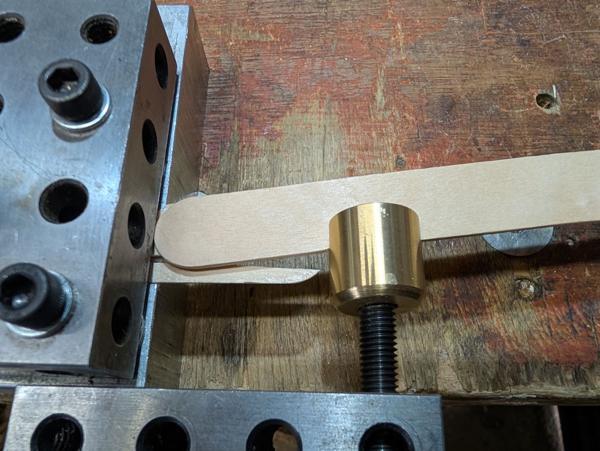
This is the second configuration:

2026-08-28-set-up-for-testing-peel-600.jpg

That's for testing peel strength.

In practice, the jig won't be that ergonomic to use as torque gauges are generally designed on the assumption that screws stop moving about the time when the torque peaks. This screw will continue to rotate and that means that the gauge will also rotate and be hard to read. To deal with that I'll be using it like this, with the drive bar dropped down into one of the bench dog holes...

2026-08-28-how-it-will-be-used-600.jpg

... and with me rotating the jig rather than the drive bar. I can see that getting boring quite quickly so I may give up and just start peeling/shearing them apart by hand to see whether the failure is glue or wood, but I thought I'd start with something slightly more metrological.

This isn't really going to be what you'd call a rigorous scientific investigation. If I wanted to be really thorough about it I'd buy a whole load of brand new glue bottles, pour away half of each bottle, leave them for (say) five years, then test them all together, with all being glued up in the same ambient temperature (rather than over the course of a week) and all being left the same amount of time between glue application and test.

However, I think this will still be instructive: all will be left at least 24 hours before testing and I'm mostly interested in whether the old glues are still usable as glues. I like to think that most joints I make (with the possible exception of edge jointing to make panels) don't rely too heavily on the glue so my demands are not too high I think.
 
I started testing today, but more on that in a minute.

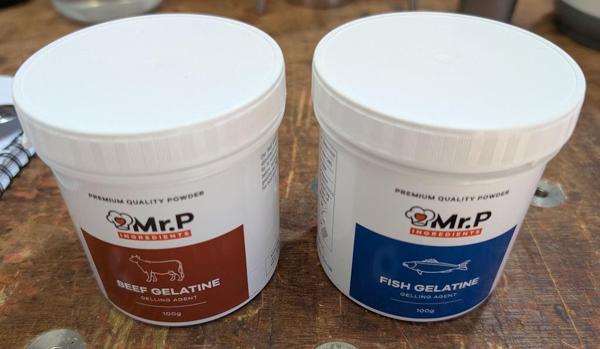
I added a couple of extra glues into the test just to see what would happen with them. Firstly there were these two pots of (newly bought) gelatine:

2026-08-29-01-gelatine_600.jpg


They were used as the equivalent of hot hide glue: soaked in water then heated up in a water bath before being applied.

In parallel to all of the glue testing I've also been experimenting with making my own liquid hide glue. There are quite a few different recipes on-line, all consisting of hide glue, water and either salt or urea. Salt seems to be the preference if you're after a long lasting glue and is more readily available so that's what I've been using. I've followed a few different recipes and so far have failed to produce a glue that stays fluid at ambient temperatures. I've got another small batch (number 8 I think now) cooling at the moment so we'll see how that goes; I'm not giving up yet!

One of the liquid hide glue attempts stayed liquid for a while when it first cooled down so I included that in the test. By the next day it was gummed up a bit so it has since been discarded.

Right, back to the testing. I very quickly gave up on using the torque gauge as it didn't seem to be giving me anything in the way of useful results. Instead, I clamped the test jig to the bench and just used an Allen key to drive the screw all the way in:

2026-08-29-02-ditched-torque-gauge_600.jpg


I've only done shear testing so far; peel testing will come next I think.

This gives an example of what happens in one of the failure modes:

2026-08-29-03-failure-example_600.jpg


As you can see, the wood has split but also the glue joint has failed in one part so that a relatively clean section of wood has separated. In the results below I've termed this a "Partial Glue Failure".

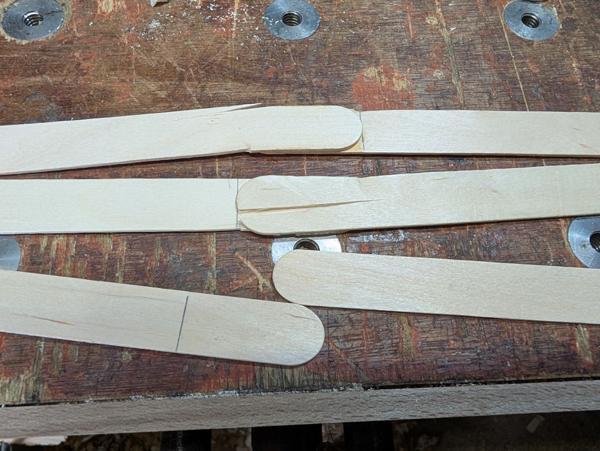
This photo shows all three of the failure modes I saw in the tests:

2026-08-29-04-three-failure-modes_600.jpg


The top one has been called "Wood Breakage" and shows that the glue is doing a good job. The middle one is the "Partial Glue Failure" I've already mentioned and the bottom one is a complete glue failure. In a couple of tests (with the same glue) the complete glue failure happened almost immediately (hardly any force from the screw) so I dubbed those "Glue Failure (rapid)" to distinguish them.

In each case where (a) the glue failed partially or completely and (b) I had at least three samples of the same glue joint, I retested to see whether the result was consistent.

That's enough waffle, here are the results of the shear testing (I've omitted glue ages from the table to keep it short, you can see them in an earlier post in this thread if you're interested):

Test TypeGlue DescriptionFailure Type
ShearFish Glue Flakes; W:G ratio Unknown (but lots of water); heat to 45°CGlue Failure (rapid)
ShearFailed attempt at home-made liquid hide glue "B"Glue Failure
ShearCA UK Medium Superglue with activator; unclamped (note clamped result below)Partial Glue Failure
ShearCA UK Medium Superglue without activator; clampedWood Breakage
ShearGolden Hide Glue; W:G 1:1, Day 1, heat to 60°C ish (note day 2 result below)Partial Glue Failure
ShearGolden Hide Glue; W:G 1:1, Day 2, heat to 60°C ishWood Breakage
ShearHosco Hide Glue; W:G 2:1, ½ hour rest then heat to 56°C ish (note retest below)Partial Glue Failure
ShearHosco Hide Glue; W:G 2:1, ½ hour rest then heat to 56°C ish (retest)Wood Breakage
ShearLiquid Fish Glue (note retest below)Partial Glue Failure
ShearLiquid Fish Glue (retest)Wood Breakage
ShearTitebond Liquid Hide Glue (note retest below)Partial Glue Failure
ShearTitebond Liquid Hide Glue (retest)Wood Breakage
ShearGorilla PolyurethanePartial Glue Failure
ShearEverbuild PVAWood Breakage
ShearEvostick Impact Contact AdhesiveWood Breakage
ShearFish Glue Flakes; W:G 2:1, ½ hour rest then heat to 60°C ishWood Breakage
ShearBeef Gelatine; W:G 3:1, ½ hour rest then 60°C ishWood Breakage
ShearFish Gelatine; W:G 3:1, ½ hour rest then heat to 45°CWood Breakage
ShearOld Titebond 1Wood Breakage
ShearTitebond 3Wood Breakage
ShearPolyvine Cascamite; W:G 1:2Wood Breakage
ShearUreka Cascamite Sample; W:G 1:2Wood Breakage


A few observations:

  1. Almost all of the glues gave a strong enough joint to be perfectly serviceable as wood glues.
  2. The two (both of a similar age) commercial liquid protein glues (Titebond Liquid Hide Glue and Preservation Equipment Ltd Liquid Fish Glue) both failed on the first test but passed on the second.
  3. The weak watery mix of fish glue flakes was awful.
  4. The superglue without activator (but with clamp) was much better than the activated version: perhaps the lack of activator gives it more time to soak into the wood?
  5. Gorilla Glue was worse than I expected it to be (especially given it was bought this year so is a fairly new glue).
  6. The hide glues generally weren't consistently great, although this might be partly down to my inexperience using them. I've got another batch of Hosco Hide Glue clamped up at the moment; the latest batch follows Hosco's instructions to mix in 3:1 water-to-glue for an hour and then heat to 75°C (which is hotter than most hide glues seem to recommend).
  7. The gelatines were much better than I expected them to be, especially considering the fish gelatine has a relatively weak bloom strength.
 
I wholeheartedly applaud you for doing all that and providing us with usefull info. 👍 Excellent stuff
I couldn't do that and I think personally I'd rather polish my car wheels. ;)
 
I couldn't do that and I think personally I'd rather polish my car wheels. ;)

Fair enough, each to their own. I think if I had to do this sort of thing regularly (like car cleaning tends to be among people who do such things) I'd get fed up with it very quickly, but I find doing it once quite interesting.
 
Fair enough, each to their own. I think if I had to do this sort of thing regularly (like car cleaning tends to be among people who do such things) I'd get fed up with it very quickly, but I find doing it once quite interesting.

Absolutely. I can relate to that with some of the carvings and those copper roses I made, once or twice is enough. I was asked to make a dozen of the roses as a commission and would have been worthwhile financially but it didn't appeal one bit. People who earn a living standing at a conveyor belt in a factory must just end up numb..
I found your experiment a fascinating read Al, I just don't have the discipline to do it.
 
Last edited:
Oooh, this was interesting: I've just done the peel testing and the results were somewhat unexpected. More to follow once I've typed them all up, but I'll share a couple of spoilers:
  1. Far more of the glues failed under a peeling load (the sort of thing you'd expect to see on a lap or panel edge joint) than failed under a shear load (that you'd expect to see trying to pull a dovetail joint apart).
  2. The old (2020 vintage) Titebond 1 survived the peel test whereas the new (bought in June 2026) Titebond 1 failed!
 
I agree with Lons - I'm glad you have the persistence to do this, and take pictures, and write it up for us all.
 
This is the set-up I used for peel testing:

2026-08-29-peel-testing_600.jpg


In several cases, it still hadn't broken once the screw reached its end of travel so in those cases I gently pushed up on the end of the lollipop stick until it failed. In this case there were two or perhaps three failure modes. In a lot of cases, the lollipop stick snapped (Wood Breakage: hence the glue is stronger than the wood). In a lot of cases, the glue joint failed, sometimes leaving evidence of glue and in one case (TB Liquid Hide Glue) leaving a tiny bit of lollipop stick still glued down but most of the joint having failed. In one case (the weak mix of fish glue flakes), the failure happened very quickly).

The results were surprising to say the least:

Test TypeGlue DescriptionFailure Type
PeelBeef Gelatine; W:G 3:1, ½ hour rest then 60°C ish (sample 1)Glue Failure
PeelBeef Gelatine; W:G 3:1, ½ hour rest then 60°C ish (sample 2)Glue Failure
PeelCA UK Medium Superglue with activator; unclamped (sample 1)Wood Breakage
PeelCA UK Medium Superglue without activator; clamped (sample 2)Wood Breakage
PeelEverbuild PVAWood Breakage
PeelEvostick Impact Contact AdhesiveWood Breakage
PeelFailed attempt at home-made liquid hide glue "B"Glue Failure
PeelFish Gelatine; W:G 3:1, ½ hour rest then heat to 45°C (sample 1)Glue Failure
PeelFish Gelatine; W:G 3:1, ½ hour rest then heat to 45°C (sample 2)Glue Failure
PeelFish Glue Flakes; W:G 2:1, ½ hour rest then heat to 60°C ish (sample 1)Glue Failure
PeelFish Glue Flakes; W:G 2:1, ½ hour rest then heat to 60°C ish (sample 2)Glue Failure
PeelFish Glue Flakes; W:G Unknown (but lots of water); heat to 45°CGlue Failure (rapid)
PeelGolden Hide Glue; W:G 1:1, Day 1, heat to 60°C ishWood Breakage
PeelGolden Hide Glue; W:G 1:1, Day 2, heat to 60°C ishWood Breakage
PeelGolden Hide Glue; W:G 2:1, ½ hour rest then heat to 60°C ishWood Breakage
PeelGorilla PolyurethaneWood Breakage
PeelHosco Hide Glue; W:G 2:1, ½ hour rest then heat to 56°C ish (sample 1)Glue Failure
PeelHosco Hide Glue; W:G 2:1, ½ hour rest then heat to 56°C ish (sample 2)Wood Breakage
PeelLiquid Fish Glue (sample 1)Wood Breakage
PeelLiquid Fish Glue (sample 2)Wood Breakage
PeelNew Titebond 1 (sample 1)Glue Failure
PeelNew Titebond 1 (sample 2)Glue Failure
PeelOld Titebond 1 (sample 1)Wood Breakage
PeelOld Titebond 1 (sample 2)Wood Breakage
PeelPolyvine Cascamite; very approximately W:G 1:2Wood Breakage
PeelPolyvine Cascamite; W:G 1:2 (sample 1)Glue Failure
PeelPolyvine Cascamite; W:G 1:2 (sample 2)Glue Failure
PeelTitebond 3Wood Breakage
PeelTitebond Liquid Hide Glue (sample 1)Glue Failure
PeelTitebond Liquid Hide Glue (sample 2)Wood Breakage
PeelUreka Cascamite Sample; very approximately W:G 1:2Wood Breakage
PeelUreka Cascamite Sample; W:G 1:2 (sample 1)Glue Failure
PeelUreka Cascamite Sample; W:G 1:2 (sample 2)Wood Breakage


Again I'll attempt to draw a few conclusions:

  1. Far more of the glue joints failed, suggesting that this was a tougher test than the shear test.
  2. The old (2020 vintage) Titebond 1 survived better than the nearly new (bought June 2026) Titebond 1!
  3. Some glues coped better with this test than the shear test (superglue, the golden coloured hide glue, the liquid fish glue and the Gorilla Polyurethane).
  4. The Polyvine Cascamite performed a bit worse than the Ureka Cascamite (two failures out of three vs one failure out of three). The Polyvine Cascamite that was mixed a bit less carefully performed better than the carefully measured ones!
  5. There are some listed above that weren't included in the shear test so I need to go back and amend that table (I've still got glued samples left). There are also some samples that I glued this morning so they can't be tested until tomorrow at the earliest.

These are the only ones that had wood breakage (i.e. no glue failures) in all tested samples in both tests:

  • Everbuild PVA
  • CA UK Medium Superglue without activator; clamped
  • Evostick Impact Contact Adhesive
  • Old Titebond 1 (but note the peel failures for new Titebond 1)
  • Titebond 3

All of those are more than a year old.
 
I started this thread off by saying I was trying to decide which glue to take with me when I next take the travel toolchest on holiday. I'm not sure I've really come to a clear conclusion.

My Priorities​

The things I look for in an ideal general-purpose glue are (roughly in priority order):
  1. Strong enough (note the emphasis: I don't need super strong, I just want my dovetails to stay together). I'm not against the idea of using different glue for panel glue-ups (which are subject to peel forces but typically don't take very long) to other joinery.
  2. Long working time: Liquid Fish Glue and Cascamite are the champions here I think. Epoxy is also good but I'd never use it for wood-to-wood joints. The hot glues seem to be the worst (unless you count superglue).
  3. Easy and pleasant to use (this is highly subjective of course). Any liquid glue meets this requirement, although some flow better than others. Hot glues are lovely as long as the temperature requirement isn't too strict (i.e. you don't have to watch the water heater like a hawk) and the pre-soak time isn't too long. Cascamite is messy and can be a pain to get into a smooth paste. Epoxy is just horrid, although I'd still use it for wood-to-metal joints.
  4. Long shelf life (which was part of what this test was about) just because I hate the waste of throwing a half-used bottle away. This is a big plus for any of the dry glues (hide glue granules, gelatine, Cascamite). Titebond 3 gets a hard disapproving stare.
  5. Easy to clean up. The protein glues are all good here, but the yellow/white glues aren't that bad. Gorilla glue is horrible.
I'm not at all interested in how long it has to be clamped as long as overnight is sufficient, so they're all equal in that sense. Commercial outfits probably like the quick setting of Titebond so they can get on with the job but I'm just a hobbyist.

My Opinions on Glues​

I think I'll probably keep using Titebond 3 for outdoor applications (although I might try the Everbuild equivalent at some point), but it'll never be my go-to glue as it doesn't seem to last long in the bottle. Titebond 1 has generally been my "I'm feeling lazy and don't want to think" glue but the peel results in this test have made me less keen.

I think Liquid Fish Glue is still my favourite (the long working time and ease of use are a great combination and it did well in the tests), followed by Titebond Liquid Hide Glue. I've got more than half remaining of the Liquid Fish Glue bottle (bought in late 2022) so while it still sticks I think I'll keep using it by default. The main downside of it is that it's quite expensive once the delivery cost is included, although given how long a small bottle seems to last me perhaps the cost isn't that big a deal. If it runs out before it stops sticking I'll probably order another bottle. If it stops sticking I might switch to TB Liquid Hide Glue.

I've quite enjoyed experimenting with the hot hide glues and I'm sure I'll use them in more projects to come. The big downside for me seems to be the short working time, but that is only a problem for some assemblies. Where I feel I can get a joint clamped up quite quickly I think the hot hide glues will be a regular feature.

Conclusion​

As for what I'll take on holiday, I think it'll probably be several: liquid fish glue, superglue (for breakage repairs) and maybe one other that I haven't decided yet (perhaps Cascamite, perhaps TB1). I doubt I'll take any hot glue with me just because I'd also have to take the glue pot, tripod and burner.

Perhaps if my on-going home-made liquid hide glue experiments work out then I'll take a bottle of that with me as well. The advantage to me of a home-made liquid hide glue would be the near infinite shelf life (of the hide glue granules) as I could mix it up in small quantities, although for the perfect glue it would have to demonstrate a long working time and I doubt it would match the liquid fish glue. As I understand it, liquid fish glue is a lot more involved to make (it's not simply liquid hide glue made with fish gelatine).
 
Last edited:
One that you don't appear to have tried is the 30min, two part epoxy available from Workshop Heaven, sold as a couple of small bottles and ideal I would have thought for your wandering tool chest. It's spendy, but ideal for small projects especially if you find yourself in a warm climate some distance south of Blighty where 'normal' PVA's and the like (Everbuild inc) will tend to go 'off' rather smartly - Rob
 
One that you don't appear to have tried is the 30min, two part epoxy available from Workshop Heaven, sold as a couple of small bottles and ideal I would have thought for your wandering tool chest. It's spendy, but ideal for small projects especially if you find yourself in a warm climate some distance south of Blighty where 'normal' PVA's and the like (Everbuild inc) will tend to go 'off' rather smartly - Rob

I did consider including epoxy (I've got the quick Araldite, the slow Araldite and some of the West Systems stuff) but I decided not to bother as I could never imagine me using them as a general wood glue given how unpleasant they are to use. They'll still come into their own for things like gluing brass to wood or whatever but I couldn't imagine ever wanting to use epoxy for a dovetail.
 
The more I've thought about glue over the last week the more I've realised you could go down a rabbit hole of trying all sorts of different tests (spoiler: I'm not going to do these tests). A few that would be great tests of working time:
  • Prepare some glue (e.g. pour it into a tray ready for brushing or heat up the hot hide glue) and then leave it for 15 minutes. Then (if possible) brush it onto the wood and assemble as normal.
  • Apply glue to each piece of wood, then leave for 15 minutes, then clamp the parts together.
  • Apply glue to each piece of wood, press together, then after 15 minutes, slide the parts slightly.
My expectation would be that Cascamite, Liquid Fish Glue and Liquid Hide glue would be the best at all of those tests. Hot hide glue would be ideal for the first one (as it'd be kept hot in the pot) but would be awful at the other two. The Titebonds and Everbuilds would be terrible at all of them, as would superglue. An epoxy would be fine in all cases but that wouldn't overcome the general unpleasantness of using the stuff.

Another good test would be to messily glue some joints together and try...
  1. Cleaning the squeezed out glue after half an hour
  2. Cleaning the squeezed out glue the next day
... before applying some oil and seeing whether the glue is visible. I think the protein glues would be the winners there whereas epoxy and superglue would be the worst. Of course that's just supposition as I'm too lazy to actually do the comparison!
 
I did consider including epoxy (I've got the quick Araldite, the slow Araldite and some of the West Systems stuff) but I decided not to bother as I could never imagine me using them as a general wood glue given how unpleasant they are to use. They'll still come into their own for things like gluing brass to wood or whatever but I couldn't imagine ever wanting to use epoxy for a dovetail.
That's true of many of them (very 'icky and messy) but that's not really fair about the stuff I highlighted mainly 'cos each of the two halves of the mix are in separate, easy to dispense squeezy bottles with long pointy spouts. When I use it, I just squeeze out the amount needed, mix thoroughly with a lolly stick and clean up the excess with a drop of meths. Really good stuff IMO - Rob
 
That's true of many of them (very 'icky and messy) but that's not really fair about the stuff I highlighted mainly 'cos each of the two halves of the mix are in separate, easy to dispense squeezy bottles with long pointy spouts. When I use it, I just squeeze out the amount needed, mix thoroughly with a lolly stick and clean up the excess with a drop of meths. Really good stuff IMO - Rob
I think I'll just take your word for it. Dispensing has never really been my issue with epoxies: it's easy enough to dispense equal portions from any type I've used. It's the texture of the stuff and that you have to use meths or similar if you want to get rid of the excess that makes me dislike it. Maybe that WH stuff is better somehow but I think I'll stick with the liquid protein glues.
 
I've used quite a lot of West Systems epoxy recently, including for gluing. It has two or three huge advantages over other glues.......for the right circumstances. For a start, you can have hours of an open time if you want. Secondly, it can be gap-filling, and still be incredibly strong. Thirdly, it's incredibly strong. It'll beat any other glue for strength, I reckon. Finally, it's waterproof. If those assets are useful for you, consider epoxy. With the dispensing pumps, it's really straight forward to mix in the right proportions.
 
I've used quite a lot of West Systems epoxy recently, including for gluing. It has two or three huge advantages over other glues.......for the right circumstances. For a start, you can have hours of an open time if you want. Secondly, it can be gap-filling, and still be incredibly strong. Thirdly, it's incredibly strong. It'll beat any other glue for strength, I reckon. Finally, it's waterproof. If those assets are useful for you, consider epoxy. With the dispensing pumps, it's really straight forward to mix in the right proportions.
Could you imagine using it as your go-to general purpose wood glue though? I'm looking for something that I'll use for dovetails in small boxes & drawers, mortices in table legs & things like that. With a good joint I struggle to prioritise strength over the glue being nice to use & easy to clean up.

I'm not suggesting for a second that epoxy doesn't have it's place, but the projects I'll make with my travel tool chest are small boxes & the like & I'm struggling to see epoxy as the glue for that place.

I do have some West Systems epoxy, but it isn't old enough (bought this year) to be worth testing in the old glue comparison.
 
Has anyone ever had a glue failure? My output is not prolific but I do have projects going back 30 years or more and I do not recall ever having a failure. Evostick Resin W in 500ml bottles has been my go to for wood joints; current bottle of which must be 10 years old or more. Small 125ml bottles are available.
 
I've had a few on commercially produced furniture. A set of quite reasonable oak dining chairs, from Habitat (which dates them!) have all had their loose joints opened reglued by me. I expect the makers preferred to use not enough glue so as to avoid spending time cleaning off the excess. I probably used Evostick Resin W to fix them and have had no problems since.
 
Could you imagine using it as your go-to general purpose wood glue though? I'm looking for something that I'll use for dovetails in small boxes & drawers, mortices in table legs & things like that. With a good joint I struggle to prioritise strength over the glue being nice to use & easy to clean up.

I'm not suggesting for a second that epoxy doesn't have it's place, but the projects I'll make with my travel tool chest are small boxes & the like & I'm struggling to see epoxy as the glue for that place.

I do have some West Systems epoxy, but it isn't old enough (bought this year) to be worth testing in the old glue comparison.
General purpose? No, no way. Far too fiddly and messy. However, I've just glued up a couple of scarfs in long oak boards which are then going to be bent, and there was absolutely no question as to which glue I'd be using: epoxy. And I really would consider it for a complex glue-up of furniture where I just needed the long open time.

Oh, and I'm not sure the "old" question arises with epoxy. I believe it can last many years on the shelf if stored properly.
 
Has anyone ever had a glue failure?
No, unless you count superglued joints (generally sticking broken bits back on and them then detaching again later). That lack of failures is why I don't really consider strength as a key priority.

General purpose? No, no way. Far too fiddly and messy. However, I've just glued up a couple of scarfs in long oak boards which are then going to be bent, and there was absolutely no question as to which glue I'd be using: epoxy. And I really would consider it for a complex glue-up of furniture where I just needed the long open time.

Oh, and I'm not sure the "old" question arises with epoxy. I believe it can last many years on the shelf if stored properly.
Thanks Mike.
 
I've had a few on commercially produced furniture. A set of quite reasonable oak dining chairs, from Habitat (which dates them!) have all had their loose joints opened reglued by me. I expect the makers preferred to use not enough glue so as to avoid spending time cleaning off the excess. I probably used Evostick Resin W to fix them and have had no problems since.
Likewise Andy. I should have said glue failures on projects we have put together.
 
Back
Top