• Hi all and welcome to TheWoodHaven2 brought into the 21st Century, kicking and screaming! We all have Alasdair to thank for the vast bulk of the heavy lifting to get us here, no more so than me because he's taken away a huge burden of responsibility from my shoulders and brought us to this new shiny home, with all your previous content (hopefully) still intact! Please peruse and feed back. There is still plenty to do, like changing the colour scheme, adding the banner graphic, tweaking the odd setting here and there so I have added a new thread in the 'Technical Issues, Bugs and Feature Requests' forum for you to add any issues you find, any missing settings or just anything you'd like to see added/removed from the feature set that Xenforo offers. We will get to everything over the coming weeks so please be patient, but add anything at all to the thread I mention above and we promise to get to them over the next few days/weeks/months. In the meantime, please enjoy!

Another tool chest

I've spent some time re-working the proportions of the upper cabinet. As I drew it four years ago, that version now looked too tall and tippy. I started from scratch and after considering various ways proportions I've come to like this one, with the top the same height as the base plus 1/6th. I also moved the posts inward so their outer edges line up with the mid point of the lower posts. That changed the width of the doors, which slightly changed the depth of the cabinet to allow the doors to fold against the sides and end flush with the back.

I also spent some time with an alternate construction using a solid dovetailed carcase. That was more space efficient but I didn't like the mismatch with the base.

Here are the proportions I have to date. Still much refinement to go, and also furnish the inside with its drawers and plane till.


137C683F-433E-458B-8068-60C391684F29_1_201_a.jpeg

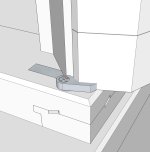
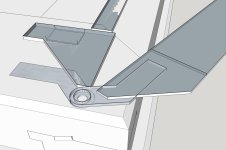
I've spent more time designing the dimensions and location of the 270 degree offset pivot hinges. I have a local machinist and woodworker friend who said he can make them for me. I'm going to wait until I have them in hand before I start cutting wood, though. The whole design hinges (as it were) on the hinge hardware. (Slight mismatch in the hinge position drawing has since been cleaned up).
A7F696EA-3B16-48D6-B847-4B07F27865F2_1_201_a.jpeg
 
Why the 45 degree splay on the corner/ edge, and why do the rails run to the outside of the frame with the stiles sitting between them?
 
Looking at the joints and construction details of your tool chest just blows me away! I admire your dedication to detail and the kill you have built up to create such a piece. I think many woodworkers on here are far more skilled than many of the professinal carpenters and joiners I work with at times. Thank's for posting this it's really interesting to see the jointing and skill level involved.
 
Why the 45 degree splay on the corner/ edge, and why do the rails run to the outside of the frame with the stiles sitting between them?
Sorry, the drawings are a bit misleading. The door stiles actually do run top to bottom with the rails between. For my rough sketch I didn't bother with door joinery and instead just overlapped the sticks at the corners. Sketchup shows all the lines whether they would be there in real life or not.

The posts are not splayed, but rather beveled. The door is inset. The only way to get the door to pivot around the corner of the cabinet is to move the pivot point to the outer most corner. And the only way to get the back face of the hinge stile to not bump into the post as the door closes is to bevel the post and stile.

Here is a section cut through the hinge. Maybe this will make the geometry clearer. And I've cleaned up the door stile/rail meeting.

The advantage of this scheme is that there is no interference between the door and cabinet through the entire 270 degrees of motion, hence no stresses on the hinge as might occur with a more conventional hinge that allows the door to bump into and lever against the cabinet if overextended.

(Although in the drawing you can see the hinge itself will bump into the post at full extension. That is solved in reality by excavating a bit of the post at that location. Too fussy to include at this point in the drawing but you can see it the photo of real example).
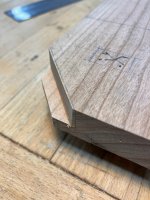
943CE146-DD20-4DA0-BD89-349FD4956F61_1_201_a.jpeg

87458464-3721-4D62-A5E1-8103CD6461C5_1_201_a.jpeg
 
Last edited:
Ah right, I see......
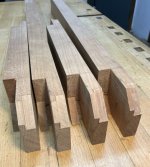
Is that internal 135 degree angle out of one piece of wood? If so, that'll be fiendishly difficult with hand tools.
 
Ah right, I see......

Is that internal 135 degree angle out of one piece of wood? If so, that'll be fiendishly difficult with hand tools.
Yes, one piece. The plan is to use a table saw to remove most of the waste and then clean up with hand planes.
 
Latest iteration. The shallow drawers are for chisels and files. The short shelf above the drawers is intended for plane storage/plane till. Should I add dividers to separate the space into stalls?
The two upper shelves are just a trial. I'm not sure what I'm going to put up there. Maybe I'll make their positions adjustable.

A95B5783-E8D1-4C1A-86EB-A3661BE1DDA0_1_201_a.jpeg
 
Latest iteration. The shallow drawers are for chisels and files. The short shelf above the drawers is intended for plane storage/plane till. Should I add dividers to separate the space into stalls?

I think that's a personal question dependent on your circumstances. Have you stopped acquiring tools special enough to go in the cabinet? Can you afford the loss of space just to get the extra neatness? (Even with quite thin wood, dividers could take up as much space as another plane or two.) I might well add an extra shelf though - few tools need much space vertically.

It's an easy question for me - undivided shelves and big drawers let me add (or subtract!) tools, gives me maximum space and lets the most useful tools move to the front. But I suspect your needs and preferences may well be different.
 
More drafting. The structure is nearly done but I'm still working on tidying up the joinery. I want to make sure I can assemble it and not design myself into a dead end.

89933E4C-9ADE-48C0-AE84-3012A3853455_1_201_a.jpegI'm making the shelves adjustable since I'm not 100 percent sure what I want to put up there.

Carrying over the drawer style from the base cabinet. 8AFE02D6-9F55-4F67-B536-B7024104E6E3_1_201_a.jpeg
Making sure I can cut the all the frame parts from the single board. All the frame plus the door rails and stiles, and drawer fronts. The rest of the drawer, web frames, and panels will come from other stock. A3535ABB-98D4-4F94-A573-B111A051D030_1_201_a.jpeg
 
Almost finished. (some assembly required.)

Here are all the parts except for the flat panels and door panel battens. Cut oversized and left to sit for a few days before I start milling to working dimensions.

F5E94BD5-F974-495D-844E-C4D7FC02B490_1_201_a.jpeg


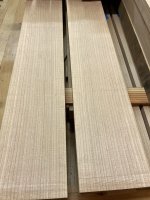
That long beam produced over 20 pieces with beautiful strait, clear rift sawn grain.

C679001E-BD99-4529-B1DC-18933F08D002_1_105_c.jpeg

And here is more of the quarter sawn sycamore from the stock i used for the base cabinet.

8CA414F4-C8ED-4406-B002-99A1C480B653_1_105_c.jpeg
 
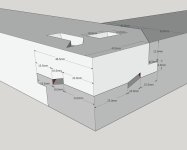
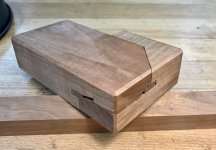
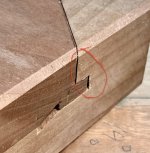
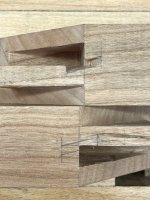
Finally getting to laying out/setting out joinery. I'm starting with the base and top, which are two rectangles with one inverted with respect to the other. The corner joints will be these half mitered, half lap joints locked with two shachi sen pins. It is a kind of scarf joint modified for 90 degree joining. The rectangular mortice is for a tenon from a corner post. The chevron shaped mortice is for a door hinge.

5C7F8859-1BD3-45C7-AE26-5636272E4548_1_201_a.jpeg

The two pieces are set out identically. The half mortices for the shachi sen are tapered on each half of the joint.

8295E697-C848-4B1B-91E9-5513150E271C_1_201_a.jpeg

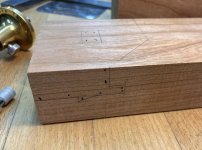
Here is one half of one joint marked out:

6F3C2D3E-3AA5-4D95-BA9D-1373AB64ADBA_1_201_a.jpeg

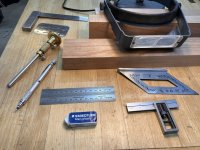
These have become my go-tools for layout/setout work recently (plus a digital caliper). I find that that little Incra ruler is particularly handy. It works perfectly with a 0.5mm mechanical pencil. The magnifier and eraser are also essential... Once I'm sure I have the lines where they are supposed to be I'll go back and knife the cross grain lines.

B212EA95-3765-407B-8F81-5E06CCB6ACD5_1_201_a.jpeg
 
I'd love to have a go at one of these mind-bendingly complicated joints some point (although I think I'll keep working on mastering the simpler sort first!)

What's that little steel sheet with cut-outs that sitting in between the engineer's square and the marking gauge in the top-left of the last photo?
 
What's that little steel sheet with cut-outs that sitting in between the engineer's square and the marking gauge in the top-left of the last photo?
It is a drafting eraser shield. These were common in the days of drafting tables and essential for correcting small mistakes or making changes to pencil drawings. The shield is placed on the drawing to isolate a small area and allow the eraser to remove only a small bit of pencil mark without affecting the rest of the drawing.
 
One subtle feature of the shachi sen is that for a proper fit it needs to be tapered both in width and in thickness. When I've done these before I've mostly eyeballed the shape and fit and bashed them in but this time I'm trying to be more precise. Here is the issue for a shachi sen that enters normal to the surface. On the entry side, imagine a pin that is a parallelogram with a width of 12 and a thickness of 4. (They can also be done as rectangular sections but the parallelogram is slightly more refined).

78FC8153-8C3D-4B4D-83DE-3C394C4DBF2D_1_201_a.jpeg
If the mortice is tapered in width by 1 mm on each side, a typical amount, then the exit side looks like this relative to the entry side.

14105C87-6180-428C-91B4-39C79EAFF26D_1_201_a.jpeg

A taper in width by a total of 2 mm means that the shachi sen also has to taper in thickness by a total of 0.7 mm. I'm noodling about a planing jig or jigs to make this job easier.
 
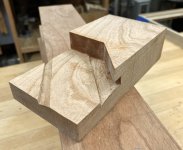
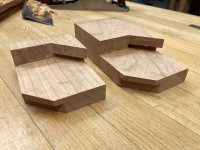
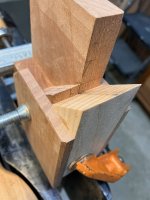
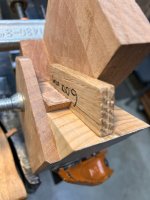
Practice. I've never made this joint before so I'm learning as I go along how best to make the cuts. Here is a first attempt on some cutoffs. Band saw for most of the lap waste except for the inner corner. Then hand saw and chisel work. I think when I gear up to do 16 of these I'll bring out the router for more of the bulk removal.

F7BC9FAD-C15F-4413-AF15-CBB8B862DEFA_1_105_c.jpeg58017335-C76C-4543-BCF3-5A02BC163255_1_105_c.jpeg

Not a great fit for a first attempt. I didn't make any attempt to fettle it to close up betteror finish the wedge mortices since this is practice. But I learned a lot for a first go. For example, it is better to fit up the lap first before laying out the wedge mortices so that their edges are sure to line up exactly. And it is difficult to pare the wedge mortice that lies next to the mitre since the only access goes uphill against the grain. You can see the difference in surface finish. Not a big deal since it will be hidden.
43449DEE-3D3D-4097-8964-972AFB8EE6CB_1_201_a.jpeg
 
Mitres! It's always the damn mitres....... It's the mitre which caused most of your inaccuracy here.
 
Excellent Gary. As it happens, I started writing the script for a video on various ways of graduating drawers. Your post has reminded me to get on with it.

When you say Sycamore, do you mean what we would call Plane, often London Plane? In the UK Sycamore is a maple, Acer Pseudoplatanus, whereas I think that your Sycamore is Platanus Occidentalis. When quartersawn it gives that fantastic figure. Our sycamore can be rippled and is often used bookmatched for the backs of musical instruments, hence the name Fiddleback Sycamore.

Am I right or am I mistaken (it wouldn't be the first time...).
 
Mitres! It's always the damn mitres....... It's the mitre which caused most of your inaccuracy here.
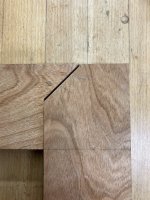
Yes. There are actually two potential kinds of mistake here. One one side the layout is OK but it still needs a few paring cuts to close the gaps. Tedious but fixable.

4789BDF3-722D-4D35-B710-E757C8E959B5_1_201_a.jpeg

On the other side I was way off the wrong way on the mitre layout. Not fixable. But the pieces came from the scrap bin so I don't mind tossing them back in. I hope I can learn from the mistakes.

4986C6D6-7118-4AAC-B664-08EC64049BF7_1_201_a.jpeg
 
Excellent Gary. As it happens, I started writing the script for a video on various ways of graduating drawers. Your post has reminded me to get on with it.

When you say Sycamore, do you mean what we would call Plane, often London Plane? In the UK Sycamore is a maple, Acer Pseudoplatanus, whereas I think that your Sycamore is Platanus Occidentalis. When quartersawn it gives that fantastic figure. Our sycamore can be rippled and is often used bookmatched for the backs of musical instruments, hence the name Fiddleback Sycamore.

Am I right or am I mistaken (it wouldn't be the first time...).
Methods for graduating drawers is a great topic. On my revised sketch I tried a few different approaches and ended up using a Hambridge progression, tweaked a bit to avoid fractional millimeter dimensions.

And yes, the sycamore I'm using here is P. occidentalis. It really is spectacular. And none of it will be visible unless one removes the drawers. My gift to any future owner who is curious enough to take a look.
 
Not mine, though, because you can't select the total height of all the drawers beforehand. Your chest of drawer height, therefore, is dictated by the width and the number of drawers, and not by the height available. It doesn't work like that in the real world, where your bounding dimensions are just about the first thing decided on.
 
True, Mike, but you can use Hambridge to get the graduation, then adjust the overall width and height to get the proportions that you need. No longer proper Hambridge, of course, but still a very pleasing set of drawers and infinitely better than an Arithmetic or Geometric progression.
 
Not mine, though, because you can't select the total height of all the drawers beforehand. Your chest of drawer height, therefore, is dictated by the width and the number of drawers, and not by the height available. It doesn't work like that in the real world, where your bounding dimensions are just about the first thing decided on.
Yes, it’s the whole rather than just a simple division of vertical space. Proportions are absolutely everything.
 
V. 2.0, less the 45 degree mortices for the pins. Not perfect but much better.

355C84B9-B4A4-46AC-B260-7D241D24377D_4_5005_c.jpeg
8B3D32D1-7BD0-42E4-B7CD-D60C657D32BE_1_201_a.jpeg


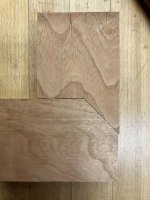
And with the mortices carved out. The trench near the mitre has to be carved uphill against the grain so it is little rough. Any suggestions for doing that better? If not, no worries. As long as it is reasonably flat and to dimensions it will work. And will be hidden in any case.

Still not acceptable but I can see a path forward.

2DCA8DC2-3AE1-4EAD-9F38-C289F6464A40_1_105_c.jpeg

32D26E01-892D-4C4C-82BE-7340E947922F_1_201_a.jpeg

The troublesome spot now is here where the tongue enters the groove.


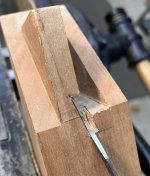
32D26E01-892D-4C4C-82BE-7340E947922F_1_201_a.jpegGetting that 45 degree corner of the groove sharp and in the right place with no chipping is the goal. So far I've chiseled it out freehand and that I know now is not good enough. I'm sure a paring jig is in my future.
 
Last edited:
I've never tried making a joint as complicated as that, so this is just speculation, not experience. But have you tried trimming the internal corner by cutting vertically down? I'd start by knifing a line, take almost all the wood away by cutting horizontally as you have done, then cut down for the last little bit, once there was no strength in what was left, so no risk of the chisel being wedged back from the line. Obviously, you'd need a bit of carefully sized scrap to fill up the groove.
 
Thanks, Andy. I was feeling confident enough to start in on the frame pieces. Here are some method pix.

A paring jig for the corner groove. I started with some saw cuts and then chiseled the rest. A 6x6 gauge block to monitor progress.

D37E3136-CFDB-404E-A174-8683318F1786.JPG1BE2F341-BEE1-4E0F-8A93-0C34D730110A.JPGE3EFB97C-3DEA-4B32-B49F-1ACDA685A408.JPG

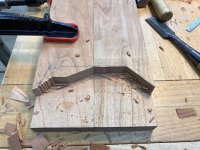
I leveled the lap in three steps. First was a rough cut with the band saw and hand saw. Then chopped out the inside corner that I couldn't reach with the band saw. Then leveled the deck with the router table and 42 mm Japanese slick.

5F00A2D9-4A0D-4070-85A0-9343B206B17C.JPG

97656E83-D644-4461-8B88-AB76631880A0.JPG3F9097FF-84E7-4278-AB2E-78ED0E9A14B8.JPG

Then trimmed the tongues at the corners with saw and rabbet plane. Staying wide of the lines so I can ensure a fit later.

72C35F37-ADC1-4C85-918C-43FE45DE7D59.JPG

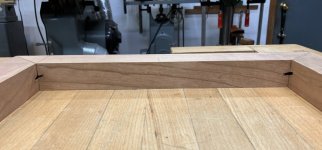
Four corners rough fit so far.

AB3CD275-1998-4132-8529-A650284657F7_4_5005_c.jpeg37FA8CD8-BD0B-4461-8A83-4E09E97F5C56_4_5005_c.jpeg
 
Gary, thanks for sharing. Much more advanced than my joinery, but fascinating to understand how it is done. Maybe I’ll have to give it a go one day.
 
I've never made this joint before and it certainly is a challenge. I think by end of the eighth one I might begin to have it right.

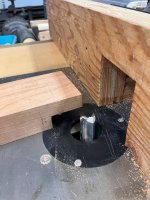
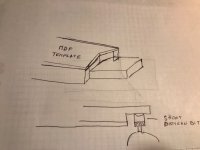
A friend suggested an alternative way to deck the laps and get into the inside corner using an MDF template and pattern bit on the router table. I may do this on the second frame. I can imagine using a rebating or slotting bit with this template to get at the groove on the mitre, too.

IMG_2046.jpeg
 
Looking good Gary. What type of glue do you use or do the joints lock tightly with the wedge system? You might have said already if so my apology.
 
The wedges lock it tightly. Incredibly tightly, I'd say. Some folks glue the wedges in place. Some glue the lap as well, which is overkill in my opinion If the wedges are glued then the joint is forever. If you leave them unglued then they can work themselves out after many seasonal humidity cycles or they get vibrated a lot. I'll probably leave them unglued for three reasons: 1) it is much less stressful than a glue up, and reversible if for some reason during assembly the frame needs to be taken apart. 2) if they loosen up over time they are easily tapped back in, and 3) if for some reason the frame pieces need to be repaired the wedges could, in theory, be drilled out and the joint disassembled.

If the wedges weren't easily accessible after assembly I'd probably glue them. My favorite glue is hide glue but PVA glue also would be fine.
 
Last edited:
Thanks Gary, I am amazed at the Japanese and Chinese joinery techniques, very complex and interesting. I guess living where you are there are plenty of examples of this architecture.
 
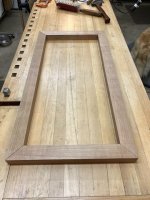
I finished the 8 corner joints for the two frames. Here is one pair with the twin trenches sawn/chiseled/pared for the shachi sen.
E474B9F7-CA42-4B88-8F42-BCE79C59B0DE_1_201_a.jpeg

Next up is the corner joinery for a kind of cornice that will sit on top of the upper frame. Shown here in white.

3D7476C2-DC9F-4FA0-86A9-67BC18A9A375_1_201_a.jpeg

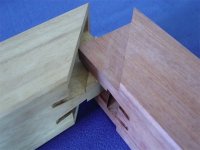
I didn't want the joinery exposed on the part so I'm using a mitred joint that is locked with single shachi sen. The two halves of the joint are set out identically. Here is a schematic.

6971E008-9643-431B-9A1B-4269EAB05E42_1_201_a.jpeg

One half with its tenon cut as well as the mortice for the opposite tenon. You can see the layout lines for the shachi trench.

C0567BC0-7D1D-4391-B460-1E5678CE06B8_1_201_a.jpeg
The tricky part here is striking the layout lines inside the mortice. To make the line for the tapered shachi trench I made a template out of some copper sheet.

E610AC4B-E5E8-4C57-84B7-F0A958E9231A_1_201_a.jpeg
Then tucked it inside. I could then get a pencil guided by the thin edge of the copper.
BEB1D3D9-14B8-41B0-82A7-A0A80017719D_1_201_a.jpeg

The other interior layout lines also required some small templates. (Sorry, no photos).

Then cutting out using small saws and small chisels. The little 1.5 mm chisel was essential.

062FF16C-8268-4415-A242-D99582BDBC2E_1_201_a.jpeg73FBAF2D-E812-4053-9B40-D4A963D2716A_1_201_a.jpeg

After a little more work nearly done. Just a little cleanup to do.

C7D4840F-A3D9-4F24-987F-B708874D1EF6.jpeg


One down. The trench for the other half is ready to cut out tomorrow.

D8BAA6ED-E897-447F-9190-1C939C829170_1_201_a.jpeg
 
It must be so satisfying to be able to cut joints like that, successfully!
 
Yes, when it comes together properly it is very satisfying.

Here is a another version of the joint but with twin tenons. Iwakuni doesn't show how to lay out or cut the shachi sen trenches, though. I suspect because it is hard to do them cleanly.
 
I suppose it would weaken the single tenon to have two wedges for balance, but amazing the way and how cleanly it pulled together.
Also incredible the way it has survived at ground level for a Century
 
Back
Top