• Hi all and welcome to TheWoodHaven2 brought into the 21st Century, kicking and screaming! We all have Alasdair to thank for the vast bulk of the heavy lifting to get us here, no more so than me because he's taken away a huge burden of responsibility from my shoulders and brought us to this new shiny home, with all your previous content (hopefully) still intact! Please peruse and feed back. There is still plenty to do, like changing the colour scheme, adding the banner graphic, tweaking the odd setting here and there so I have added a new thread in the 'Technical Issues, Bugs and Feature Requests' forum for you to add any issues you find, any missing settings or just anything you'd like to see added/removed from the feature set that Xenforo offers. We will get to everything over the coming weeks so please be patient, but add anything at all to the thread I mention above and we promise to get to them over the next few days/weeks/months. In the meantime, please enjoy!

Bobby Workshop & Shed (advice needed)

KitchenBOB

Seedling
Joined
Jan 2, 2026
Messages
10
Reaction score
2
Name
Bobby
LOCATION
Bedfordshire
Hello,

I would really appreciate some guidance and advice.

Recently had one to many children so had to extend the house and make the most of the space to make additional bedrooms. Problem is lack of internal storage. My wife is a childminder so has lots of children's toys and push chair etc and I am kitchen fitter with lots of expensive tools which I don't like leaving in the van (VW caddy) so store inside but again there isn't enough room for this.

What i am looking to achieve is a large workshop & storeroom. We have and angular shaped boundary with neighbour so was looking to maximise the footing of the workshop. i had a 100mm concrete slab put down with hardcore sand and dpm, and i had the slab made to match the boundary with 800mm all around. in regards to the workshop i will be using often for multiple different projects.

i was going to start the build in the summer 2025 yet not knowing where to start and over complicating myself plus no time meant i delayed. yet i cant delay an further which is why I'm reaching out for advice to get the details nailed down on how to create something which isn't going to destroy my tools, destroy my wife's working equipment and have storage still for gardening tools and Christmas trees etc.

I had taken the idea from a video on youtube where the guy built a garden room and i was going to base my workshop on the same spec, he is building a garden room i am creating a workshop, would this be over the top for that?. Also the guy in the video adds his dpm after so on top of the concrete, as i have dpm under the concrete would i still add another layer above or just lay 100mm insulation straight down with OSB above that. Also he installs windows and uPVC glass doors i wont be doing either (may reconsider a window for natural light) as i will be installing 2 metal doors on the shorter side as entrance to a workshop one side and my wife and general storage on the other (wall straight through the middle). i was going to install the rubber roof as i feel this may require less maintenance, yet need to know how that would work with my angled roof. as for cladding i would just use tounge and groove shiplap, all though i have seen some videos where the shiplap expands and contracts quite a lot. Originally i was going to use black feather edge but the wife think it would look horrid in the garden.


I usually over do everything and perhaps spend way to much then is really required and over think a lot which tends to delay my decisions as well. i will be carrying out all the work my self as i am a confident worker yet building a workshop to last and keep the items inside dry and safe requires some knowledge i don't have.

Any advice would be much appreciated

Thank you,

i have attached an overhead with dimensions to give some type of idea, i also attached the video.
 

Attachments

  • Shed Slab.jpeg
    Shed Slab.jpeg
    123.1 KB · Views: 30
Hi Bobby, and welcome to the forum. I am an architect, and did a guide to building your own workshop here on the forum. I also did an in-depth report on building my own workshop. I know there is some sort of issue with the images, but also that there is a work-around. I'm hoping someone on the forum will be able to advise you on how that's done.

I haven't time right now to look at your Youtube clip, but will try tomorrow. My initial comment, though, is that your proposed shed would need planning permission as it is above 15 sq metres and within a metre of your boundary. I'll do what I can to advise you, but suggest you start with the two threads I linked you to and then come back with your questions.
 
Welcome To the woodhaven Bob,
Good luck with your project. You’ll find some excellent advice around here.
 
Hello on your guide for workshop builds you have two layers of bricks forming the base. can i build a wooden framed base and then build directly on top that? i have one week to build my workshop so dont have the 7 days for bricks to cure
 
The reason for the two courses of bricks is to lift the timber parts out of range of rain splashing up from the floor or pooling at the base. You can build a timber structure directly on the slab, and the vast majority of garden sheds are done that way, but it won't last nearly as long before rot sets in as the brick plinth would.
 
Could concrete lintels be used to raise the timber off the concrete slab as detailed here?
Although this was laying the lintels on the ground it might be possible to lay the lintels on the concrete. I'd leave others to comments on this as I have no experience
 
I know there is some sort of issue with the images, but also that there is a work-around. I'm hoping someone on the forum will be able to advise you on how that's done.
The issue is that most of Mike's photos are hosted on Imgur, who in response to the Online Safety Act have decided not to serve the UK any more. The workaround is to use a VPN when browsing Mike's thread, so that you appear to be in a non-UK country. Many VPNs are available, free or charged for and some browsers (eg Opera, Brave and now Firefox) have their own easy to use built-in offerings.
 
The reason for the two courses of bricks is to lift the timber parts out of range of rain splashing up from the floor or pooling at the base. You can build a timber structure directly on the slab, and the vast majority of garden sheds are done that way, but it won't last nearly as long before rot sets in as the brick plinth would.
hi thank you for the reply. i have a concrete base 100mm above floor level. i was going to dpm and build the wooden frame on top and then come up with the dpm thus protecting against moisture.

im just not sure how efficient timber wrapped in dpm on the floor will be. will stop moisture coming through but could also trap moisture at the floor joists
 
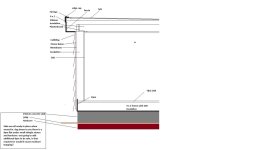
Draw a sketch section through your proposed floor/ wall junction, Bobby, and I'll have a clearer idea of what you are considering doing. Plastic and wood in the wrong configuration can cause far more problems than you'd imagine.
 
im trying not to go over kill with the build. as im going to divide the space inside one half for a shed to store garden tools and some household boxes as lack storage internally and the other half a small workshop and some where to store all my powertools for work. i just worry about moisture ruining my tools and household items in storage. hence the extra precaution on the floor for moisture.
 
So your proposed building follows the exact outline of the existing concrete slab, does it?
 
Last edited:
Well, I suggest omitting the plastic above the slab, which isn't doing anything at all if the plastic below the slab is intact. You could also omit the frame for the floor, as putting insulation down and then a (glued) T&G flooring board over that is absolutely standard practice. It would be optimal to raise the frame above the slab on bricks, but as the entirety to the slab is above ground, and the lowest timber is 150mm above the finished ground level, you can be confident in just building directly onto the slab.

I would return to the point I made a while back: you'll need planning permission for this shed because of its size and proximity to the boundary.
 
I think your roof joists need to be deeper for that span. Maybe 8” but it is a long time since I last designed any roof.
 
I think your roof joists need to be deeper for that span. Maybe 8” but it is a long time since I last designed any roof.
Hmm, 11 1/2 ft depends on the spacing too, also of course if there’s anything going on top. Personally I think it’s ok
Just been looking at the regs over here for my 12’ 6” span and they specify for different grades of timber and spacing and upstairs use, I may be putting a few piles of boards up onto mine so I followed Mikes advice and went for 8” and the codes say no more than 16” on centres.
 
I think your roof joists need to be deeper for that span. Maybe 8” but it is a long time since I last designed any roof.
I agree. I was only looking at the base, and didn't notice that. I've gone back to the original drawing and the maximum span is 4.8m. The minimum depth of joist to span that distance is ex 250mm. That's massively bigger than the proposed ex 150.

There's another really big issue with the roof, too. With a trapezoidal roof shape, a "flat" roof will require a sloped wall plate. In other words, at least one of the walls will have a sloped top. I haven't the first idea how I'd work that out on site, and I'm absolutely certain I couldn't build that building properly in a week.
 
Hmm, 11 1/2 ft depends on the spacing too, also of course if there’s anything going on top. Personally I think it’s ok
Just been looking at the regs over here for my 12’ 6” span and they specify for different grades of timber and spacing and upstairs use, I may be putting a few piles of boards up onto mine so I followed Mikes advice and went for 8” and the codes say no more than 16” on centres.
If it were 11 1/2ft I would agree with you Ian. The proposed structure tapers from 3500mm at the narrow end to 4800mm at the wide end. 4800mm is 16ft. I have not looked at the span tables to check, but my gut reaction is that 8" or 9" by 2" joists are needed even at 16" centres. Bobby check the span tables.
 
I agree. I was only looking at the base, and didn't notice that. I've gone back to the original drawing and the maximum span is 4.8m. The minimum depth of joist to span that distance is ex 250mm. That's massively bigger than the proposed ex 150.

There's another really big issue with the roof, too. With a trapezoidal roof shape, a "flat" roof will require a sloped wall plate. In other words, at least one of the walls will have a sloped top. I haven't the first idea how I'd work that out on site, and I'm absolutely certain I couldn't build that building properly in a week.
That's a good point otherwise the roof will be twisted when viewed from either end.
 
If it were 11 1/2ft I would agree with you Ian. The proposed structure tapers from 3500mm at the narrow end to 4800mm at the wide end. 4800mm is 16ft. I have not looked at the span tables to check, but my gut reaction is that 8" or 9" by 2" joists are needed even at 16" centres. Bobby check the span tables.
There's an old rule of thumb which works beautifully, and almost always agrees with the span tables: half the span in feet, plus 2, in inches. 4.8m is about 16'. Half that is 8, plus 2, equals 10". That's as far as the rule of thumb can take you, as it doesn't cover spacing, or point loads, or live loads, or indeed the width. But for a roof like this, which only has to not sag under its own weight, ex250x50 at 600 centres is fine.

-

I've worked out how I would build the roof with sloping plates, working it out on site. Build the long walls with parallel top and bottom plates, and erect them. Obviously they're not the same height. (Build the end walls to the height of the lower of the long walls, and infill to the roof afterwards). Lay a joist on each end of the roof, and set up a viewing point a few metres back from one end. Sight across the two (in the manner of winding sticks), and incrementally pack one end of one of them to bring the two into line. Then, cut a giant (5.8m long) firring piece to suit. This needs to be the full width of the plate, so if using 2" material that would mean making two of them. What a schlep!
 
Mike, the problem with this roof is to avoid transferring the twist from the outside to the inside and showing on the ceiling. The design was for firing pieces on top of level joists. If the firings are all made for the first 4.8m joist and fixed from high end. Then as the roof dimishes cut of the excess from the thin end. This maintains a level at the high end and a tapered fascia at the lower end Would that work?
 
Mike, the problem with this roof is to avoid transferring the twist from the outside to the inside and showing on the ceiling. The design was for firing pieces on top of level joists. If the firings are all made for the first 4.8m joist and fixed from high end. Then as the roof dimishes cut of the excess from the thin end. This maintains a level at the high end and a tapered fascia at the lower end Would that work?
Yes. In fact, that's probably preferable.

Non-parallel plates are always such a pain. Obviously the best answer is to build a hand-cut pitched roof with a horizontal ridge, and with each joist cut individually...........then thatch the whole thing so no-one can ever see!
 
Nah, my C17 house has an eaves line that is more like a big dipper at Blackpool but in both planes just to really mess with your head.
 
I costed up a self build and couldn’t beat the price of the ready made kit jobs. This was 6 years ago. My son has just looked at costs and came to the same conclusion. Coincidentally his arrived two hours ago.


Because he lives in a conservation area this was the maximum size the PP allowed.
 
Last edited:
"i had a 100mm concrete slab put down with hardcore sand and dpm, and i had the slab made to match the boundary with 800mm all around."

Your drawing says "Slab was already in place when I moved in". Then you dug down to find out how it was built. I'm wondering what planning considerations were made at the time the slab was laid.

As your building is around 23m square it's 50% over PDR. Asking for trouble not to get planning consent - and that will take a good few weeks and also require Building Control inspections (probably including further excavations of the slab). I am wondering if you could re-jig the design (maybe separate workshop and store each below 15m square internal? (If you have enough land area to stay within PDR rules).

In your shoes I would save myself a world of trouble and make the building rectangular with dead square corners rather than letting the slab dictate. Alter the slab.

The building is adjacent to a garage. Is that yours? If so, would it be feasible to extend off the garage and utilise an existing wall.

I would also plan in (especially if around the slab is soil or loose material, water supply, beefy armoured cable, and internet trunking.
 
You could do a lot worse than follow the build and design concept used by the manufacturers of our garden room. They base it on pre-fabricated panels using 3x2 and a thin skin of chipboard, clad with a membrane.

20250901_093004.jpg

On the outside is composite cladding which is already fitted to the panels. We went for composite to minimise maintenance. You could just as easily clad with wood like cedar.


20250901_103950.jpg

Panels are then infilled with insulation.

The roof panels are similarly pre-fabricated on an 8 x 4 ft panel. EDPM then used over the whole roof and done very quickly.


20250901_094815.jpg

They had the whole building up, erected and watertight by mid-afternoon. External walls sized to be a little larger than the concrete base. DPM over the base first.
 
Back
Top