• Hi all and welcome to TheWoodHaven2 brought into the 21st Century, kicking and screaming! We all have Alasdair to thank for the vast bulk of the heavy lifting to get us here, no more so than me because he's taken away a huge burden of responsibility from my shoulders and brought us to this new shiny home, with all your previous content (hopefully) still intact! Please peruse and feed back. There is still plenty to do, like changing the colour scheme, adding the banner graphic, tweaking the odd setting here and there so I have added a new thread in the 'Technical Issues, Bugs and Feature Requests' forum for you to add any issues you find, any missing settings or just anything you'd like to see added/removed from the feature set that Xenforo offers. We will get to everything over the coming weeks so please be patient, but add anything at all to the thread I mention above and we promise to get to them over the next few days/weeks/months. In the meantime, please enjoy!

Cased frame sliding sashes with hand tools

Planeiron

New Shoots
Joined
Mar 3, 2025
Messages
156
Reaction score
418
Location
Co. Down
Name
Dave
LOCATION
Co. Down
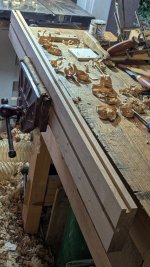
Preliminary stages of making some sliding sashes and cases. Probably 3 sliding and further fixed lights but haven't decided yet. These will be almost entirely made with handtools. I thought I'd make one sliding sash and post as a WIP if there's interest.


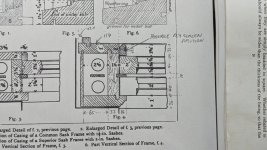
These windows will all be opening to a garden so I was thinking of integrating a roller fly screen into the design as indicated in fig 4. Has anyone done this before? The inside part of the metal housing of the fly screen runner would replace or be the staff bead and then further decorative wood casing go on the outside to hide the screen housing.

PXL_20260807_122559078.jpg

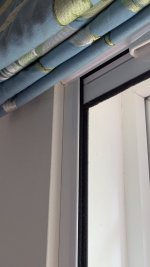
Here's a picture of a fly screen from our house. The screen housing in white here would be covered and I'd change the bottom piece to look a bit nicer. The upper mechanism would be hidden in the head lining.

PXL_20260807_122421493.jpg

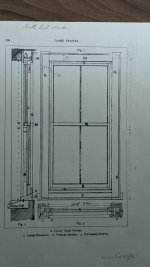
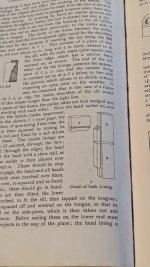
I usually print out parts of Ellis's text rather than writing over my copy. These out of print books are freely available


Attachments

  • PXL_20260807_122529527.jpg
    PXL_20260807_122529527.jpg
    108.8 KB · Views: 3
Brilliant, huge thanks in advance for this. I've been fascinated by this subject since I first lived in an older house with timber sash windows and gradually realised how there must have been small scale, pre-industrial methods that could make them efficiently enough to be commercially viable.

Skip forward several decades and I have read what descriptions I can find, acquired most of the tools needed, but not yet found an excuse for having a go at making a window I don't need! But I shall enjoy watching you, I'm sure.
 
Brilliant, huge thanks in advance for this. I've been fascinated by this subject since I first lived in an older house with timber sash windows and gradually realised how there must have been small scale, pre-industrial methods that could make them efficiently enough to be commercially viable.

Skip forward several decades and I have read what descriptions I can find, acquired most of the tools needed, but not yet found an excuse for having a go at making a window I don't need! But I shall enjoy watching you, I'm sure.
I echo Andy's sentiments. I have read the Lost art Press book on doors and windows and bought a few old wooden window sash planes but haven't had a chance to do anything with them. House built in 1940s so may redo some one day, but too many other things going on.
 
Finding the time is most of the battle and skill in making I've come to find. I've never had much luck in finding sash planes and they would certainly speed things up especially if a few needed making: but these can be made with relatively few handtools that probably most people, the ones using this forum anyway, will have.

This build will possibly be sharing time with a writing desk that I've just been informed needs to be made (with no more than a vague idea of dimensions etc, not sure whether I will be required to build drawers either)... It's quite nice though that writing is still a thing.

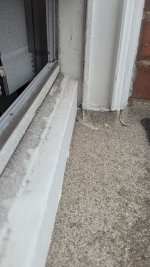
Another detail of the cased frame that will differ from Ellis is the sill. This will probably be more like the filthy one pictured with less close-to-horizontal timber. I plan to form a metal sill (probably copper) which would be attached to the vertical sill part or slip under it with a little upstand (like the concrete sill in the picture) to shed water though I haven't worked out the detail yet.

PXL_20260210_154011176.jpg
 
There are so many variations!

Here in Bristol we have what I think of as normal, with a timber cill twice as deep as yours, coming out as far as the front vertical bead, and no external architrave.

In Bath, a lot of the Georgian buildings have sashes down to the stone cills, with no fixed horizontal timber.
 
It will be good to see such a thread. I used to make them when I was an apprentice 45 years ago. I have made one or two since.
Now will you use lead weights or spirals? On a serious note will you incorporate modern draft proofing measures?
 
There are so many variations!

Here in Bristol we have what I think of as normal, with a timber cill twice as deep as yours, coming out as far as the front vertical bead, and no external architrave.

In Bath, a lot of the Georgian buildings have sashes down to the stone cills, with no fixed horizontal timber.
I have actually been to Bath. Beautiful town. But I only visited the old baths, walked around a church and ate somewhere that had giant hamburger buns as plates? I vaguely remember getting a cornish pastry before hopping back on the train.
 
I have actually been to Bath. Beautiful town. But I only visited the old baths, walked around a church and ate somewhere that had giant hamburger buns as plates? I vaguely remember getting a cornish pastry before hopping back on the train.
I think you missed the best bits!
 
Now will you use lead weights or spirals? On a serious note will you incorporate modern draft proofing measures?

Weighted sashes to be used. I've a few old weights that were donated to me years ago by a friend so will hopefully get to use those. If memory serves correctly they were quite large diameter so I would think larger than I would need though maybe not lead so we'll see: I seem to remember quite a bid of surface corrosion. I have a lot of lead scraps so maybe could form some weights though I've never tried that before.

Planning on incorporating draft proofing which no doubt will complicate things with accommodating in housings and channels and changing measurements a bit.

I can't see how to integrate and hide a flyscreen without seriously weakening the boxed casings so might put that to one side for now.

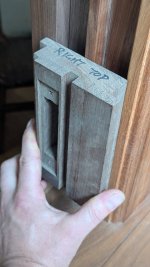
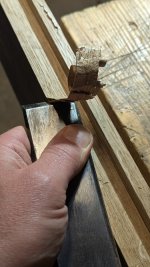
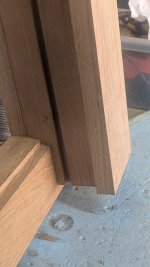
Luckily I have found my old prototype piece of a previous pully stile (I usually keep old pieces) to help visualise and plan.

PXL_20260808_140110018.jpg

Cut list in process of finalising so hopefully will buy some timber during the week.
 
Weighted sashes to be used. I've a few old weights that were donated to me years ago by a friend so will hopefully get to use those. If memory serves correctly they were quite large diameter so I would think larger than I would need though maybe not lead so we'll see: I seem to remember quite a bid of surface corrosion. I have a lot of lead scraps so maybe could form some weights though I've never tried that before.

Planning on incorporating draft proofing which no doubt will complicate things with accommodating in housings and channels and changing measurements a bit.

I can't see how to integrate and hide a flyscreen without seriously weakening the boxed casings so might put that to one side for now.

Luckily I have found my old prototype piece of a previous pully stile (I usually keep old pieces) to help visualise and plan.

View attachment 57360

Cut list in process of finalising so hopefully will buy some timber during the week.
Interesting I wonder if you could use fishing weights. If you go to an actual fishing bait & tackle store seem the good ones have a huge range of lead weights. Though i suppose its easy enough to melt with a torch if you need to sand cast some.
 
I think you missed the best bits!
I’m sure i missed a lot. Unfortunately the only time i have been to the UK was for work. We would stay in London, our office was on Bishopsgate downtown, but I would have to take a train to Slough where our datacenter was some of the times. So the trip to Bath was a quick stop after work but i had to get back (i seem to remember the last train was somewhat early)
 
I have a selection of CAD drawings for Sash windows that I plagiarised to use for my own purposes, attached is a PDF of one, which was for use on a listed and conservation project, keeping with single glazing but incorporating modern draft seals, it’s been a long time since I worked on this one, so I can’t be specific with regards the draft seals that were intended to be used, but it gives you an idea if nothing else.
 

Attachments

Interesting I wonder if you could use fishing weights. If you go to an actual fishing bait & tackle store seem the good ones have a huge range of lead weights. Though i suppose its easy enough to melt with a torch if you need to sand cast some.

I think if I'm in need of the additional weight I might try using up the scrap I already have. I hadn't considered a tackle shop. It's actually quite difficult to get weights in Northern Ireland and few companies are willing to ship over given the literal weight! My second method was to be using rolled up lead flashing which allows the cord to go through easily: not my idea but seems easy.
I have a selection of CAD drawings for Sash windows that I plagiarised to use for my own purposes, attached is a PDF of one, which was for use on a listed and conservation project, keeping with single glazing but incorporating modern draft seals, it’s been a long time since I worked on this one, so I can’t be specific with regards the draft seals that were intended to be used, but it gives you an idea if nothing else.

Brilliant, many thanks. This definitely makes things easier.
 
This is likely going to be at a leisurely pace. I thought I'd include much of the planning stage too as I sometimes find this the most challenging aspect, arguabley the most important.

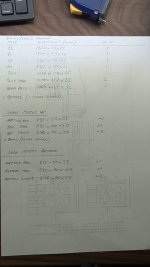
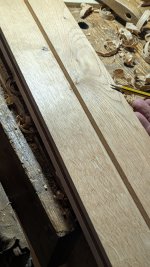
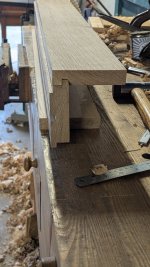
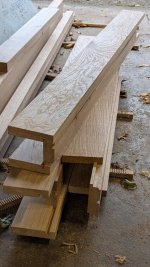
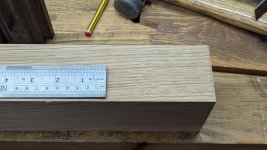
Here is my cut list, reasonabley accurate. This will be further refined, especially lengths, when I start to groove and rebate the boards but it's a start. The cases comprise a sill, 2 pully stiles and a head piece (similar to the pulley stiles). They also then have inner and outer lining pieces (perpendicular to the stiles) and inner and out head pieces. The beads will probably come from off cuts but I'll buy an extra board or 2 anyway.

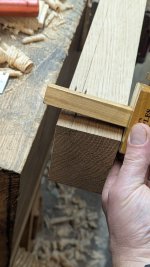
Top and bottom sashes are similar but not the same. The stiles are longer than half of the vertical reveal to accomodate horns (maybe 2 or 3 inches extra). The meeting rails are wider than the other pieces so that they can indeed meet in the middle (so I add on the parting bead width to each of these) but also a bit thinner so the middle portion doesn't look too unbalanced. The bottom rail is thicker than the other pieces.

PXL_20260810_183733498.jpg

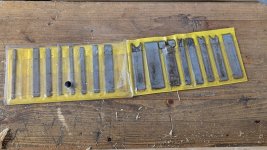
I'll probably plane out a channel to recieve a carrier piece for the various brushes and seals as per @HOJ s CAD diagram but I'll need to get a few off cuts to see whats required. For completion here is a list of seals etc provided on another thread by @GaryR and @PAC1 which should cover US and UK.

https://conservationtechnology.com/building_weatherseals_components.html

https://www.mightonproducts.com/category/sash-window-hardware/staff-and-parting/

Undecided on the wood: possibly spruce or meranti or something else. I've used a lot of oak for recent work and would prefer to work with something else, not least to save a few pounds. Certainly the outside will be painted in linseed oil paint, may leave the inside natural but not decided on that yet. I think, as long as the exterior is properly protected, sheds water well and can dry out, it'll probably last well enough. Could even just use the most durable for the sill only.
 
Back
Top