• Hi all and welcome to TheWoodHaven2 brought into the 21st Century, kicking and screaming! We all have Alasdair to thank for the vast bulk of the heavy lifting to get us here, no more so than me because he's taken away a huge burden of responsibility from my shoulders and brought us to this new shiny home, with all your previous content (hopefully) still intact! Please peruse and feed back. There is still plenty to do, like changing the colour scheme, adding the banner graphic, tweaking the odd setting here and there so I have added a new thread in the 'Technical Issues, Bugs and Feature Requests' forum for you to add any issues you find, any missing settings or just anything you'd like to see added/removed from the feature set that Xenforo offers. We will get to everything over the coming weeks so please be patient, but add anything at all to the thread I mention above and we promise to get to them over the next few days/weeks/months. In the meantime, please enjoy!

Cheap shed/ setup for outdoor MIG?

Chris152

Sapling
Joined
May 2, 2021
Messages
452
Reaction score
64
I have no space indoors for MIG welding and understand it's not much good outdoors, especially with the winds we seem to get here in Wales. I've pondered a metal shed but it seems condensation's a problem, and I'm assuming a wooden shed's not the way to go. A concrete block shed seems like it'd be good but lots of work/ money, especially as I'm looking to move from here in a few years.
Whatever we come up with it'll be for use in daylight hours, power supplied by an extension lead (assuming that'd work for a relatively low power MIG(?).
Is there any setup (screens or whatever to stop wind) that anyone uses occasionally (rather than daily) that could work for us on less windy days? A wooden frame with a tin roof and screens?
In the words of Manuel, I know nothing, so any suggestions much appreciated.
 
9fingers":35363atp said:
Unless you can keep your mig inside the house be careful that the wire does not rust.
You might be best to take the wire out to keep it dry when not in use.

Bob
Thanks Bob, duly noted. I'm happy to keep the kit (except gas) in the garage and fetch out when using.
 
I can't see a problem with a wooden building and MIG welding. I weld in my workshop, for instance. It is actually quite hard to set a wooden building alight.......but obviously, once alight they do burn quite well. You could always line the inside with skimmed plasterboard, which is fire-resistant, for peace of mind.
 
Why not have the gas in there? Its inert, if theres a fire it will put it out.

You are unlikely to set fire to a shed with it either.
For welding outside use flux core (i now wait to be told its ****, blar blar blar, cant weld with it, yak yak yak,whatever they say must be right) or set up a wind break from a drop cloth.

Move the machine indoors at night.

I know your lads just started a metal work course, do him a favour and get a stick first.

You can run it off an extension just fine,but a beefy one is better than a cheap one.

When im on a computer not my phone ill elaborate a bit more.
 
Forgot to add. We used to use a cheap plastic green house for welding on site. :lol:
 
I wouldn't run a MIG set from an extension cable unless it's completely unavoidable.

I have an old but fairly good SIP set (OK it's definitely not Miller quality). It's rated at 120A and will work on fairly thick stock, but had a 13A mains plug fitted when I got it. Changing this to 16A (blue, "commando" plug), and using it with the 16A circuit in the workshop made a big improvement to the weld quality.

It's all about ensuring the in-use voltage drop on the supply cable is as little as you can manage. Welders draw a lot of current, and anything that inhibits that is bad for welding. In the UK the biggest issue is those fuses in every 13A plug: they add significant resistance, especially if they are chained through multiple extension leads, etc. Also, the round pins of a 16A plug+socket make far better electrical connection than the rectangular ones of 13A plugs.

Also consider all the wiring back to where your mains comes into the property. My workshop is unavoidably on a spur circuit, but it's the heaviest cable I had available (rated at 60 amps I think - it was done a few years back!). This minimises the voltage drop along the cable when running the welder, or any other heavy current machine.

Incidentally, if you must run off extension cables, for any sort of heavy-current application, don't use a half-unwound cable drum - take all the cable off the drum, and spread it out. I have seen abused drums melted together by the heating effect.

Most commercially-made extension cable drums are very poor quality, with cheap cable that has thin conductors (and thin insulation). It's far better to get heavier duty flex and make your own extensions, checking you have good tight connections inside the plugs and sockets, and that those are decent quality too. It's no accident that welders come with pretty heavy mains cables!

I'm with Bob too on keeping your spools of welding wire dry. I also got a good improvement by using PTFE liner in the welder umbilical, as the wire feed has far lower friction to overcome, BUT apparently PTFE is hygroscopic (attracts moisture), so not good for your wire when not in use. It hasn't yet been a problem for me, but I only weld occasionally. Also, check both the connection to the torch inside the welder, and the quality of the ground cable and clamp. Again, the lower the resistance these are, the better and more controllable your welds will be. In the garage/workshop I can't avoid having two low current circuit breakers in series, one at the garage board and one on the main consumer unit where power comes into the property.

E.

PS: Obviously oxy-acetylene welding gases are highly flammable, but MIG welding gases are definitely not. The whole idea is to prevent oxygen getting to the puddle of weld while you are making it, done by surrounding the weld with a "shield" of inert gas. Carbon dioxide (CO2) is a cheap way to do this, but it does react with the welding arc slightly, and thus doesn't give the best results. "Argoshield" which is a mix of Argon and CO2, works really nicely for most grades of steel, but you need pure Argon for stainless steel (and anyway MIG really isn't the best system to use for that). The only common ways you will start a fire with a MIG set is either spatter, a hot workpiece or the wiring the set uses!
 
Thanks for all the replies chaps.

Mike - wooden shed it is, kept clear of potential combustibles. Would it be a good idea to have a roof with an overhang on all sides (to keep rain out) and sides that don't reach to the top to allow flow of some air to save having to use an extractor for gasses?

Dave - the bizarre thing is, it was a welder who told me not to keep the gas in the house. When we bought the lad's car it needed a bit of welding on the chassis, and I ended up with what I think might have been the worst 'professional' welder on the planet. Seriously, I might have done better with half a day's practice in terms of how it looks, but it seems solid enough. When I got it home, I told him that he had to cut it out and do it better as soon as he'd learned how. I had a few hours MIG tuition from a colleague a few years ago, he's a brilliant welder who previously worked in the ship yards and I really enjoyed it. Part of my cunning plan is that I learn to MIG too, with the lad's guidance, so I can combine metal and wood in my stuff. I've searched stick welding, it's not so good for car panels/ thinner metal?

Eric - I'm going to have to research a lot of what you've written as it's over my head, but the concern over an extension is helpful, if a bit of a stumbling block. I'd thought to get something like this:
https://www.machinemart.co.uk/p/135te-turbo-mig-welder/
Comes with a 13 amp plug, so just assumed it'd be ok but, as stated above, I really don't know - is that a relatively low power one that might be ok with an extension lead over about 10 metres? Getting electrics fitted to the 'shed' I have in mind would be a real pain.

Again, thanks for your help and patience. Heventually, I'll get there:
https://www.youtube.com/watch?v=s6EaoPMANQM
 
Chris152":33jhjb1f said:
Eric - I'm going to have to research a lot of what you've written as it's over my head, but the concern over an extension is helpful, if a bit of a stumbling block. I'd thought to get something like this:
https://www.machinemart.co.uk/p/135te-turbo-mig-welder/
Comes with a 13 amp plug, so just assumed it'd be ok but, as stated above, I really don't know - is that a relatively low power one that might be ok with an extension lead over about 10 metres? Getting electrics fitted to the 'shed' I have in mind would be a real pain.
An extension lead in and of itself isn't going to be a problem; the problem is that most commercially available 13A ones are made as cheaply as possible and can't take a sustained load. If you wire up your own with 2.5mm² arctic flex, or even H07RN-F rubber flex, you'll be fine for 10m or so. If you're going longer than that, you might step up to 4mm², but you'll have trouble getting that into your average 13A plug top.
 
I have a suppressed desire for a MiG welder. Used to use one quite a lot in my working life but no formal welding training. Hardly ever need anything welding now though.

We used air products for gases and the Argon CO2 mix was called cougar. never welded with pure CO2 but can't see it being different for most things.

I did bring home a buzz box stick welder when we closed the business as it wasn't worth selling. Welded the frame of my home work bench with it - sparks everywhere over the wooden workshop floor and no fires. Sparks are much less with MiG.

The MiG at work was on a 13A plug and I think it was about 230A rated. It was a big lump on wheels that took a full size bottle on the back platform. It was also often used on an extension lead and it wasn't a super heavy duty one. never had a problem and never blew a fuse. Thing is it was mostly welding sheet metal or tubing not maximum capacity plate. So if you are not pushing it to its limits I'd not worry too much.

I looked at your linked welder briefly. get a proper auto darkening helmet if you don't already have one as those hand shields are so awkward.

What are you going to be welding?
 
As far as fire risk, school yourself to do a timed check after finishing for the day.

Whenever we had to weld on site, we were REQUIRED to stay on site for a 30 minute check.
Naked flame required an hours wait.
 
my old workshop was in a converted water mill.......
always damp"ish and never warm.....
god fed up of binning 15kg rolls of 0,8mm mig wire.....
then one bright day decided to put a bulb holder in the base of the unit.....
it's called a batten bulb holder as I cant load the photo.....
I used an 11watt curly whirly bulb and it was left on 24x7 from Sept until March.....
along with an old Duvet over the machine.....
never a problem with rusty wire and v/grateful as all the electronics were kept warm as well....
 
right, I'm on a PC. :)
most of what is said above is what I'd have clarified.
1, don't use a premade lead, but if you want to, go to a camping shop and buy a caravan cable (it will be cheaper if you make your own as described above).
2, learn what duty cycle is. on the clarkes machines they are around 60% at 60 amps (very low current, so for thin stuff), which means that every 10 seconds of welding the machine needs 4 seconds of cool down, doesn't sound much, till you up it too 2 minutes (about a 1 foot long wide bead) then you need nearly a minute between each weld. for shorter stuff and the stuff you want it for on cars, you'll be doing inch long bead and joining them up (stops overheating of the metal and minimises distortion), so you shouldn't get near to pushing it.
3, mask, gauntlets, jacket. these are the bare minimum of PPE you NEED. 30 quid will get you an OK autodarken mask (something like a parweld), guantlets from screwfix are less than a fiver, a jacket, charity store for a cotton jacket will get you started or an old leather jacket (seriously, I wore an old leather trench coat for a while).

the clark unit will be fine if a bit temperamental on wire feed and spare parts can be awkward to come by. most of it's issues can be rectified although as a new welder you may not realise it's an issue with the unit. they are made by Telwin.

rusted wire, only the top layer, the rest is normally fine. put a moisture trap from wilkos in the bottom of the cabinet.

the clarke will also run gasless wire, which is worth knowing how to use as it isn't the same as MIG. I guess the reason your welder said don't store the bottle inside is that if it leaks it's a dense gas that can displace the oxygen. It can happen, but it's pretty unlikely, (my bottle is in the garage).
 
Chris152":16fu0zyu said:
.......Mike - wooden shed it is, kept clear of potential combustibles. Would it be a good idea to have a roof with an overhang on all sides (to keep rain out) and sides that don't reach to the top to allow flow of some air to save having to use an extractor for gasses?...........

Yep, why not? It's simple to do, and the gap doesn't have to be large (no more than the thickness of the rafter above the birdsmouth, saving the trouble of infilling between the rafters). A normal overhang will cover that perfectly well.
 
Bear in mind that welding with inert gas shielding requires ventilation at floor level as well as ceiling. Argon is denser than air and will fill a closed space from the bottom up.

There have been cases of deaths while welding in car inspection pits, for example. Your physiology is set up to detect high CO2 as a measure of poor ventilation, not low O2 as happens in these cases.

As long as there’s not a direct breeze on the weld area, a MIG should perform perfectly well. So err on the side of more ventilation, not less, when planning to weld in a little shed.

As hinted above, get into the habit of fiddling about, tidying up etc, for half an hour after welding, to make sure nothing has started smouldering.
 
Guineafowl21":2ri67c0x said:
Bear in mind that welding with inert gas shielding requires ventilation at floor level as well as ceiling. Argon is denser than air and will fill a closed space from the bottom up.

There have been cases of deaths while welding in car inspection pits, for example. Your physiology is set up to detect high CO2 as a measure of poor ventilation, not low O2 as happens in these cases.

As long as there’s not a direct breeze on the weld area, a MIG should perform perfectly well. So err on the side of more ventilation, not less, when planning to weld in a little shed.

As hinted above, get into the habit of fiddling about, tidying up etc, for half an hour after welding, to make sure nothing has started smouldering.

leave the door open. :)
 
Er, yes :D

All too tempting to shut it on a foul winter’s night, and carry on welding, I think.
 
12lpm. 1000l in a m3. How many minutes to completely displace the oxygen in a 5m3 box with only 1 outlet? Ok,how many minutes to displace 1% oxygen in air?

Short of a leak in the cylinder i am not to worried about it, kust a little draft will clear it.
 
novocaine":3monvobf said:
12lpm. 1000l in a m3. How many minutes to completely displace the oxygen in a 5m3 box with only 1 outlet? Ok,how many minutes to displace 1% oxygen in air?

Short of a leak in the cylinder i am not to worried about it, kust a little draft will clear it.
The danger isn’t constant and severe, I’ll certainly admit. It is a well known risk, though, taught to me at school.

The argon doesn’t have to disperse and evenly displace the oxygen - it’ll be concentrated around the work in the short term. If you’re lower than the work, you’ll be breathing low oxygen gas, and it doesn’t take many breaths of this to feel woozy and lose consciousness, at which point you might fall to the floor.
 
Im not dowting you, nor am i saying you are wrong. Mearly pointing out that it isnt as big of a hazard as some would have you belief and that a gentle breeze is enough to displace it rapidly. As to how many breaths, a 1.5% decrease in oxygen will knock you out.

Taught to me whilst working as a welders mate. Toxic gas calcs from what i now do for a living. Ive got the stired tank model setup in a a speadsheet for doing it properly for CO2 buildup in a temporary refuge.
 
In my woodstore I have used my old workshop but have discarded the floor and stood it on bricks all around with gaps this is to help will a little air circulation the floor is slabs. Could you not do this which will let any heavier gas flow out under the edges as well as getting rid of the wooden floor so any hot pieces that fall end up on the slabs.
I find it is dry in there with very little water ingress under the walls. Any wooden benches I stand on bricks to prevent the feet getting wet and rotting.
 
Several times in the past I thought it might be nice to have a welder. I was taught gas welding many years ago but never had the opportunity to keep my hand in. As the cost of equipment dropped I looked at the subject again some years ago and did some research. I decided for several reasons that if I did invest in it, it would be for a TIG set. I spoke to a guy at my last job who did all the welding and he agreed that TIG was best if I could afford the equipment. He even offered to teach me but sadly left before I could take up his offer. I’ve still got the deerskin TIG gloves I bought in anticipation! :D
 
Woodster":2bf7acp4 said:
Several times in the past I thought it might be nice to have a welder. I was taught gas welding many years ago but never had the opportunity to keep my hand in. As the cost of equipment dropped I looked at the subject again some years ago and did some research. I decided for several reasons that if I did invest in it, it would be for a TIG set. I spoke to a guy at my last job who did all the welding and he agreed that TIG was best if I could afford the equipment. He even offered to teach me but sadly left before I could take up his offer. I’ve still got the deerskin TIG gloves I bought in anticipation! :D

I really enjoy TIG welding - I find it a very therapeutic thing to do! MIG welding is definitely easier and much, much quicker, but it's smellier and dirtier. Stick (aka Arc aka MMA) welding is a horrible process in my opinion (I only do that when I absolutely have to and I always do it outside).

TIG takes a bit of practice (especially aluminium), but it's clean and quiet and completely under your control. I often think that stick welding is akin to an HGV (brute force), MIG welding is like a car (practical and easy) and TIG welding is like a motorcycle (elegant with lots of control of everything). Each have there place but TIG's more enjoyable (for me).
 
Agree with all that, only thing I'd add is that if I end up upside down I'd rather be in an HGV or car than on a bike. Same with welding. :)
 
Thanks for all the replies fellas - lots for me to think about.

The shed I have in mind is more like a little barn with boards on the walls (I guess you could say that of many sheds, but hopefully you get the picture) so leaving a gap top and just up from the bottom shouldn't be an issue, or maybe just a doorway with no door. Nothing will be kept in there except the bench, I think. (Again, I'm not clear what kit's needed but we'll find out).

As for type of welder, that's on hold - I'm planning on setting this up for my lad who (as Dave said above) is starting a wetalwork course next week, some time at home and some away and I want him to be able to practice while home - and teach me, of course. I've told him if he's going to be welding, he has to be the best welder he can be and from what I understand, that's all about practice. They'll be doing all types of welding and he's going to ask the tutors which type is best for practice - there's little point in me spending a few hundred £s just to discover it's not the type they'd recommend.

All that said, I know he ultimately wants to work on cars and we have one sat on the drive that I was going to pay someone to weld, using the repair panels some of you helped us cut. When he decided he wants to go down the metal/ welding route, it seemed fair to wait (the repair on the car's non-essential) til he can do it himself, hopefully next spring. Out of sight behind the rear bumper, it'll be a good first stab for him. To my 'understanding', MIG's good for that, and I'm really hoping the suggestion is we get one of those for practice, as I have lots of ideas for things to make of my own. 8-)
 
Sounds a great plan. Do you have a full set of these sons, one interested in plumbing, one keen on electrics, one good at IT... :D :D
 
If hes wanting to do body work its MIG all the way up till you reach bespoke coach building at which point TIG takes over (because ypu can position the panels to make tig easier).
But just because MIG rules the roost in bodywork doesnt mean he shouldnt learn other processes. A lot of bodywork is about knowing thw tios and tricks,keeping heat out of panels with sinks, alternate welding (1 inch then move to let the steel cool) etc. Along with plug welding and tacking and forming he should be fine.

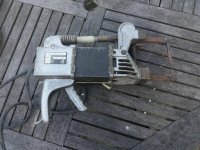
I have a toy that most bodyshops would steel if they could. Ill takr a piccie later l. :lol:

Edit: wasnt as hard to get at as i thought it would be.
 

Attachments

  • 20210907_181810.jpg
    20210907_181810.jpg
    544.2 KB · Views: 2,839
novocaine":1a2i4h7t said:
Agree with all that, only thing I'd add is that if I end up upside down I'd rather be in an HGV or car than on a bike. Same with welding. :)

:text-goodpost: :text-lol:
 
AndyT":2clz1047 said:
Sounds a great plan. Do you have a full set of these sons, one interested in plumbing, one keen on electrics, one good at IT... :D :D
No, but I have a daughter who I'm hoping will drop her plans to study psychology and focus on 'domestic science' instead. (And who'd no doubt punch me in the eye if she saw that remark. :lol: )

Not that I'd have a clue Dave, but is that for spot welding? Just looking at the two prongs.
 
Remembering this is a temporary/ makeshift 'shed', are the sides best made with sheets of ply or OSB? Essentially, they're just to keep wind out.
 
Thanks Dave. I wondered if that quantity of glue made OSB more combustable.
 
Nope. If hes chucking so much spatter that he sets fire to the shed, hes doing it wrong and wont matter what matetial you use. :lol:
 
I'll let him know!
Sheet material's v expensive now so I think 5.5mm ply @ about £25/ sheet, unless anyone says that's a bad idea.

Roof - corrugated steel? It'll have plenty of ventilation (gaps in sides top and bottom to vent), so shouldn't be any issue with condensation?
 
Well, this has been on the back boiler for some time now. And nothing's happened.
He needs to practice and it occurred to me yesterday that such a thing as a welding tent (/elephant tent) exists and could be a quicker and transportable alternative to a shed (I'm planning on moving in a couple of years). I'm looking at this one:
https://www.ebay.co.uk/itm/174643030401 ... SwKEZansBJ

I've read around on the MIG welding forum but no specific advice (it ranges from 'get a cheap old canvas frame tent and hope it doesn't catch fire', to 'build a proper workshop'). Has anyone used one of these welding tents? And what do you make of the flame retardant material - will it work?! (M2 / BS7837-1996 - I searched for it online but couldn't find any information that meant anything to me.)

Thanks for any thoughts.
 
Have you bought a MIG welder yet?

Not read all the thread but the welder would be the first thing to buy.

If it is not windy just use it outdoors. Using it you will get a better idea of what shielding is needed and how much fire safety you need.

I wouldn't buy an expensive site tent just for learning to weld. Must be cheaper options and I'd start with nothing :)
 
Thanks Robert - yes, he has a Clarke 135 TE. Outdoors on non-windy days would be ok if it weren't for the endless windiness we get here - we have the odd days of course, but the chances of that coinciding with him having time is really limited. So a tent that he can keep and take with him seems like a decent option?
 
Not sure what you are hoping to achieve with this.

A tent is a very damp place at night so you don't want to be leaving steel and equipment in it over night for rust /electrics /security reasons.

Welding environments I've been in feature heavy metal slab work tables (the earth clamp usually goes on the table) and are not clean areas due to the grinding that often follows welding. We had a welding and grinding area with extraction to keep other people safe and protect the CNC machines from abrasive dust.

I was a have a go welder and MIG is easy once you get the hang of it and understand the right wire feed for the current. I used to adjust the wire speed just by the sound the weld made. TiG is the really skilled welding. We had a guy that was an artist on stainless and aluminium with TiG.

Think I'd vote with the welding forum if you must enclose him - make a shed/ workshop of some kind. Screw it all together so you can dismantle and move?
 
It's just a space for him to practice welding bits of metal for the part-time course he's on, Robert. It seems tents are standard for use in welding pipelines and railway tracks, I was really just wondering about the one I linked to. It'd be something we put up on days he has time to practice, then take down again.

C
 
Back
Top