• Hi all and welcome to TheWoodHaven2 brought into the 21st Century, kicking and screaming! We all have Alasdair to thank for the vast bulk of the heavy lifting to get us here, no more so than me because he's taken away a huge burden of responsibility from my shoulders and brought us to this new shiny home, with all your previous content (hopefully) still intact! Please peruse and feed back. There is still plenty to do, like changing the colour scheme, adding the banner graphic, tweaking the odd setting here and there so I have added a new thread in the 'Technical Issues, Bugs and Feature Requests' forum for you to add any issues you find, any missing settings or just anything you'd like to see added/removed from the feature set that Xenforo offers. We will get to everything over the coming weeks so please be patient, but add anything at all to the thread I mention above and we promise to get to them over the next few days/weeks/months. In the meantime, please enjoy!

Exercises in bowl-making

Dr.Al

Old Oak
Joined
Dec 31, 2020
Messages
3,172
Reaction score
1,388
Location
Dursley, Gloucestershire
Name
Al
I've posted a few things recently in the "Post a photo" thread with my trials and tribulations of trying to get vaguely competent at bowl turning.

I had another go this afternoon and, rather than cluttering up the "Post a photo" thread with lots of photos, I thought I'd start a new one. I started with a couple of the Iroku bowl blanks made from some pieces that @Malc2098 had kindly given me.

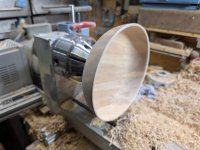
I started by turning the outside of both blanks. This is what the first one looked like after bowl gouging...
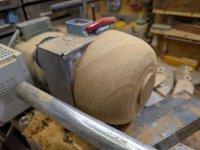
2025-10-19-01-first-bowl-outside-tool.jpg

... and after not too much sanding:

2025-10-19-02-first-bowl-outside-sanded.jpg

I wasn't completely sold on the outside shape of that first one, so I rounded the second one a lot more. I prefer this shape:

2025-10-19-03-second-bowl-turned-nicer-shape.jpg

Again, not much sanding was needed:

2025-10-19-04-second-bowl-outside-sanded.jpg

The inside of the first one went quite smoothly, although I'd like to get better at getting a smoother internal finish off the tool. Admittedly, I didn't try using any scrapers on this one (which might have helped); this is straight off the bowl gouge. This is miles better than any of my previous attempts at getting a smooth finish on the inside of a bowl and, while it still took a fair bit of sanding, it's a step in the right direction.

2025-10-19-05-first-bowl-inside-tool.jpg

Sanded:
2025-10-19-06-first-inside-sanded.jpg

The second bowl was less successful:

2025-10-19-07-second-bowl-failed-during-hollowing.jpg

I'd already drilled the centre out (to give a depth mark), so there isn't enough material there for me to cut a new tenon of some sort, so I think that one will have to go in the firewood pile.

After a small amount of cursing, I remounted the first one with the Cole jaws and had a go at an @AndyP style foot:

2025-10-19-08-first-bowl-finished-base.jpg

To keep things nice and simple, I went with a Mike's Magic Mix finish after removing it from the lathe. One coat applied:

2025-10-19-09-first-bowl-mmm.jpg

That's it for now, but no doubt I'll have a few more goes over the next few weeks. I want to get the practice in before it gets too cold to have the garage door wide open.
 
Very good Al. Shape and proportions are all part of the hard to define artistic element of woodturning bowls.
So you’ve made your own lathe, made you own tools, just need to fell your own timber too now.
Oh and don’t forget to sign them.
 
I've posted a few things recently in the "Post a photo" thread with my trials and tribulations of trying to get vaguely competent at bowl turning.

I had another go this afternoon and, rather than cluttering up the "Post a photo" thread with lots of photos, I thought I'd start a new one. I started with a couple of the Iroku bowl blanks made from some pieces that @Malc2098 had kindly given me.

I started by turning the outside of both blanks. This is what the first one looked like after bowl gouging...

View attachment 36285

... and after not too much sanding:

View attachment 36286

I wasn't completely sold on the outside shape of that first one, so I rounded the second one a lot more. I prefer this shape:

View attachment 36287

Again, not much sanding was needed:

View attachment 36288

The inside of the first one went quite smoothly, although I'd like to get better at getting a smoother internal finish off the tool. Admittedly, I didn't try using any scrapers on this one (which might have helped); this is straight off the bowl gouge. This is miles better than any of my previous attempts at getting a smooth finish on the inside of a bowl and, while it still took a fair bit of sanding, it's a step in the right direction.

View attachment 36289

Sanded:
View attachment 36290

The second bowl was less successful:

View attachment 36291

I'd already drilled the centre out (to give a depth mark), so there isn't enough material there for me to cut a new tenon of some sort, so I think that one will have to go in the firewood pile.

After a small amount of cursing, I remounted the first one with the Cole jaws and had a go at an @AndyP style foot:

View attachment 36292

To keep things nice and simple, I went with a Mike's Magic Mix finish after removing it from the lathe. One coat applied:

View attachment 36293

That's it for now, but no doubt I'll have a few more goes over the next few weeks. I want to get the practice in before it gets too cold to have the garage door wide open.
If you havent finished the inside of the bowl with the broken tenon just glue it back - cut a few little bits off, it's a clean break.
 
I've done the last few bowls by using the old schoolboy trick of glueing a paper shim between the job and a sacrificial piece of material, which is then held in the chuck jaws of choice; once the turning has been finished, I tap the paper with a chisel to break the glue bond to release the bowl. This gives an extended section for creating a 'foot' in the Cole jaws. As the blank is now an extra 20mm (say) away from the chuck, I can turn the outside and inside without removing it from the chuck. Cunning:cool: - Rob
 
Dr.Al, I think you are making things unnecessarily difficult for yourself by choosing such deep blanks to tackle whilst getting to grips with which tool and approach suits you best when hollowing out.

I think you would gain the knack of avoiding catches and best presentation angles 'for you' working with shallower subjects rather than tackling deep subjects with a bowl gouge.

We are all different, I know for certain that a purist wood turner would be appalled at some of my approaches to wood removal if they were to see them but at the end of the day speedy removal of waste material in a safe manner gives you more time to concentrate on form and finish.

Smoothing out internal contours with a smaller close supported round nosed scraper (conventional or negative rake) held above centre is far less risky and easier than trying to keep a conventional bowl gouge riding on its bevel.

Unless your personal aim is to become a purist wood turner I'd say don't be afraid to mix and match your metal turning techniques.
 
Thanks @CHJ, that's really useful. I think part of the reason for choosing the deeper bowls was to try to stretch myself (on the premise that, if I can figure out how to do deep bowls, I'll be okay with almost any bowl†). I'd felt like I knew what I was doing with scrapers (not that I'd mastered it, but I at least knew what I was trying to do) but wasn't close to that with bowl gouges, so focusing on the latter would help me.

I haven't had any catches at all in the last few bowls I've turned, so it feels like I've turned (no pun intended) a corner there. Getting to the point of having a smooth internal surface definitely needs more work. Perhaps that'll end up being scrapers (or something else), but it's still feels good to practise the gouge.

† Where "almost any bowl" here means "almost any fairly simple bowl" and certainly doesn't include interrupted cuts on wavey edged bowls and such-like!

Unless your personal aim is to become a purist wood turner I'd say don't be afraid to mix and match your metal turning techniques.

I'm not really sure what my overall aim is, but probably just to feel comfortable with the tools. I have no aspirations to be a wood turner at all really, so certainly not a purist one. I just want to be able to set up the lathe and turn something for a project with the confidence that I know what I'm doing with the tools I pick and that the piece of wood I've chosen is at least relatively unlikely to end up on the firewood pile.
 
If you haven't finished the inside of the bowl with the broken tenon just glue it back - cut a few little bits off, it's a clean break.

Well, we'll see how it goes. I didn't have much time this evening, but I figured I could find enough for a bit of gluing. I also wanted to apply another coat of finish to the other bowl, so I daubed that on (probably a bit excessively thickly) and, while that was resting for a few minutes (before being wiped off), I brushed some glue onto both sides of the broken tenon....

2025-10-20-01-glue-applied.jpg

... and then clamped it to the bench...

2025-10-20-02-clamped.jpg

... before wiping off the excess glue and then going back and wiping off the excess finish on the other bowl.

I'll have to tweak the outer shape a bit (as it gained a couple of dents after flying across the workshop!) and then there's loads more hollowing out to do, but if it fails I won't be any worse off than I am at the moment, so it can't hurt to try.
 
Had half-an-hour free so I thought I'd pop out and see how the broken bowl looked. I popped it in the Cole jaws to true up the tenon:

2025-10-21-01-truing-up-tenon.jpg

Then remounted in the O'Donnell jaws ready to have another go at hollowing it out:

2025-10-21-02-remounted.jpg

I stopped to adjust the rest position; looking good so far:

2025-10-21-03-so-far-so-good.jpg

Maybe a bit too aggressive a cut. It had been working so well up to this point (including with even heavier cuts). I probably should have been more cautious so far out given the torque equation and all that:

2025-10-21-04-nope.jpg

I've glued the tenon back on again (with some newer glue in case that makes a difference). I'll keep trying as I've nothing to lose; it's all good practice! I might need to use some different jaws for the next attempt though: if I take much more off that tenon when truing it up the O'Donnell jaws won't tighten on it.
 
Out of interest, did it break on the glue line second time around?
 
Well the glue had been setting since yesterday and I figured that was probably enough. The bowl went back in the Cole jaws again to true up the tenon (again!):

2025-10-22-01-back-in-cole-jaws.jpg

I only took a very light pass (and probably should have cut a bit more to get it running truer):

2025-10-22-02-light-skim-on-tenon.jpg

As I'd taken such a light pass, I could still put it in the O'Donnell jaws. Hollowing out went fairly smoothly (this photo is after bowl gouge and scraper):

2025-10-22-03-bowl-gouge-and-scraper.jpg

I also needed to take quite a bit off the outside (as it wasn't running true as I hadn't taken enough off the tenon), but I could do that in the same setting. After doing that and sanding, it looked like this:

2025-10-22-04-sanded-inside-and-turned-and-sanded-outside.jpg

I could then put it back in the Cole jaws for the umpteenth time...

2025-10-22-05-back-in-cole-jaws-again.jpg

... and turn off the tenon (and all the glue!):

2025-10-22-06-bottom-finished.jpg

After breathing a sigh of relief, I took it off the lathe and gave it a coat of Mike's Magic Mix. Here it is (on the left) just after the first coat was applied, and next to the other one I was originally making at the same time:

2025-10-22-07-first-coat-of-mmm.jpg

The newer one is quite a bit smaller. That'll be partly because of all the truing up I did over and over again, but I think it started a bit smaller as I took more off when shaping the outside the first time round.

This shows a side view of the two bowls. I definitely prefer the shape of the newer one:

2025-10-22-08-better-view-of-shape.jpg

I think this bowl is one I'll keep, if only to remind me of the ordeal I went through making it and to remind me that glue is quite strong really 😁
 
Nice Dr.Al! As a suggestion, if you were to leave say, 6-7mm more material on the tenon, this could be turned into a decorative 'foot' to add a little 'je ne sais quois' to the bowl. Merely an idea to ponder for the next one(s) - Rob
 
Nice Dr.Al! As a suggestion, if you were to leave say, 6-7mm more material on the tenon, this could be turned into a decorative 'foot' to add a little 'je ne sais quois' to the bowl. Merely an idea to ponder for the next one(s) - Rob
Thanks Rob. I think I might have done that on an early bowl (I really can't remember now!) I doubt it was "decorative" in the sense that you would do, but it was mostly still present, so that's part of the way there. I've quite liked the fairly plain ones so far (with just enough of a "lip" to make it look like it's floating ever so slightly above the table).

For this one I just wanted to get rid of any remaining evidence of the glue line and that meant there wasn't anything left for anything but a fairly flat bottom.
 
I really like the bowls that have spalted wood, maybe with some holes, and an uneven rim. I have no idea how they are made but if I ever retire I might try to do that.
 
If you have a particularly interesting or expensive blank and wish to make the most of it you can hot melt glue a piece of scrap to it or use a paper joint. You can then either turn a tenon or screw it to a faceplate thus wasting none of the original blank. Don't be afraid of hot melt - the pro turner at the club I used to belong to used three glue guns at a time on blanks weighing 50kg. When I use it I put a 1mm spacer between the waste and the blank allowing a heated knife to slide between them for removal, it can be a pig to seperate otherwise. It's handy for thin trays and platters where screws can't be used anyway.
 
Thanks Phil.

I think I need to learn to trust glue a bit more. I've spent most of my career trying to get rid of glued joints from production processes as it can introduce all sorts of problems, but most of those relate to making a hundred thousand parts a year and aren't really relevant for the home workshop.

I've always been astonished that you can superglue a (metal) part to a block of aluminium held in the chuck of the metal lathe and then proceed to hog off lots of material from the stuck-on part. As long as you don't let the part get too hot, it works really well. There's absolutely no reason why a wood lathe would be any different (apart, perhaps, in choice of glue); it's just a mindset thing to overcome my wariness. I've been through that on the metal lathe and I'm sure I can do the same for the wood one!
 
That's a whole other level & way beyond anything I can even aspire to at the moment :)

The weird shapes are not as difficult once you learn to keep fingers away (sorry for hijacking this @Dr.Al ) but below is an old bit of firewood I had a bash at, I filled the hole with some red resin and turned away anything that wasn't a bowl. the finish never even dried when my sister came into the workshop and said "oh that would look nice on my table with lemons in it" and spirited it away.

You should have a bash as it is certainly more 'interesting' than turning bowl blanks.
20220418_134008.jpg
 
Well the glue had been setting since yesterday and I figured that was probably enough. The bowl went back in the Cole jaws again to true up the tenon (again!):

View attachment 36325

I only took a very light pass (and probably should have cut a bit more to get it running truer):

View attachment 36326

As I'd taken such a light pass, I could still put it in the O'Donnell jaws. Hollowing out went fairly smoothly (this photo is after bowl gouge and scraper):

View attachment 36327

I also needed to take quite a bit off the outside (as it wasn't running true as I hadn't taken enough off the tenon), but I could do that in the same setting. After doing that and sanding, it looked like this:

View attachment 36328

I could then put it back in the Cole jaws for the umpteenth time...

View attachment 36329

... and turn off the tenon (and all the glue!):

View attachment 36330

After breathing a sigh of relief, I took it off the lathe and gave it a coat of Mike's Magic Mix. Here it is (on the left) just after the first coat was applied, and next to the other one I was originally making at the same time:

View attachment 36331

The newer one is quite a bit smaller. That'll be partly because of all the truing up I did over and over again, but I think it started a bit smaller as I took more off when shaping the outside the first time round.

This shows a side view of the two bowls. I definitely prefer the shape of the newer one:

View attachment 36332

I think this bowl is one I'll keep, if only to remind me of the ordeal I went through making it and to remind me that glue is quite strong really 😁
I do like the second deep bowl it came out really well
 
After a bit of a tidy-up today, I thought I'd have another go at a fairly small bowl so see if all the practice of turning bigger deep ones has helped. Out of curiosity I also had a stopwatch running so I could see how long it took (not that it matters really).

This was the sweet chestnut blank I started with (cut from an off-cut from my garden table build or possibly the earlier travel tool chest):

2025-10-24-01-sweet-chestnut-blank.jpg

This was the resulting bowl (which hasn't had any finish applied yet):

2025-10-24-02-sweet-chestnut-bowl.jpg

That took me 22 minutes in total and that included all the time moving the soft pads for the Cole jaws into the right place as well as a bit of time trying to remember where I'd put the sandpaper! By contrast, when I made the elm and walnut bowls in this linked post I think I spent more time than that just on the 80 grit sandpaper (hence the frustration I expressed in that post). I'm definitely going in the right direction I think.

I had one exciting moment though - I think I was running the lathe a bit quick when I had the Cole jaws on. I'd finished the last bit of sanding so I hit the stop button to stop the lathe. The spindle stopped quite quickly. The chuck stopped less quickly and unscrewed itself. I rather stupidly reached out and caught the unscrewing chuck, saving the bowl but taking a (thankfully small) chunk out of my finger in the process. It would have been better to (a) run the lathe a bit slower and (b) turn the speed down rather than just hitting stop.

The other chuck (which you can see in the background of the second image) has an "ASR flange" on it that can be used as a safety feature to stop it unscrewing (even if you run the lathe backwards). I've got the clamp to go with it but it needs a minor spindle modification on the lathe, which I haven't got round to doing. The chuck also has some threaded holes for grub screws to clamp onto the bit of the spindle between the thread and the register, but I never bothered to tighten them up and as a result the grub screws have long since worked their way loose and disappeared. I'm sure I've got some of the right size in a drawer but again, I've never bothered to replace them.
 
@Dr.Al,
Next time you have a shallow blank you wish to maximize why not fit a sacrificial holding spigot from the off.

If you don't mind referring to old threads elsewhere these images might be of interest in showing how I've supported awkward pieces whilst roughing out.

If you do attempt a Natural Edge piece there is no reason not to use the same or similar initial support methods, just remember that once you have started on the bark rim areas finish as far as possible as you go never try to go back as it's most likely the edge will have moved.
 
@Dr.Al,
Next time you have a shallow blank you wish to maximize why not fit a sacrificial holding spigot from the off.

If you don't mind referring to old threads elsewhere these images might be of interest in showing how I've supported awkward pieces whilst roughing out.

If you do attempt a Natural Edge piece there is no reason not to use the same or similar initial support methods, just remember that once you have started on the bark rim areas finish as far as possible as you go never try to go back as it's most likely the edge will have moved.
That's really useful (and very well written) tutorial, thanks Chas.
 
A bit more Iroku bowl practice today and I had a success rate of 1 out of 3. That's not great, but I'm actually not that unhappy about it. The two that broke went really well up until the point of failure and I think I know what I did wrong, so that counts as progress in my book.

I started with a pair of relatively narrow but quite deep blanks. I wasn't really sure what I was aiming for, but I figured I'd do two at a time again:

2025-10-25-01-two-more-blanks.jpg

The first one got left mostly full-size and I was really pleased with the finish straight off the tool. There were some tool marks in the tightest bit of the curve (visible at the bottom right in the following photo) but I think I could have dealt with them with a gouge if I had noticed them before starting sanding. It was close enough (as were all the bowl attempts in this post) that I felt comfortable starting with 120 grit rather than 80 grit.

2025-10-25-02-tool-finish.jpg

For the other one, I thought I'd do something a bit different. I turned a cylinder on the base rather than a short dovetail tenon. I also shortened the bowl quite a lot because I wanted one that wasn't too deep and hence would be a bit easier. Again, this is the tooled finish ready for sanding:

2025-10-25-03-tool-finish-cylinder-end.jpg

The first (deeper) bowl got the outside finished with sanding sealer and beeswax; the second one I left unfinished for now. Hollowing out of the big one felt like it was going quite well (although I struggled to get a smooth finish straight off the gouge at the "peak" of the curve down in the bottom of the bowl. When I got the scraper out I think I'd already gone a little thin on wall thickness and I think I plunged it a little hard and it broke:

2025-10-25-04-going-so-well-but-broke.jpg

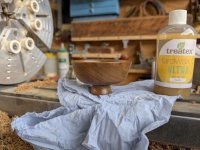
The smaller one went very smoothly though with nothing "exciting" happening at all! One quite nice thing about bowls is that, being quick to make, I don't mind trying out new/different finishes. Usually by the time I've finished a box or whatever, there are so many hours sunk into it that I really don't want to take any risks so I just fall back on old faithful (Mike's Magic Mix). For this little bowl I tried out some hardwax oil:

2025-10-25-05-trying-out-new-finish.jpg

Another view, showing the "foot" that was shaped after hollowing:

2025-10-25-06-another-view.jpg

Close-up, just because my new-ish phone camera can do close-ups!

2025-10-25-07-super-close-up.jpg

Having broken the deeper bowl, I thought I'd have another go at a deeper bowl, so I got another one of those blanks out and did so. All went well up to the point of finishing hollowing (and applying sanding sealer & beeswax):

2025-10-25-08-another-attempt.jpg

I'd left a big-ish tenon on the base (although not as big as on the small bowl above). When I had the bowl mounted in the Cole jaws to shape that tenon into a foot, the bowl came out of the jaws. I was being quite wary of overtightening the jaws (so as not to break the relatively thin rim of the bowl) and I think I didn't tighten it enough. I then had a small "catch" and the bowl launched itself out of the garage door, resulting in a big crack:

2025-10-25-09-cracked.jpg

A bit disappointing, but like I said: I'm still happy with how it went in general. What I definitely should have done is added some tailstock support rather than relying entirely on the Cole jaws - even with a pointy tailstock centre (which would have left a mark), it would have been easy enough to deal with the centre mark after the rest of the shaping was done.
 
.... even with a pointy tailstock centre (which would have left a mark), it would have been easy enough to deal with the centre mark after the rest of the shaping was done.....
Next project: Turn yourself a wooden cap for your Live Tailstock Centre, even fit a self adhesive felt pad on the end.

Cap.jpeg

Also makes a good elbow protector when tailstock is retrieved down the lathe bed.
 
The next attempt at a narrow but deep bowl went pretty well all things considered. The only thing I wasn't entirely happy with was the size of the foot. I was aiming for something a bit bigger, but when I'm turning, things often end up slightly smaller than initially planned due to having to clean up the shabby effects of the first attempt!

2025-10-25-10-small-foot.jpg

I'm still pleased with the overall result though:

2025-10-25-11-still-pleased-with-it.jpg

That's the last of the narrow but deep Iroku blanks. I've still got a couple of the bigger diameter ones, but I thought I'd try something different instead. I hot-melt glued a bit of Sweet Chestnut to a bit of Cedar of Lebanon:

2025-10-25-12a-glued-on-sweet-chestnut.jpg

The chestnut got made into a cylinder and the Cedar of Lebanon into a bowl shape:

2025-10-25-12-sacrificial-tenon.jpg

When nearing the end of hollowing it out, it cracked, with a chunk coming out and a long crack emanating along the wood. I'd forgotten how brittle Cedar of Lebanon is; I probably should have been more careful. I decided to carry on anyway, pouring lots of thin superglue into the crack:

2025-10-25-13-crack.jpg

I then skimmed the rim down a fair way (feeling pleased I had the Sweet Chestnut sacrificial tenon as there wouldn't have been much bowl left without it) and did my best to clean up the inside. The thin superglue had wicked into the wood so however much I sanded it, the colouring wasn't going anyway so in the end I stopped when it looked like this:

2025-10-25-14-superglue-still-visible.jpg

After applying some sanding sealer and beeswax, it's still visible but not looking too bad really (when Carolyn saw it she thought it was just an unusual bit of wood grain):

2025-10-25-15-superglue-after-waxing.jpg

Back to the Cole jaws to get rid of that Sweet Chestnut lump:

2025-10-25-16-remounted.jpg

Nearly all gone:

2025-10-25-17-tailstock-support-for-as-long-as-possible.jpg

Gone, and the base sanded, sealed and waxed:

2025-10-25-18-base-finished.jpg

The finished bowl:

2025-10-25-19-finished-col-bowl.jpg

I'm still not all the way there, but I'm definitely feeling more confident with bowls than I was a week or so ago.
 
crack.jpg

When you see End-grain tear-out appearing try soaking the area in sanding sealer to swell fibres and support the weak end grain.

If final finish does not involve sanding sealer (oils etc.) then just use water.

Freshly sharpened cutting edge is given of course.
 
I finished another bowl a day or two ago. I'm pleased with the end result but still not entirely happy with the process, but more on that later.

It started like this:

2025-10-30-01-started-like-this.jpg

Then became this:

2025-10-30-02-then-became-this.jpg

I then started hollowing out the inside, which seemed to go well mostly. However, I made the mistake of trying to clean up the surface near the rim with a scraper. I'm not entirely sure what happened, but having read Richard Raffan's book on turning, I found the quote:

Richard Raffan in Taunton's Complete Illustrated Guide to Turning said:
... I never use a scraper flat on the rest anywhere near the rim of the bowl. If you have torn grain or chatter marks near a rim that resist removal with a gouge, shear scraping might do the job, but heavy sanding is a lot safer.

I wish I'd read that before trying it! Scraping left a lovely finish at the bottom of the bowl, but when I tried near the rim, the bowl snapped into two pieces with a big chunk going flying across the workshop.

I retrieved it, glued it back on with Titebond 3 and lots of masking tape and then daubed Ultra-Thin superglue all over the rim area inside and out (just because why not).

When that had been left for plenty of time to dry, I remounted it in the chuck and bowl-gouged it again inside and out (resulting in quite thin walls, but thankfully thick enough) and then did lots of sanding. That was followed with Cole jaws to get rid of the sacrificial bit of Sweet Chestnut and clean up the bottom and then it got a couple of coats of hard wax oil:

2025-10-30-03-top-view.jpg2025-10-30-04-side-view.jpg2025-10-30-05-closer.jpg

As I said, I'm pleased with the result, but still don't feel like I've mastered hollowing yet. You can see the crack if you look very closely but I don't think anyone who doesn't know it's there would notice it. Even knowing it's there it takes me quite a long time to find it.

I am starting to get a bit fed up with bowl turning if I'm honest, but I'm going to keep going until I have at least managed to make one bowl start-to-finish without anything untoward happening and without needing to do a sizeable amount of the shaping with sandpaper.
 
The bowl looks pretty good to me. Well done for continuing after seeing half of it fly across the workshop which is something I have never experienced.
have you considered using a screw chuck to start off with? The screw going into what will be the inside of the bowl. Shape the outside of the bowl leaving a ¼” stub tenon to hold in the chuck while attacking the inside. Button (cole) jaws then used to remove the tenon and finish the base.
This wont help your tool finish sanding woes but I have never felt comfortable gluing on a stub tenon like that.
 
The bowl looks pretty good to me. Well done for continuing after seeing half of it fly across the workshop which is something I have never experienced.
have you considered using a screw chuck to start off with? The screw going into what will be the inside of the bowl. Shape the outside of the bowl leaving a ¼” stub tenon to hold in the chuck while attacking the inside. Button (cole) jaws then used to remove the tenon and finish the base.
This wont help your tool finish sanding woes but I have never felt comfortable gluing on a stub tenon like that.
Thanks Andy. Yes, most of my bowls were made with screw chucks (mostly these two although I've got another one with a big central screw that came with the chuck).

Only the last two have had glued on bits as I thought it would be interesting to try @CHJ's suggestion & lose less of the bowl to tenon.[/URL]
 
Last edited:
@Dr.Al
Richard Raffan in Taunton's Complete Illustrated Guide to Turning said:
... I never use a scraper flat on the rest anywhere near the rim of the bowl. If you have torn grain or chatter marks near a rim that resist removal with a gouge, shear scraping might do the job, but heavy sanding is a lot safer.

Understanding what is happening here is important to tackling this problem.

Remember that every time a 'conventional' bowl blank rotates it presents side grain and end grain twice to the cutting tool.

If you were using a hand plane on bench stock you would not get very far trying to attack end grain with a straight full width blade, you would either use a skew blade or present the straight blade in a skew fashion to slice the end grain as opposed to chopping it.

"Try cutting a pencil in half with pen knife"

So whatever the cutting edge that is being presented it needs to be presented as a slicing action across the end grain so that you are not trying to Chop it.

Any chopping action load is also intensified by the fact that a conventional bowl blank will go out of round as the internal stresses are released, it may be only half a millimetre or so and of no consequence when sanding.
However the shock loads to a straight chopping action cut will rapidly compound to increase the distortion and cause the tool to dig itself ever deeper into the wood.
 
Morning all

Speaking of screw chucks and Richard Raffan ...


A really useful and informative YouTube channel

Cheers

Dave
 
@Dr.Al


Understanding what is happening here is important to tackling this problem.

Remember that every time a 'conventional' bowl blank rotates it presents side grain and end grain twice to the cutting tool.

If you were using a hand plane on bench stock you would not get very far trying to attack end grain with a straight full width blade, you would either use a skew blade or present the straight blade in a skew fashion to slice the end grain as opposed to chopping it.

"Try cutting a pencil in half with pen knife"

So whatever the cutting edge that is being presented it needs to be presented as a slicing action across the end grain so that you are not trying to Chop it.

Any chopping action load is also intensified by the fact that a conventional bowl blank will go out of round as the internal stresses are released, it may be only half a millimetre or so and of no consequence when sanding.
However the shock loads to a straight chopping action cut will rapidly compound to increase the distortion and cause the tool to dig itself ever deeper into the wood.
That's incredibly useful, thanks @CHJ. That'll help a lot with getting my head round what's going on.
 
Back
Top