• Hi all and welcome to TheWoodHaven2 brought into the 21st Century, kicking and screaming! We all have Alasdair to thank for the vast bulk of the heavy lifting to get us here, no more so than me because he's taken away a huge burden of responsibility from my shoulders and brought us to this new shiny home, with all your previous content (hopefully) still intact! Please peruse and feed back. There is still plenty to do, like changing the colour scheme, adding the banner graphic, tweaking the odd setting here and there so I have added a new thread in the 'Technical Issues, Bugs and Feature Requests' forum for you to add any issues you find, any missing settings or just anything you'd like to see added/removed from the feature set that Xenforo offers. We will get to everything over the coming weeks so please be patient, but add anything at all to the thread I mention above and we promise to get to them over the next few days/weeks/months. In the meantime, please enjoy!

Post a photo of the last thing you made...

Last full day of the holiday so it didn't seem sensible to start a new box project, but I thought I'd finally have a play with some tools my other half bought me for my birthday:

1758470299338.png

Okay, it's not going to win any awards, but I was quite pleased with it for my first finished spoon.

1758470346786.png

Made out of lime (which seemed an appropriate choice as it's what's usually recommended for beginner carvers I think).

Tools and PPE for scale:

1758470393289.png

The process reminds me a bit of turning bowls on the wood lathe: most of the wood gets turned into waste and part of the art seems to be knowing when to stop! I definitely could have fettled a lot more and refined the shape, but I was getting more and more nervous of doing something irreparable so I decided to call it quits.
 
We bought a couple of Winnie the Poo prints a few years ago, framed (so called) in hideous wannabe plastic wood:

IMG_5597.jpeg

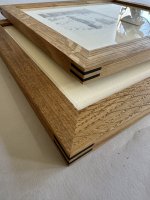
...and as the final part of a bedroom paint job, they were re-framed in quarter sawn oak with Bog Oak splines:

IMG_5640.jpeg

IMG_5644.jpeg

Artglass AR70 used as well, which needs to be handled with care as each bit for these two pics was about £25+

IMG_5642.jpeg

I also used 1.6mm picture cord as the braided steel stuff I've used for decades eventually frays!...I had a very close call a couple of weeks ago with a largish mirror. Acid free backing board as well. Finished with a coat of Odie's Oil and Butter - Rob
 
Nice Rob, I like the splines too. Not sure why but I’ve always found it very satisfying applying wet gum arabic tape to the back of pics, I think it may be the way it sort of moulds itself to the profile, also unlike a lot of tapes it doesn’t fall off after a few years.
 
Nice Rob, I like the splines too. Not sure why but I’ve always found it very satisfying applying wet gum arabic tape to the back of pics, I think it may be the way it sort of moulds itself to the profile, also unlike a lot of tapes it doesn’t fall off after a few years.
Even picture framers tape does not last forever. I had to redo a couple of prints a week of so ago.
The stuff I use is Japanese and readily available at Amazon and elsewhere. It's really very 'icky' and once stuck to card or bare wood, is extremely reluctant to come off..except that this time, being a numpty, I didn't mask off the back of the frame where the tape was going to go. It didn't stick to the polished oak! - Rob
 
I got an unusual commision (well for me at least). It involved this bit of 2" thick Scottish Elm as well as a 4" block. The elm was too thick and well seasoned (translates to bloody hard). I needed an 11" x 1" board about 22" long. Cutting to length was easy as was squaring off and cutting to width but thickness was another matter entirely, I ran it through my table saw which only could cut 3" in from each edge and went back to my roots and broke out the handsaw (this was when I remembered that they invented power tools for a reason and I'm pretty sure that reason was hard elm). Anyway all parts got roughed out and left in the house to acclimate for a couple of weeks.
View attachment 29383

First to the 4" block it was to be turned and made into this shape.

View attachment 29384

It was then inserted into the end of this old 75mm shell case, British army circa 1972 (I had alread fixed the badge on by this point).

View attachment 29385

The shell case belongs to an old family friend who served in the SAS Regiment and was involved in the Battle of Mirbat in 1972 (https://alanmalcher.com/2021/12/14/...-july-1972-22nd-special-air-service-regiment/), the shell was one which his friend had been firing (he was operating a 3 man gun on his own against around 250 charging insurgents, the chap firing the gun was firing, unloading and sighting down the open breach until he saw the enemy in the barrel, loading and firing. he stayed in that gun emplacement until he was shot and died from his wounds. I was asked if it were possible to mount a cap badge to the shell case (this in itself took a bit of finding as apparently the SAS are one of the few regiments who only have cloth cap badges), plug the end of the shell and mount it on a stand. The ultimate goal is that it will be presented to 22 SAS and will live in their officers mess as a memorial to those that died in the battle.

So, hand cut a couple of shallow mortices and stub tenons.and made a couple of brackets to hold the shell.

View attachment 29386

There is a plaque being made which will sit on the elm board, unfortunately I dont have it yet.
View attachment 29387
Who remembers this?

Thought I would post an update as life came along and (as life does) hit Bernard a kick that no one was expecting. On his 83rd birthday Bernard was diagnosed with acute liver failure (for a man who doesn't drink he was shocked) on top of this he was also diagnosed with a tumour in his brain. He is now on medication to make life easier and is responding well but he never did get around to sorting out the brass plaque for his shell casing. This was something which was causing him great anxiety, I had a chat with him about what he wanted and after a bit of back and forth we came up with some wording. This was the proof from the engravers.

Screenshot_20250925_153431_M365 Copilot.jpg

With Bernard happy with the wording i went ahead and ordered the plaque. it arrived last week and I fitted it on Saturday.

20250920_162537.jpg

All that remains now is to get it to Hereford. Bernard has said that he would love to make one more trip but also knows that he isn't fit. He said that death is coming but he is not scared as he has kicked death in the balls to many times, its his turn now. My son is a Royal Marine Commando and has said that he would be honoured to deliver it so we are hoping to get it to Hereford before Brenard faces his last battle.
 
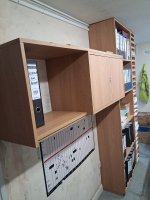
Finally got the office furniture finished yesterday, I’d fitted the main units a couple of weeks ago, which they’ve started using, but they asked for shelves & end panel on the end of the locking unit which I’d had to wait for.
Luckily for me @Bungle needed his wood welder repairing so he dropped of extra pieces when he bought that down.
20250927_102121.jpeg

20250927_102136.jpeg

This made me smile this week a chap dropped off a cupboard at the workshop to be cut down, he’d got his measurements wrong & bought a fridge too high for the gap in his kitchen & could I cut 80mm off it.
I was dubious about doing it as as I explained to him the door could fall to pieces taking 40mm off top & bottom, as he was unconcerned I did as instructed.

20250926_162322.jpeg

Looks wrong to me but he was delighted particularly on the stain match on the new ovolos top & bottom.

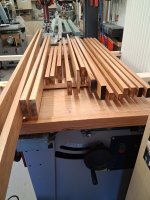
Tomorrow will be an oak trimming day,

20250925_165310.jpeg

I’m replacing all the softwood trim on an oak combination doorframe & windows with oak, I ran this all out on Friday then gave it a coat of oil, not a very exciting shape but the customer wants a modern look so that’s what they wanted.
Oak is getting to be a ridiculous price, this was just over a cubic foot & worked out at nearly £80 a cube
 
Last edited:
His what?
It’s an old one of these Mike

It produces a radio frequency that sets water based glues so saves enormous amounts of time in a production shop. You just put the paddle on the glued & clamped joint pull the trigger & the radio frequency cures the glue.
I don’t know if all the machines are the same but Jon’s has 4 big valves in his & I have a good mate who back in the day worked for Carlsbro & there isn’t much he doesn’t know about valves & electronics.
Ironically it wasn’t the valves that were at fault but a dodgy internal switch but as the machine can produce 3000 volts internally it isn’t something you want to mess around with if you don’t know what your doing.
 
Last edited:
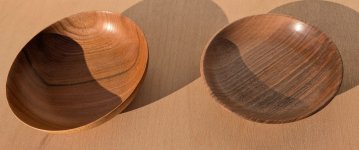
Made yesterday...

I'm pretty sure I said I'd never make another bowl again. However, short-notice birthday present requirements took precedence over personal preferences so I had a few more goes to see if I'd magically got any better at it (spoiler: I haven't).

One lovely bit of Sycamore and one lovely bit of Spalted Beech ended up in the firewood pile, but I did manage to get something bowl-ish out of a piece of Elm and piece of English Walnut (the latter of which nearly ended up in the firewood pile but I realised there was enough left for another go at a shallower tray thing).

2025-10-05-bowls-sunny-view.jpg

2025-10-05-bowls-side-view.jpg

2025-10-05-bowls-top-view.jpg

Two bowls out of five attempts is not that bad... maybe? If it wasn't for the magical effects of 80 grit sandpaper, it probably would have been 0 out of 5! Perhaps I should stick to boxes and tool chests!
 
It would take a better man than I to give advise on how to reduce sandpaper usage while turning; sharpness of tool, right tool, angle of attack, speed and sometimes just awkward grain; there maybe others. To me the end result justifies the journey.
 
Exactly as Andy says, so does it matter what tools you use to achieve the desired result?
 
The process has always been more important to me than the end result. If I don't enjoy the process, then why am I doing it as a hobby? I've come to accept that there will have to be a bit of sanding with lathe work, but if it's mostly sanding then I'd rather not be doing it at all.
 
Totally understand Al. I might also proffer that as amateurs it is also hard to know and understand quite how much sanding a full time professional would do to achieve the same results.
I might also wonder how an engineer used to working with ultra fine tolerances while working with metal manages to accept the different challenges that working with wood presents.
I have never used a metal working lathe of course but I am sure that as the cutting tool is not held in the hand there is less “feel” required to achieve the desired finish. Feel and the challenges that an inconsistent medium throw up are hard things to master on the wood lathe (I certainly haven’t) but don’t give up.
 
It would be interesting to know Al what went wrong with the ones you decided to burn? Chipped edges? Tool went through the bowl?

I don't do much turning as I only bought my cheap record lathe to do repair work on a staircase. It doesn't have electronic speed control unlike the ones I learnt on (an Axminster turning course). I made a few bowls and goblets, but generally feel that my work ends up much thicker than a skilled turner manages. It's a bit of an art and takes a lot of practice I suspect.
 
It would be interesting to know Al what went wrong with the ones you decided to burn? Chipped edges? Tool went through the bowl?
  1. On the first (English Walnut) one I (probably stupidly given lack of practice and never having tried it on an end grain bowl) tried to use the skew chisel to finalise the dovetail tenon thing (after roughing out with a bowl gouge). It grabbed and took a big chunk out. That was the one I was able to bandsaw thinner and have another go. On the later ones I finalised the tenon shape with a spindle gouge and that was fine.
  2. The second (Spalted Beech) one seemed to be going quite well, but, after getting to the target depth (marked with a drill bit) when hollowing, I spent a long time trying to get a smooth finish and, without realising it, went quite a bit deeper than the target depth. I was feeling very proud of myself for not needing much sanding on that one, then when I turned it round and turned the dovetail tenon thing off, I went through the bottom of the bowl.
  3. The third one was the Elm bowl, which had a couple of minor catches but mostly went okay. It just needed loads and loads of sanding with 80 (or 60: I can't remember) grit sandpaper.
  4. The fourth one was the Walnut tray, which seemed to go very smoothly (no catches) but still needed bucketloads of sanding to get rid of tear-out.
  5. The fifth one was Spalted Sycamore (the left-over bit from my mini-moravian bench), which snapped in two when I was hollowing it out.
I don't do much turning as I only bought my cheap record lathe to do repair work on a staircase. It doesn't have electronic speed control unlike the ones I learnt on (an Axminster turning course). I made a few bowls and goblets, but generally feel that my work ends up much thicker than a skilled turner manages. It's a bit of an art and takes a lot of practice I suspect.

I'm sure I agree about it needing lots of practice. It would probably help if I enjoyed the practice more. I always have the concern with these things that "practice makes permanent" - i.e. if you keep practising the wrong thing over and over, you'll do the wrong thing forever. I did a one-day woodturning course last year, but haven't done much since and I'm not sure how much of it I remember really. I've gone back and re-watched a few youtube videos and they definitely helped with the later bowls, but I'm a long way off competent.

One thing I do struggle with quite a bit (in the true spirit of bad workman blaming his tools) when hollowing is getting the tool angle right. It feels like I need the tool handle dropped down quite low to "ride the bevel" when I'm hollowing. If I have it as low as I feel like I should, it hits the bed as I pull the handle back towards me (due to the limited centre height). When I did the woodturning course day, it was on a much bigger lathe where that wasn't an issue. If I had a better feel for what I'm doing, I could probably compensate for it somehow, but I'm not at that sort of skill level.
 
The process has always been more important to me than the end result. If I don't enjoy the process, then why am I doing it as a hobby? I've come to accept that there will have to be a bit of sanding with lathe work, but if it's mostly sanding then I'd rather not be doing it at all.
I sand all my stuff on the lathe starting with 80g to get most of the tool marks/tear out removed. If a power sanding system such as this one is used it really doesn't take too much time at all to work down through the grits; essential though to have a decent extraction system and wear a mask, eye protection etc - Rob
 
If a power sanding system such as this one is used it really doesn't take too much time at all to work down through the grits
I'm sure that "doesn't take too much time" thing depends on the size of the tool marks & the amount of tear-out you're trying to remove.

On those bowls it was probably about 20-30 minutes (at a guess, I wouldn't be surprised if it was longer) of 80 grit, followed by a couple of minutes going through 120, 180, 240 & 320. I have no issue with the time spent going through the grits, I have an issue with the first stage.

If I were a far better turner, then it wouldn't take long and I'd (slightly grudgingly) be happy to run through the grits. As it is, I'm stopping turning with tools when I get to the point there's still loads of tear-out but I'm too worried about snapping the part if I keep going.

There isn't a sanding fix (powered or otherwise) that will sort that out. It's entirely an inept woodturner issue.
essential though to have a decent extraction system and wear a mask, eye protection etc - Rob

I don't have a decent dust extraction system unfortunately. I do weas an air-fed mask (JSP Powercap) for everything wood lathe-y and the lathe is next to the wide-open garage door, but it's certainly not ideal. Space is the limiting factor here.
 
..... I have an issue with the first stage.

If I were a far better turner, then it wouldn't take long and I'd (slightly grudgingly) be happy to run through the grits. As it is, I'm stopping turning with tools when I get to the point there's still loads of tear-out but I'm too worried about snapping the part if I keep going.

There isn't a sanding fix (powered or otherwise) that will sort that out. It's entirely an inept woodturner issue.
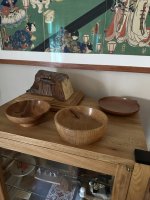
I classify myself as still a 'learner turner' as I don't do enough of it to get really proficient with the bowl gouge; that takes a lot of practice which I'm not prepared to do. As such, I do a bit of spinning when the urge gets to me (probably about once every couple of months) or after I've built up a respectable collection of oddments and offcuts which are either too large to bin or too good to burn; they're then spun up and taken up to our local district hospital for them to flog to raise fundage...after all, how many damned bowls do you really need? In my case it's a couple of fruit bowls and that's about it. So, I get reasonably close to the mark with a sharp bowl gouge, then a succession of scrapers of one sort or another to refine the profile a bit more and then it's onto the powered sanding where 80g is the 'prime mover' to shift any final bits of tear out. The remaining grits remove virtually nothing but bring the wood to a state where it's fit to polish. Just for interest and in no way to detract from your excellent thread:

IMG_5744.jpeg

...these are three little n's in Greengage (timber donated by the late 9fingers), Oak and a small platter in Swiss Pear, a leftover from the JK 'Silver Chest'. The peculiar looking blob of oak at the rear is chunk of HMS Victory still with it's original Georgian lead paint (I think). I have another two or three to do as and when; then it'll be time to chuck everything in a plastic bag and jump on the bus up to the hospital (no way I'm paying for parking!) - Rob
 
I might also wonder how an engineer used to working with ultra fine tolerances while working with metal manages to accept the different challenges that working with wood presents.
Thats bang on
I did an engineering apprenticeship as a toolmaker.The company produced rubber seals and gaskets for automotive and aerospace industry and rubber rollers for money printers and we made the moulds
All pre-computerisation and a thousands of an inch to work within, and for the elite old guard closer tolerances were required especially for the jet engine parts
It was quite stressful given the material costs and no unnecessary noise was permitted.
I could never get into woodworking as the material was by comparison so unpredictable.
 
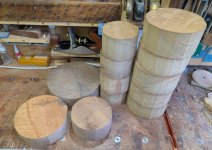
In case you haven't been paying attention, I've been a bit frustrated by my woodturning ineptitude. To help me get some practice, today I made some round-ish bowl blanks (I say "round-ish" as I was too lazy to change the 19 mm blade that lives on my bandsaw so I just kept chopping off corners until they looked close enough):

PXL_20251007_171931871 - Copy.jpg

The two big stacks on the right are from a few pieces of 80 mm thick Iroku that I was very kindly given by @Malc2098 🙏 when he visited a couple of years ago. I hadn't come up with any uses for it yet so I thought I'd chop it up and round-ify it for bowl practice. I've heard Iroku is particularly nasty to breathe in, but I always use an air fed mask when turning (and wear a lab coat to cover my arms etc) so I'm not too concerned (I also used the air fed mask while bandsawing it up). I might chop some of the smaller ones in half in the other way as I suspect it might be easier on an inept woodturner to have a shallower aspect ratio.

The ones on the left are cut from some other bits I had lying around. Clockwise from the bottom-left they're 60 mm thick Cedar of Lebanon, 60 mm thick English Walnut and 70 mm thick mahogany-ish stuff of some sort (cut off the end of a "Mahogany" lintel I bought in Ironbridge Antiques a few years ago).

I'm a great believer in "practice makes permanent", so by the time I've turned all that lot into bowls I'll either have got the hang of bowl turning or all the bad habits will be so ingrained that I'm a lost cause :ROFLMAO: More likely I'll quickly become thoroughly fed up with the whole idea and will give most of them away while they're still blanks :)

In the unlikely event that I end up with some decent bowls out of it, I can see our local GWAAC shop getting some donations!
 
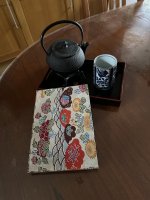
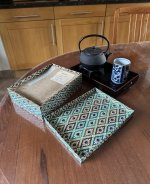
And now for something completely different. For the last few days, I’ve been making archive quality receptacles for a set of ancient Japanese texts (Soken Kisho) on tsuba (sword guards) published in 1781. Included in the set is the first known book on netsuke (which we collect), now protected in its own dust jacket and slip cover. The books are very rare in Japan and virtually impossible to find in the West, but my wife bought a set recently from the USA. An envelope was also made for the provenance documents, including a hand written letter from one Charles F Stein of Midvale Rd, Baltimore, the previous owner. We even managed to find a photo of his house where the book collection was once kept. All items made using archive card, paste and hand printed Japanese washi paper.

IMG_5751.jpeg

IMG_5766.jpeg

IMG_5767.jpeg

IMG_5768.jpeg

Fun to do with some of the techniques (sharp tools, accurate marking out etc) used in wood mangling - Rob
 
I heard on a r4 programme recently that 19 and early 20 th century exports of fine goods from Japan to worldwide markets were wrapped in pages of old manga publications
The recipients had not seen anything like it before and the market for manga became equal to artifacts
 
Back
Top