• Hi all and welcome to TheWoodHaven2 brought into the 21st Century, kicking and screaming! We all have Alasdair to thank for the vast bulk of the heavy lifting to get us here, no more so than me because he's taken away a huge burden of responsibility from my shoulders and brought us to this new shiny home, with all your previous content (hopefully) still intact! Please peruse and feed back. There is still plenty to do, like changing the colour scheme, adding the banner graphic, tweaking the odd setting here and there so I have added a new thread in the 'Technical Issues, Bugs and Feature Requests' forum for you to add any issues you find, any missing settings or just anything you'd like to see added/removed from the feature set that Xenforo offers. We will get to everything over the coming weeks so please be patient, but add anything at all to the thread I mention above and we promise to get to them over the next few days/weeks/months. In the meantime, please enjoy!

I think Gramercy got it wrong

Cabinetman

Sequoia
Joined
Oct 11, 2020
Messages
5,530
Reaction score
1,231
Location
Lincolnshire Wolds + Massachusetts
Name
Ian
Whenever I read about Gramercy holdfasts people say they have put leather bits on the foot to prevent damage to the work and following the information supplied, - that on a 1 3/4” thick or thicker top a 3/4” inch hole should be used, it is obvious that only the toe is touching

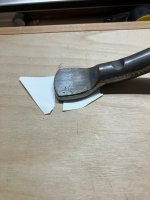
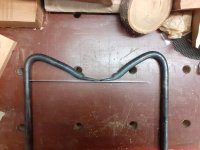
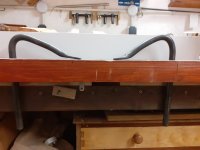
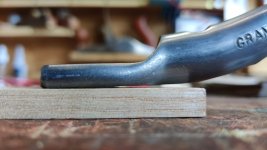
8A40F48A-3D59-4959-9E58-9DB9ECFB4B7E.jpeg68A7E6C3-D6B9-4A1E-ABB5-33523C36738B.jpegUsing pieces of paper pushed under, this Photo shows, after two good whacks that most of the foot isn’t touching the surface when using a three-quarter inch hole, the amount of bend in the holdfast is negligible BTW – and I wasn’t about overhand whack it with a sledgehammer!
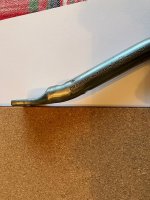
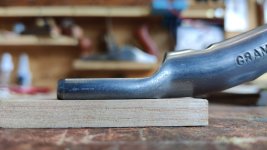
638B29E1-F28F-406F-97ED-F0251A52F66A.jpegTo enable the foot of the holdfast to sit flat on the work I have experimented and a 22 mm hole is needed on a bench top of 1 3/4” as can be seen the slip of paper can’t be pushed under the foot at all.
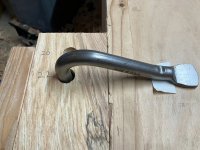
D962182C-0AA9-4327-9C91-79CAD105A2DA.jpeg Holdfasts work by touching/pressing against the outer edge of the hole at the top and the opposite edge at the bottom if this wasn’t the case the hole would be the same size as the shank i.e. 0.715 inches not 0.75 inches (18 mm) but the hole would need to be angled and that’s a no-no.
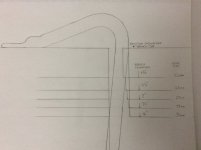
As the hole is larger than the shaft this action means that the shaft is held at an angle to the benchtop not straight up and down, the angle can be seen in this drawing. To keep this angle when using holdfasts on different thickness of benches the size of the hole needs to be increased for thicker worktops, as can be seen the amount of increase is a steady 2 mm for each half inch of increase in benchtop, this needs to be the case to keep the foot flat on the workpiece.
On a bench top of 4 inches this means that the hole should be 31 mm in diameter obviously these are great big holes! And if people do want such thick benches (the style at the moment), then it means that the thickness needs to be relieved underneath around the hole.
Just why Gramercy made the holdfasts with the feet angled quite so toe down I don’t know, but it definitely seems wrong to me as it is. Because of only the small toe area touching the work the work can swivel, using the full pad of the foot this is much reduced.

BUT please don’t take my word for all this, please do a test before you start to drill larger holes in your benches.
Ian607FF0E9-C427-459E-AC73-E2D06CCA7993.jpeg
 
Last edited:
Interesting write up, I have never used one myself but then there are still a lot of woodworking things/gadgets I could be using to make my life easer.
 
Interesting write up, I have never used one myself but then there are still a lot of woodworking things/gadgets I could be using to make my life easer.
I’m similar in not being someone who buys a lot of gadgets, but these are really handy, it surprises me how often I reach for one. And now of course I have realised the correct hole size for my new bench, 22 mm as the top is 1 3/4” thick.
Very good information as I have a 1 1/2" worktop and thinking of purchasing holdfasts.
And you are in the right place to buy them duke, us Europeans either have to bring them back from the States or import them from Germany. It is possible of course to have a set made by a blacksmith but that, although a good thing to do will be a lot more expensive than $40 a pair for Gramercy ones!
 
The angle of the toe, is a compromise to allow for wear in the bench hole, what started as a 3/4 inch hole, after 10-20 years of regular use, will not be 3/4 or maybe even 1 1/4 inches.
The life span of these holdfasts I would expect to be measured in generations, not decades.

Bod
 
Personally I would be wary of holding anything wooden with anything metal without a pad of some sort. I have a couple of the late Richard T’s (ukw) hand forged holdfasts. I use them a lot in, from memory, 19mm holes and always with a packer
 
The angle of the toe, is a compromise to allow for wear in the bench hole, what started as a 3/4 inch hole, after 10-20 years of regular use, will not be 3/4 or maybe even 1 1/4 inches.
The life span of these holdfasts I would expect to be measured in generations, not decades.

Bod
That’s something I must say I hadn’t considered Bod, not sure how much wear there would be? I’ve been using mine on my 3” Beech top for about 5 years and can’t say I’ve noticed much, if any wear.
Personally I would be wary of holding anything wooden with anything metal without a pad of some sort. I have a couple of the late Richard T’s (ukw) hand forged holdfasts. I use them a lot in, from memory, 19mm holes and always with a packer
Absolutely agree, but as they are, the geometry of these dictates that to be able to use the foot (as apart from just the toes) the packer would need to be wedge shaped.
And it would be of great interest to me Andy to see the shape/profile of yours?
 
Great thanks Andy, this is strange, I wonder why, is it me? Seems obvious that the foot should sit flat on the work even with packing, why have a foot otherwise?
I did wonder at first if it was to allow for the bar to bend, but in practice you would have to use huge force to make that happen.
Anyone else have any that aren’t Gramercy we could see please?
 
My take on this interesting thread is that the geometry here is quite subtle. Anyone whose holdfasts aren't working well should experiment with the size of the hole.

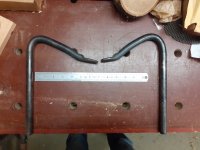
I bought a pair of holdfasts from Richard Tomes when he first made them available. They had the toes at a steeper angle to AndyP's, only touching the workpiece at the very tip.

After doing more experiments, and listening to his customers, Richard changed his design to have a flatter tip, like those shown by Andy above.

Being such a good person, he gave me one of the Mark 2 design, refusing to take any money for it. In practice I prefer it to the others but they all work well enough in my 2 1/2" bench, in a 3/4" hole.
If they stop working so well, I now know what to try.

Thanks!
 
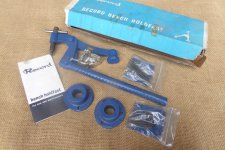
I have a couple of these. Same basic idea really except the pad is articulated and you can adjust the pressure. The collars are let into bench top, flush, and so there is no risk of slippage or wear.

1000x667.jpg
 
My take on this interesting thread is that the geometry here is quite subtle. Anyone whose holdfasts aren't working well should experiment with the size of the hole.

I bought a pair of holdfasts from Richard Tomes when he first made them available. They had the toes at a steeper angle to AndyP's, only touching the workpiece at the very tip.

After doing more experiments, and listening to his customers, Richard changed his design to have a flatter tip, like those shown by Andy above.

Being such a good person, he gave me one of the Mark 2 design, refusing to take any money for it. In practice I prefer it to the others but they all work well enough in my 2 1/2" bench, in a 3/4" hole.
If they stop working so well, I now know what to try.

Thanks!
That’s interesting thanks Andy, I am away at the moment, I will experiment when I get back as to whether they work better with a flat foot or toes acting on the workpiece and how much force is needed to deflect the work. Getting the forces equal might be difficult.
A thought, is the foot there because it’s a thinner section and gives a little bit of spring?
 
Just out of curiosity I thought I'd take a couple of pictures of mine for another data point.

In the 20 mm dog hole but loose (i.e. I haven't hit it yet):

gram01-loose.jpg

After hitting:

gram02-tight.jpg

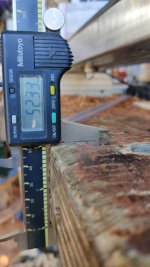
Bench thickness:

gram03-bench-thickness.jpg
 
Just out of curiosity I thought I'd take a couple of pictures of mine for another data point.

In the 20 mm dog hole but loose (i.e. I haven't hit it yet):

View attachment 29512

After hitting:

View attachment 29513

Bench thickness:

View attachment 29514
Thanks Al, now that is interesting. I tried mine in a 20mm hole and couldn’t get it anywhere near that flat. It makes me wonder if Gramercy have changed the angle or maybe they vary? Certainly yours look just right to my eyes.
What made you drill 20 and not 18mm holes?
 
Thanks Al, now that is interesting. I tried mine in a 20mm hole and couldn’t get it anywhere near that flat. It makes me wonder if Gramercy have changed the angle or maybe they vary? Certainly yours look just right to my eyes.
What made you drill 20 and not 18mm holes?

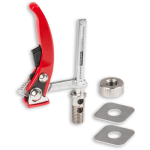
I was never quite sure about what I was doing with bench holes for dogs etc and I umm'ed and ah'ed about whether to go with 19 mm (3/4") or 20 mm but in the end I quite liked the MFT-style grid thing as it gives a lot of options (especially when I use the tracksaw on one end of my bench). These are the hold-downs (designed for 20 mm holes) I use most of the time as they're very quick to use (I never bother with the nut or square washers) and, importantly, can go anywhere on the bench (whereas the Gramercy ones can only go in the relatively few places where there isn't anything under the bench in the location of the hole):

1730045838132.png
 
Update.
Well I finally got back home from our (very successful) trip to Boston and have now found the time to test two Gramercy Holdfasts, one in a 3/4” hole and the other in a 22mm one, two together so that with an identical piece of wood held down hard on the bench after two pretty identical hard thumps from my mallet, I could test the grip by hitting the captured wood sideways to test the relative grip of the Holdfasts in different holes.
One would be gripping with the toe and the other in the larger hole would be gripping with the foot.
Drumroll time, and the winner is?
(Big pause to annoy the audience)
No discernible difference at all ! Tried it a few times and I’m so confident that I shall go back to 3/4” holes in my new bench, mainly because they are smaller but also easier to drill. So I’m sorry for wasting your time.
One thing I did learn though is just how critical it is to get them drilled perfectly at 90 degrees, one of mine wasn’t.
Ian
 
Last edited:
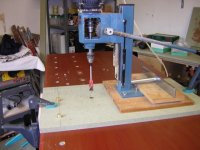
This is how I made the holes in mine Ian. The bench dogs through the base the morticer is attached to ensures that all the holes were aligned and equidistant from each other.

DSCN7219.jpeg
 
Back
Top