Cabinetman
Sequoia
- Joined
- Oct 11, 2020
- Messages
- 5,530
- Reaction score
- 1,231
- Location
- Lincolnshire Wolds + Massachusetts
- Name
- Ian
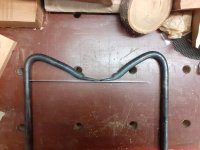
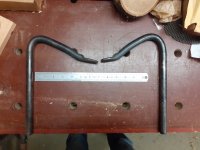
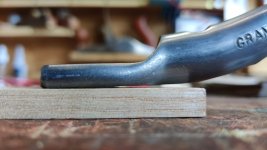
Whenever I read about Gramercy holdfasts people say they have put leather bits on the foot to prevent damage to the work and following the information supplied, - that on a 1 3/4” thick or thicker top a 3/4” inch hole should be used, it is obvious that only the toe is touching

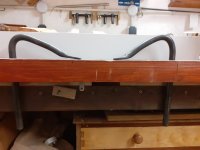
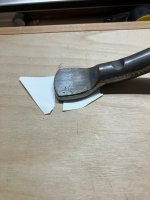 Using pieces of paper pushed under, this Photo shows, after two good whacks that most of the foot isn’t touching the surface when using a three-quarter inch hole, the amount of bend in the holdfast is negligible BTW – and I wasn’t about overhand whack it with a sledgehammer!
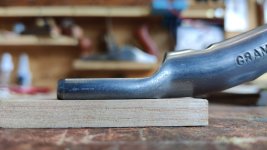
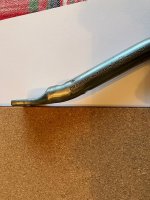 To enable the foot of the holdfast to sit flat on the work I have experimented and a 22 mm hole is needed on a bench top of 1 3/4” as can be seen the slip of paper can’t be pushed under the foot at all.
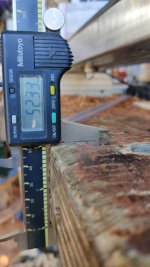
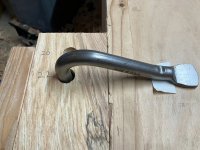 Holdfasts work by touching/pressing against the outer edge of the hole at the top and the opposite edge at the bottom if this wasn’t the case the hole would be the same size as the shank i.e. 0.715 inches not 0.75 inches (18 mm) but the hole would need to be angled and that’s a no-no.
As the hole is larger than the shaft this action means that the shaft is held at an angle to the benchtop not straight up and down, the angle can be seen in this drawing. To keep this angle when using holdfasts on different thickness of benches the size of the hole needs to be increased for thicker worktops, as can be seen the amount of increase is a steady 2 mm for each half inch of increase in benchtop, this needs to be the case to keep the foot flat on the workpiece.
On a bench top of 4 inches this means that the hole should be 31 mm in diameter obviously these are great big holes! And if people do want such thick benches (the style at the moment), then it means that the thickness needs to be relieved underneath around the hole.
Just why Gramercy made the holdfasts with the feet angled quite so toe down I don’t know, but it definitely seems wrong to me as it is. Because of only the small toe area touching the work the work can swivel, using the full pad of the foot this is much reduced.
BUT please don’t take my word for all this, please do a test before you start to drill larger holes in your benches.
Ian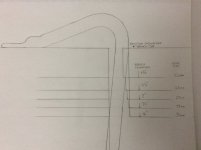
Using pieces of paper pushed under, this Photo shows, after two good whacks that most of the foot isn’t touching the surface when using a three-quarter inch hole, the amount of bend in the holdfast is negligible BTW – and I wasn’t about overhand whack it with a sledgehammer!To enable the foot of the holdfast to sit flat on the work I have experimented and a 22 mm hole is needed on a bench top of 1 3/4” as can be seen the slip of paper can’t be pushed under the foot at all. Holdfasts work by touching/pressing against the outer edge of the hole at the top and the opposite edge at the bottom if this wasn’t the case the hole would be the same size as the shank i.e. 0.715 inches not 0.75 inches (18 mm) but the hole would need to be angled and that’s a no-no.As the hole is larger than the shaft this action means that the shaft is held at an angle to the benchtop not straight up and down, the angle can be seen in this drawing. To keep this angle when using holdfasts on different thickness of benches the size of the hole needs to be increased for thicker worktops, as can be seen the amount of increase is a steady 2 mm for each half inch of increase in benchtop, this needs to be the case to keep the foot flat on the workpiece.
On a bench top of 4 inches this means that the hole should be 31 mm in diameter obviously these are great big holes! And if people do want such thick benches (the style at the moment), then it means that the thickness needs to be relieved underneath around the hole.
Just why Gramercy made the holdfasts with the feet angled quite so toe down I don’t know, but it definitely seems wrong to me as it is. Because of only the small toe area touching the work the work can swivel, using the full pad of the foot this is much reduced.
BUT please don’t take my word for all this, please do a test before you start to drill larger holes in your benches.
Ian
Last edited: