• Hi all and welcome to TheWoodHaven2 brought into the 21st Century, kicking and screaming! We all have Alasdair to thank for the vast bulk of the heavy lifting to get us here, no more so than me because he's taken away a huge burden of responsibility from my shoulders and brought us to this new shiny home, with all your previous content (hopefully) still intact! Please peruse and feed back. There is still plenty to do, like changing the colour scheme, adding the banner graphic, tweaking the odd setting here and there so I have added a new thread in the 'Technical Issues, Bugs and Feature Requests' forum for you to add any issues you find, any missing settings or just anything you'd like to see added/removed from the feature set that Xenforo offers. We will get to everything over the coming weeks so please be patient, but add anything at all to the thread I mention above and we promise to get to them over the next few days/weeks/months. In the meantime, please enjoy!

Ornamental lathe restoration

wallace

Old Oak
Joined
Aug 17, 2014
Messages
1,316
Reaction score
442
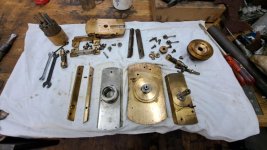
I made a start on my new lathe, it is going to take a while so instead of having bits laid around I got some storage crates.

5072613d-48aa-4dad-b66f-23b1829d46a6.jpg

The previous owner had done some work on it but there is still alot to do.

Screenshot 2024-11-08 204302.jpg

Screenshot 2024-11-08 204354.jpg

b88edd28-9f90-4151-929a-29e776f5ee66.jpg

c466c295-9534-414a-876d-35db694a36d1.jpg

This is very different to my wadkin stuff. Its amazing what quality was achieved 150 years ago. I think the parts might have some kind of plating. It seems similar to the finish on carriage clocks, the silver section is nickel plated.
 
This is going to be fun to watch and I'm sure it will be beautiful and functional. Thanks for documenting it all.
 
On a slight tangent, I did a upgrade on my tent heater. The original twin wall flue did not give off much heat, whereas the single layer flue did. I had the bright idea of changing the flue to 6". I also played around with the minimum settings on the float valve. It now gives off more heat whilst using less fuel. I've been running it continuously for 3weeks and it uses about 25ltr a week. It is so nice to go into the workshop that isnt the same temp as outside.

CnyrUe0.png

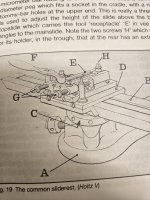
Next up is this cross slide type affair. I think it holds a cutter which can be actuated by moving the lever.

WP7tRhd.png

5XLp1qN.png

O5yiJ1s.png

Evaporust is great stuff

AHuYJBy.png

Got myself a copy of a scotchbrite wheel, the proper ones are pricey.

7I8aLme.png

RoKherZ.png

This was very pitted so it got a skim, I will mill new flats as well.

dsMc18K.png
 
I'll follow this with great interest. You could consider joining the Society of Ornamental Turners - I think they would be very helpful if you need any help or advice.
 
Evaporust and a scotchbright seem to do wonderful work! Looking like new.
I’m like you I can’t work for long if I’m cold, it’s just about freezing in the workshop at the mo, and all I could stand was about an hour sweeping up and clearing up.
Not viable trying to heat the space at the mo, moving soon - more on this later.
Ian
 
Next up is this cross slide type affair. I think it holds a cutter which can be actuated by moving the lever.

WP7tRhd.jpg


Yes indeed, spot on. Get yourself a copy of Tom (T.D.) Walshaw's "Ornamental Turning", you'll get all you need in there to start you off. About a tenner, but it's all in there. If you fancy going further, same title, but by J.H. Evans is one of the original texts. Highly fallutin' (read pretentious) Edwardian or Victorian text, but cracking illustrations.
 
Mark, the third picture in this thread, slide rest top left, cutting frames centre ground and what I suspect, but do not have enough experience to definitively say, is a geometric chuck, or parts of it. on the right. The fourth image is, I think, an eccentric chuck.

Holtzapffel volumes 1 - 5 are available (in English) to download for free if you fancy trying to work out what it is he is trying to say and The Society of Ornamental Turners is alive and well too.

Try this: https://www.ornamentalturning.co.uk/ the third image shows the overhead pulleys and gearing in your first picture.

Sam
 
Thank you. That is a very good video. Dead simple.

And now I know why you have to plate steel with nickel first. Will now research silver plating.
 
Last edited:
Wallace, that is a great project…..I hope you have all the parts :unsure:
Dont know yet, I think the listing said the leadscrew was missing.

I was making the nickel solution and forgot about it.

kEgHAC2.png

It seems to be working

QdCKJ2n.png

There are a couple of these bits which were very pitted.

uTY0eNg.png

I have a little eagle surface grinder

cNFtM1g.png

Xraj4wx.png

The finished article after being plated.

gKgFOm2.png

Another pitted part

b5w3b9n.png

After sanding with a powerfile, polishing and plating.

5ToF1xV.png

I tried re cutting the square on the screw but it didnt go very well. It took a while to realise it will be hardened. I think I will try the grinder.

9wguUz3.png
 
Its been along time since I got to do any of this, been busy with other stuff.
The castings generally have a few voids, obviously you cant have holes in your ways. They are filled with a metal that is softer than the cast iron. I dont know the date of this but probably 19thC. Wadkin were still filling castings during their zenneth period in the 40/50's.
GgObs7l.png

5isIjgT.png

I had a piece of brass where the nickel was worn away, thought I'd try removing it by reversing the polarity

mo1ojfK.png

You end up with a grey sludge that comes off with scotchbrite

Bs7ZwPR.png

FCPCYNf.png

The next bit to start is this lump, not sure how or where it would go on the lathe, obviously some kind of cutting frame?

DWzwM7W.png

It has some really tactile curves, the fettling of the casting is quite impressive

uwbxEN2.png

iAJf7m0.png

I tried out a phosphoric acid rust removal

x1oXrS8.png

It worked quite well but I did panic when I first took it out and the part had a layer of grey soft stuff. I thought I'd dissolved the metal

uI5uhtQ.png

4RMpS2o.png
 
Note to self, do not use aldi's masking tape. Supposed to be low tack, easy to remove. It aint, it stuck like a stucky stuck thing and deposited schmoo all over. I had to use acetone to get the adhesive off. I will stick with my yellow frog tape which is silly money but you can leave it for ages and it will still peal off easily.

a47e213e-d14a-44b8-87d3-ebdb5cdce419.jpg

I'm quite pleased how this turned out

9sbFs8G.png

nz5BGgd.png

el7YQlN.png

iQXxY8h.png

U273MOB.png

oL3meNm.png

I3a8qNI.png
 
Just lovely. Have fun using it.
S.
There are a lot more bits to clean up before I attempt to play. Plus I'm very new to ornamental turning. The SOT have some great footage but a lot of it is old being done by camcorder by the looks of it. Wifey was asking what I'd like for our wedding anniversary, SOT have some nice books that they have had reprinted.
 
That really is a thing of beauty.

3M blue masking tape always seems good to me (easy to remove after a long time in place).
 
Don't forget that you can get free, legal PDFs of old out of print books on ornamental turning. Even if you do decide to buy a reprint or an antique copy, rather than read on a screen, it's useful to be able to preview the whole book.
Search on archive.org and Google Books for authors such as Holtzapffel and John Henry Evans.
 
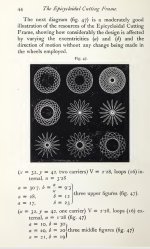
Exactly Sam. Who'd of thunked it, that I would be trying to understand the radius of a apocentral circle or the differential angle :unsure: . I managed a B in O level maths but this may as well be astro physics.
I found a book which makes it much easier to understand. Like not at all.

Screenshot 2025-06-24 193525.jpg

Screenshot 2025-06-25 070440.jpg

Screenshot 2025-06-25 071019.jpg
 
Using a Spirograph was never that complicated and the patterns created look the same;):)

Good luck.
I hope that you will be able to take a video of this machine in operation.
 
Using a Spirograph was never that complicated and the patterns created look the same;):)

Good luck.
I hope that you will be able to take a video of this machine in operation.
I loved my spirograph in the 70's. Not sure why you would need the maths to put a pattern on something. I think the piece of work is attached to this and moves around whilst a cutter spins attached to a cross slide.
 
Ordinarily I'd be a bit sceptical about this ever being fully restored to working order, but based on your track record and the work done so far I have no doubts whatsoever!
 
Using a Spirograph was never that complicated and the patterns created look the same;):)
They look the same because it's the same principle that drives them both. The pencil in a Spirograph, and the cutter here, turn in lots of small circles while simultaneously also moving in a single large circle, at a fixed ratio to each other.

The difference is just that you need rather more rigidity in a lathe cutter than a pencil, so the mechanism needs to be more complex to hold it firmly enough while also moving to create the patterns. I believe the overall arrangement is that the cutter moves, either from side to side or in its own smaller circle, while the workpiece turns in the lathe; the multiplicity of gears and adjustments is to let you choose how many revolutions the cutting tool makes per revolution of the workpiece, and how far it moves with each one.

In that sense it's not very dissimilar from the change gears that are used for threading on a conventional metal lathe - lots of gears present, only a few actually in use at any one time and the actual task it performs is actually quite simple. The main difference from that one is that threading needs to choose between a relatively small number of fixed pitches, whereas this needs a much wider and more granular range of fractional speeds.

Going back to the Spirograph comparison, the gear selection is the same as the choice of inner gear; it determines how many small circles your cutter/pencil makes for each turn of the large circle. The eccentricities are the same as choosing which hole in the inner gear your pencil goes into; they determine the size of those small circles. The size of the large circles are determined here by how far from the centre line of the lathe you fix the cutting frame, and on a Spirograph by the choice of the large gear.

(It's a little more complex than that in the Spirograph case; rather than just the size of the small and large gears, it's the ratio between their sizes and the linear difference between them that affects those two factors, but I thought the simplification was easier to follow)
 
spb nailed it:
I believe the overall arrangement is that the cutter moves, either from side to side or in its own smaller circle, while the workpiece turns in the lathe; the multiplicity of gears and adjustments is to let you choose how many revolutions the cutting tool makes per revolution of the workpiece, and how far it moves with each one.
and that is how the O.L. was derived into Spiroraph.
Back on the lathe, a dense wood, fine grained, will show the intricate possibilities; save up "fish scales" until you have had a bit of practice.

Did you manage to get the cubical box of cutters too Mark? They really open up possibilities of patterning.

Sam
 
Ordinarily I'd be a bit sceptical about this ever being fully restored to working order, but based on your track record and the work done so far I have no doubts whatsoever!
Its been a while since I did a machine and I am enjoying myself, its unknown if anything is missing. If I recall the original listing, the leadscrew is awol.

Sam I'm not sure, I've not gone through everything properly, I've just been grabbing a lump from a crate.
 
Back
Top