
Malc2098
Sequoia
I've bought a few pairs and will try them out next year.Small box (50mm)
It’s an experiment with small barrel hinges, they seem to work well, I have some bigger ones (8mm) to try next.

I've bought a few pairs and will try them out next year.Small box (50mm)
It’s an experiment with small barrel hinges, they seem to work well, I have some bigger ones (8mm) to try next.

Well it’s a lot better than mine (at the moment)!The fastest ever work bench!
I present a reconfigured fire door!


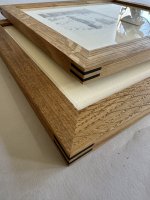


Indeed Andy; entry of 'thunderbugs' denied. Apparently, so SWIMBO mentioned, the little demons are attracted to the colour white - RobI hope you’ve taped the backs too, to stop little beasties getting in.
Nice Rob, I like the splines too. Not sure why but I’ve always found it very satisfying applying wet gum arabic tape to the back of pics, I think it may be the way it sort of moulds itself to the profile, also unlike a lot of tapes it doesn’t fall off after a few years.
The stuff I use is Japanese and readily available at Amazon and elsewhere. It's really very 'icky' and once stuck to card or bare wood, is extremely reluctant to come off..except that this time, being a numpty, I didn't mask off the back of the frame where the tape was going to go. It didn't stick to the polished oak! - RobEven picture framers tape does not last forever. I had to redo a couple of prints a week of so ago.

Who remembers this?I got an unusual commision (well for me at least). It involved this bit of 2" thick Scottish Elm as well as a 4" block. The elm was too thick and well seasoned (translates to bloody hard). I needed an 11" x 1" board about 22" long. Cutting to length was easy as was squaring off and cutting to width but thickness was another matter entirely, I ran it through my table saw which only could cut 3" in from each edge and went back to my roots and broke out the handsaw (this was when I remembered that they invented power tools for a reason and I'm pretty sure that reason was hard elm). Anyway all parts got roughed out and left in the house to acclimate for a couple of weeks.
View attachment 29383
First to the 4" block it was to be turned and made into this shape.
View attachment 29384
It was then inserted into the end of this old 75mm shell case, British army circa 1972 (I had alread fixed the badge on by this point).
View attachment 29385
The shell case belongs to an old family friend who served in the SAS Regiment and was involved in the Battle of Mirbat in 1972 (https://alanmalcher.com/2021/12/14/...-july-1972-22nd-special-air-service-regiment/), the shell was one which his friend had been firing (he was operating a 3 man gun on his own against around 250 charging insurgents, the chap firing the gun was firing, unloading and sighting down the open breach until he saw the enemy in the barrel, loading and firing. he stayed in that gun emplacement until he was shot and died from his wounds. I was asked if it were possible to mount a cap badge to the shell case (this in itself took a bit of finding as apparently the SAS are one of the few regiments who only have cloth cap badges), plug the end of the shell and mount it on a stand. The ultimate goal is that it will be presented to 22 SAS and will live in their officers mess as a memorial to those that died in the battle.
So, hand cut a couple of shallow mortices and stub tenons.and made a couple of brackets to hold the shell.
View attachment 29386
There is a plaque being made which will sit on the elm board, unfortunately I dont have it yet.
View attachment 29387




It’s an old one of these MikeHis what?
Fequency? Radio what? Do we know if Nick Robinson or Georgia Mann are more effective?You just put the paddle on the glued & clamped joint pull the trigger & the radio frequency cures the glue
Somewhere I believe, in Joyce's TofFM there's a snippet about radio frequency gluing. I came across the section decades ago when I first perused the tome but I didn't follow it up as it was a bit esoteric for me - RobHis what?
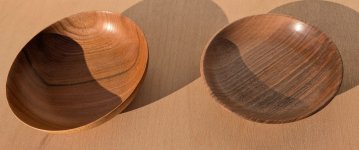


I think it depends how much you use it: I think I spent substantially more time with 80 grit sandpaper than I did with the bowl gouge! I definitely haven't got the hang of it.Those bowls look very good to me Al. Nowt wrong with sandpaper either.

It would be interesting to know Al what went wrong with the ones you decided to burn? Chipped edges? Tool went through the bowl?
I don't do much turning as I only bought my cheap record lathe to do repair work on a staircase. It doesn't have electronic speed control unlike the ones I learnt on (an Axminster turning course). I made a few bowls and goblets, but generally feel that my work ends up much thicker than a skilled turner manages. It's a bit of an art and takes a lot of practice I suspect.
I sand all my stuff on the lathe starting with 80g to get most of the tool marks/tear out removed. If a power sanding system such as this one is used it really doesn't take too much time at all to work down through the grits; essential though to have a decent extraction system and wear a mask, eye protection etc - RobThe process has always been more important to me than the end result. If I don't enjoy the process, then why am I doing it as a hobby? I've come to accept that there will have to be a bit of sanding with lathe work, but if it's mostly sanding then I'd rather not be doing it at all.
I'm sure that "doesn't take too much time" thing depends on the size of the tool marks & the amount of tear-out you're trying to remove.If a power sanding system such as this one is used it really doesn't take too much time at all to work down through the grits
essential though to have a decent extraction system and wear a mask, eye protection etc - Rob
I classify myself as still a 'learner turner' as I don't do enough of it to get really proficient with the bowl gouge; that takes a lot of practice which I'm not prepared to do. As such, I do a bit of spinning when the urge gets to me (probably about once every couple of months) or after I've built up a respectable collection of oddments and offcuts which are either too large to bin or too good to burn; they're then spun up and taken up to our local district hospital for them to flog to raise fundage...after all, how many damned bowls do you really need? In my case it's a couple of fruit bowls and that's about it. So, I get reasonably close to the mark with a sharp bowl gouge, then a succession of scrapers of one sort or another to refine the profile a bit more and then it's onto the powered sanding where 80g is the 'prime mover' to shift any final bits of tear out. The remaining grits remove virtually nothing but bring the wood to a state where it's fit to polish. Just for interest and in no way to detract from your excellent thread:..... I have an issue with the first stage.
If I were a far better turner, then it wouldn't take long and I'd (slightly grudgingly) be happy to run through the grits. As it is, I'm stopping turning with tools when I get to the point there's still loads of tear-out but I'm too worried about snapping the part if I keep going.
There isn't a sanding fix (powered or otherwise) that will sort that out. It's entirely an inept woodturner issue.
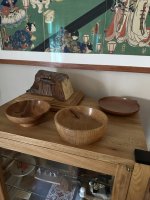
Thats bang onI might also wonder how an engineer used to working with ultra fine tolerances while working with metal manages to accept the different challenges that working with wood presents.
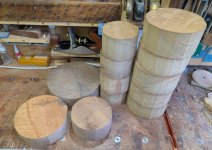
 when he visited a couple of years ago. I hadn't come up with any uses for it yet so I thought I'd chop it up and round-ify it for bowl practice. I've heard Iroku is particularly nasty to breathe in, but I always use an air fed mask when turning (and wear a lab coat to cover my arms etc) so I'm not too concerned (I also used the air fed mask while bandsawing it up). I might chop some of the smaller ones in half in the other way as I suspect it might be easier on an inept woodturner to have a shallower aspect ratio.
 More likely I'll quickly become thoroughly fed up with the whole idea and will give most of them away while they're still blanks



 Apple ladle by Pete Maddex, on Flickr
 Apple ladle by Pete Maddex, on Flickr


