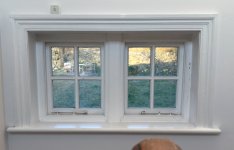
Once the glue was set, I cut off the horns with a flush cut saw to end up with a rectangular window.
As hoped, the casement fit inside the opening of the liner with ~3mm gap all round.
I used an electric planer to ease the back of the non-hinge side just a little and set about attaching hinges.
I marked out the hinge mortises using each hinge as a template and a knife for marking. The two-band leaf of the hinge attaches to the casement and the three-band leaf attaches to the frame. I started with the casement first, chiseled the mortises, then drilled pilots for the screws.
There’s
a thread on attaching the hinges, but in summary, my first attempt was not good. I was using weak hinges (not the hinges mentioned upthread - those are the good ones), but I also drilled the pilot for one of the screws off-centre which shifted the hinge position. This all meant the casement hit the frame during opening/closing.
I had to fill the original screw holes, and get new hinges. I also got self-centring drill bits for drilling the pilot holes.
Here you can see the screw holes being filled. Extra glue for the extra annoyance.

After fitting the new hinges, I could see that I needed a bit more space around the casement, so I unscrewed the hinges and shaved the outside of the casement with the track saw.
During the course of fitting and painting, I probably attached and detached the hinges about a billion times and each time it was a pain. My workshed is cramped with a low roof: not enough space to put everything flat on the bench and open the window towards the sky, not enough elbow room to open sideways without knocking stuff to the floor. Finding the angle that offered stability, access to the screws, and didn’t scatter tools was a constant quest. If I make future windows, they will have hinges on the long side and this problem will disappear.