• Hi all and welcome to TheWoodHaven2 brought into the 21st Century, kicking and screaming! We all have Alasdair to thank for the vast bulk of the heavy lifting to get us here, no more so than me because he's taken away a huge burden of responsibility from my shoulders and brought us to this new shiny home, with all your previous content (hopefully) still intact! Please peruse and feed back. There is still plenty to do, like changing the colour scheme, adding the banner graphic, tweaking the odd setting here and there so I have added a new thread in the 'Technical Issues, Bugs and Feature Requests' forum for you to add any issues you find, any missing settings or just anything you'd like to see added/removed from the feature set that Xenforo offers. We will get to everything over the coming weeks so please be patient, but add anything at all to the thread I mention above and we promise to get to them over the next few days/weeks/months. In the meantime, please enjoy!

Conversion - bathroom to en-suite

OK I have created leaks by poor soldering very ocasionally
Often as a result of not fully cleaning the joint or moisture in the pipe. To clean 15 & 22 mm pipes externally and fittings internally buy yourself some of these, quick and easy .


The reason plastic is now popular is simply you do not need the skill set, how many plumbers today can pull multiple bends on a single length of pipe to reduce the number of joints. Do they even teach pipe bending anymore in colledge, but there is really no excuse as if you don't want to lug a floor standing pipe bender around or find the portable hand bender hard work you can just buy a battery version that is great in confined spaces. The Rothenberger makes easy work of 22mm pipe, just not a cheap tool at around £1500 except when you think how much some woodworking tools like XL700 Domino and Lamello machines cost so comparative.

1770635751818.png
 
I used to pride myself on using as few elbows in mains pressure pipes as possible (to keep it quiet). Our incoming feed goes from 25mm MDPE to 22mm copper up the house, as the boiler is in a side attic. It has to follow walls that don't align between floors, which was 'fun' to do.

It's pretty quiet although Torbeck valves for the cisterns are getting hard to find now.
 
I used to pride myself on using as few elbows in mains pressure pipes as possible (to keep it quiet). Our incoming feed goes from 25mm MDPE to 22mm copper up the house, as the boiler is in a side attic. It has to follow walls that don't align between floors, which was 'fun' to do.

It's pretty quiet although Torbeck valves for the cisterns are getting hard to find now.
I can relate to that. At our last place I out in a H/W pump and it was very noisy. Here, I decided no pump and use mains pressure. Bliss. Silence
 
Anyway back to the OP.....

Decided that all the perspex-type stuff should go. So it's a question of...

Cut and seal off relevant water pipes feeding shower.

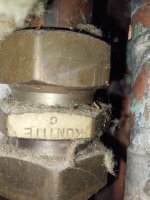
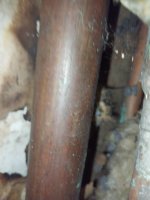
Came across this monster copper pipe. It's the largest that I've ever seen in a domestic environment. I have no idea what it was used for or even if it's still live. Certainly not seen it anywhere else. For size comparision the pipe on the right is 15mm !
20260211_162007.jpg

20260211_162000.jpg


As foir the rest, going...

20260214_161646.jpg

Gone ...

20260215_115054.jpg

Shower tray also in the skip.
 

Attachments

  • 20260211_162007.jpg
    20260211_162007.jpg
    214.7 KB · Views: 4
Came across this monster copper pipe. It's the largest that I've ever seen in a domestic environment. I have no idea what it was used for or even if it's still live. Certainly not seen it anywhere else. For size comparision the pipe on the right is 15mm !
My guess is that they were the original pipes for the backboiler which were unpumped, thermosyphon probably with a pressure release valve somewhere and in 28mm (1 1/8).
 
When we moved in 30 years ago, our place had two balanced-flue boilers, side-by-side, They were connected 'in parallel' by 35mm copper pipe, which also went as far as the pump (up in the suspended ceiling of the kitchen, next door to the scullery where the boilers were).

After we ripped it out, I kept as much of it as I could for odd jobs (e.g. you can split it, anneal and flatten it for copper sheet, etc.). I shudder to think what it would cost new today.

That looks about 35mm.

And, to add to Lurker's comment, also cut off soldered ends and joints - they go in the bag with the brass as 'brazings' - you definitely get the most for clean copper pipe. I also take lead to the scrap merchant, but to be honest, I haven't left much of it in the house now :-)
 
When we moved in 30 years ago, our place had two balanced-flue boilers, side-by-side, They were connected 'in parallel' by 35mm copper pipe, which also went as far as the pump (up in the suspended ceiling of the kitchen, next door to the scullery where the boilers were).

After we ripped it out, I kept as much of it as I could for odd jobs (e.g. you can split it, anneal and flatten it for copper sheet, etc.). I shudder to think what it would cost new today.

That looks about 35mm.

And, to add to Lurker's comment, also cut off soldered ends and joints - they go in the bag with the brass as 'brazings' - you definitely get the most for clean copper pipe. I also take lead to the scrap merchant, but to be honest, I haven't left much of it in the house now :)
Yup. Bang on the money. 35mm. It’s not coming out. No sign of a back boiler or room for one or a flue of any sort. I think it may have been an overflow from the tank in the loft
 
It's much more likely to have been part of a gravity-driven heating system. They were common about 70 years ago. Boiler at the bottom, heats the water that expands and creates a convection current up the system. Often a circulating pump was unnecessary (not saying it heated evenly, mind!). Wide-bore pipes are a necessity for this to work, big-ish right up to the radiators, usually. That said, grey cast iron was commonly used.

Copper would be unusual, unless it was, say, between boiler and a DHW tank's coil.

Any overflow from either DHW or heating headers would've been in plastic from the late 1960s onwards, before that, most likely 1/2" lead, running to a spout under the eaves. You needed it to drip obviously, so you knew the washer needed changing.

PS: the compression coupler is seriously impressive, in a biceps-testing way, I'd guess.
 
Well, obviously I don't know the layout, but it's not any sort of overflow. And it's also too big for either cold or DHW.

That only leaves heating, or a waste pipe of some sort (which it yet might have been). As I said, though, that's a bit extravagant for a waste pipe (bath or kitchen sink sized, too).
 
My cousin was a time served plumber who must roll his eyes at modern day plumbing. He did a full apprenticeship and attended day and evening classes for years to acquire his skills. He worked with chrome, cast iron, stainless steel, copper and lead, could join any one type of pipe to another as well as doing welding and lead flashing work. One thing I learned from him was never to shake hands with him. It took hours for the feeling to come back into my fingers.
 
One always forgets just how much extra work is involved when trying to retrofit/redo something that is already there. Give me a blank floor or wall any day. I seem to spend ages deciding whether to rip out this bit or that bit. There's that flakey OSB board to consider. But only the one side is really bad and that only at the bottom so ripping it all out didn't seem a sensible idea.

But then there are areas of old ..circa 100 year old ...lath and plaster to content with. For the non-UK members, lath and plaster was an old technique. Nail laths go uprights with about 1/4 " or so gap between. Then apply plaster in a thick coat pressing it well onto the laths so that a lot of it exudes through the gaps and gravity makes it drop down a bit thus helping key it to the laths when dry. You can see the reverse side at the top of this picture.

20260214_161650.jpg
Removing it is a horrible dusty job. Good PPE mandatory. Much easier to simply board over if you can.

That then raised another issue in that on this wall, the RH end of the lath and pladter was not fixed to anything and was floating. Making life impossible for a plasterer. So battens were required.

20260219_135820.jpg

To make life easier for the plasterer I also rationalised a rebate in the wall. That necessitated adding fiddly blocks to provide support for the plasterboard to come.


20260219_135833.jpg

1771681547166.jpeg

Gradually made progress making due allowances for Bodgeo's wiring prowess


20260219_141413.jpg

20260220_115451.jpg
20260220_115457.jpg

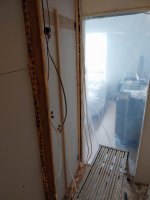
One benefit of the battens is that it gives me a hollow area behind the new plasterboard to hide the wires.

Ceiling plasterboard was glued and scrwed up, supported by telescopic lightweight jacks while the glue went off overnight

20260220_115451.jpg

And finally all boarded up and a coat of trade paint sploshed on the floor to seal in any remaining plasterboard dust. A lot despite Hoovering.

20260221_103031.jpg

Joints are not taped or beaded as past experience showed that a lot of plasterers prefer to do it themselves.

Onwards and upwards to the next stage
 
The older part of our home has lathe and plaster as well as another home we once owned.
Real pain in the arse when it comes to demolition.
 
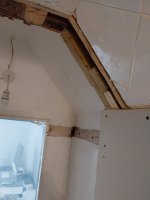
What's going on with those ceramic tiles, Roger?
Are they really on a bit of sloping ceiling, and laid cornerwise?

If so, I think it will look a lot better when you have finished covering it up.

Is there no end to the previous owner's "originality?!"

Edit: I looked again... They're expanded polystyrene, aren't they, previously covered up, now exposed and ready to be removed, I hope!
 
Last edited:
What's going on with those ceramic tiles, Roger?
Are they really on a bit of sloping ceiling, and laid cornerwise?

If so, I think it will look a lot better when you have finished covering it up.

Is there no end to the previous owner's "originality?!"

Edit: I looked again... They're expanded polystyrene, aren't they, previously covered up, now exposed and ready to be removed, I hope!
My bad...thought I'd taken a 'finished' photo. They're ceramic tiles and now covered over.

"Originality". Most definitely. I haave also learnt to always have two types of screwdriver to hand. One flathead and one Philips as you can guarantee that nearly any item fixed down will have used both types of screws and of varying lengths. He used whatever he could find on the floor.
 
My bad...thought I'd taken a 'finished' photo. They're ceramic tiles and now covered over.
what's bad about getting shot of old ceramic tiles, I am surprised that non were fixed down with chewing gum as that last owner seems to be a highly skilled bodger.
 
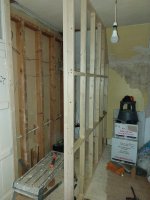
It was slow for the last day or so because the loft has been boarded up (very well and so he must have got a professional in :) ) and fortunately I've got a pretty good Gizmo from Worx that let's me easily cut out sections so I could get some noggins. I've not made a stud partition for over 20 years probably and so it was a re-learning. Mistake I made was not doing the top piece first and then dropping a plumb line to give me where to put the bottom length. I think that I was subconsciously not wanting to get up in the loft in all the dust. But the frame's pretty much there.

Also spent a lot of time head scratching as to how to layout the corner. Lons helped me with this one and other niggles I kept coming across. (y)

20260224_092840.jpg

20260224_083851.jpg

Had to shift the light fitting in this room else it would have been part of the ensuite !

Drilling the holes in the wall at the far end was dusty and flakey. Holes were cleaned out using a can of Air Duster as the vacuum wouldn't touch the dust inside the hole.

20260224_172156.jpg

The reason for the overkill on the noggins is that damn staircase. No way I can (a) carry up a full sheet of plasterboard or (b) around that turn on the stairs. Petrified of falling back down as a result of whatever I'm carrying knocking into the wall or a step. So cutting each plasterboard into three fixes that.

Tomorrow is site visit with my client.
 
Well it may have been a while Roger but that stud wall looks to be competently built!
Shan’t be able to copy much as there are strange rules over here, like the top ( header) has to be double thickness.
 
Trying to work out the optimum position for the new washbasin was proving difficult because of the existing stud wall. So 20 minutes with the Fein and opened it up enough to get a feel for how it would all work. The red marking on the floor being the shower unit.


20260225_111354.jpg

Worked a treat. So modesty panel put up to keep LOML happy, noggin added where the sink bolts will be going and two panels on either side for the mirror fixings and wall-lights. I always do this when fitting radiators or anything to plasterboard. Saves all the faffing around and gives me a guaranteed fixing point.

20260225_174203.jpg20260225_174215.jpg
 
I have a question.

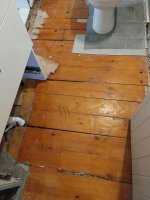
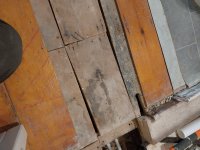
The existing flooring is a dog's dinner. This is the topmost layer (originally hidden underneath that grey lino (?) around the toilet.
20260302_102232.jpg

Then underneath that is the original floorboards....in bits.

20260302_102355.jpg

The actual rafters are OK and pretty much level although there is a drop from L to R across the room (at right-angles to the rafters). I will need to level it up for the shower tray albeit by a small amount. So my thoughts are tending towards ripping up all the flooring (it's less than two 2400 x 1200 sheets) and replacing with ....what ? Bear in mind that I will be laying down cementboard or similar for the tiler to do his stuff.

I originally thought about structural ply (which would have to be cut down to get upstairs) but now I'm thinking that this would be a better alternative.
Screenshot 2026-03-02 at 10.45.38.jpg

Lastly I will need to fix some timber to each rafter to get rid of that slight drop. CLS ? Sawn ?

I welcome your thoughts
 
Yes I agree, I had to remove a load of it after a leak once, you could level up with CLS ripped down but that’s assuming that the slope is uniform, if you were to use ply you could get away with short bits on 16” centres?
 
I always prefer to use waterproof glued underlayment as the lowest layer of a floor. When I was building my last house I had to do so in very wet weather. Sadly it stayed liked that for more than a month. It just wouldn't stop raining. The roof was not there yet, causing the floor of the second floor to be soaking wet for all that time. I feared I would have to remove the whole layer of sheeting when I finally could proceed after the floor had dried again. Not so. As a matter of fact, that same layer of sheeting is still in there 14 years later. No sign of any adverse effect. Since then I have always used that stuff in my projects. It is easy to install and quite durable. It makes it also easy to have a flat floor. The only downside is those sheets are so damn unwieldy when you work on your own, as I always do. Try getting them up the stairs on your own. No fun...
 
Rodger I would not use normal chipboard.
Minimum would be green chipboard and glue the joints.
Best option is WBP ply.
CLS is nicer to work with IF it’s straight!
 
Thanks all. My two usual suppliers are Travis Perkins and Huws Grey but neither seem to list either WBP or green chipboard. Might they call it something else?
 
Thanks all. My two usual suppliers are Travis Perkins and Huws Grey but neither seem to list either WBP or green chipboard. Might they call it something else?
P5
MR (moisture resistant)
Caber Floor
 
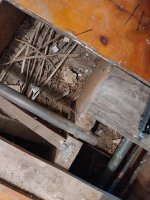
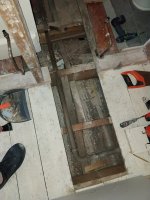
One concern I had was how easy it would be to drill 35mm holes for the 32mm waste pip as it's new location is at 90 degrees to the rafters.. So I've been prying up floorboards to be able to replumb and sort out the waste pipe.

You can imagine my surprise when I came across another of those large pipes...or maybe a continuation of the original one perhaps.
20260228_133129.jpg

And to my surprise found that it was dead and cut off.

20260228_133204.jpg

And to my delight found that I had a ready made channel for the 32mm waste pipe if I removed that old pipe. Result.


20260228_145739.jpg

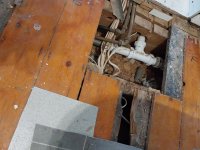
In this next photo you can see the waste pipe that I will eventually connect up to. The grey pipe connected to the LH pipe is an odd size ...37mm....luckily the white pipes are 40mm as Google failed to throw up any converters.

20260302_102349.jpgH

The spur is the old shower pipe. As far as I was aware, it was empty of water and decided to disconnect and remove it from underneath. It still had some manky old shower water and that horrible slimey, gungey stuff that is basially human and shower gel detritus. I got a mouthful, an eyeful, a noseful. Clothes soaked and stinking to High Heaven. Straight to the bathroom to use saline solution to flush out my eyes. I was wearing goggles but the water came down vertically. :eek:
 
Last edited:
Looking at some of your pictures it is almost requiring an archaeological survey, those pipe fittings are antique and why is there so much rubbish under the floors.

1772476911237.png

This bit of plunbing says it all about that bodger who sold you the house, is it plumbing or some attempt at modern art.

1772477290408.png
 
Back
Top