• Hi all and welcome to TheWoodHaven2 brought into the 21st Century, kicking and screaming! We all have Alasdair to thank for the vast bulk of the heavy lifting to get us here, no more so than me because he's taken away a huge burden of responsibility from my shoulders and brought us to this new shiny home, with all your previous content (hopefully) still intact! Please peruse and feed back. There is still plenty to do, like changing the colour scheme, adding the banner graphic, tweaking the odd setting here and there so I have added a new thread in the 'Technical Issues, Bugs and Feature Requests' forum for you to add any issues you find, any missing settings or just anything you'd like to see added/removed from the feature set that Xenforo offers. We will get to everything over the coming weeks so please be patient, but add anything at all to the thread I mention above and we promise to get to them over the next few days/weeks/months. In the meantime, please enjoy!

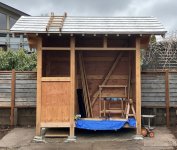
A Japanese style garden shed

Interesting. Gary - I admire your joinery and all things are of course a matter of taste. To me, to achieve a tea house style (I know it's a shed), you have three roof choices. If it's rustic, then thatch, or failing that wooden shingles. If it's a finer building then the curved interlocking Chinese originated ceramic tiles with flower ends or failing that....thatch.

The metal tiles sadly don't look at all right to me. Very sorry to say, as I love your joinery, but this aesthetically does not look at all classical Japanese. All wooden buildings have fire risk I suppose, and that is more about precautions than roof material. In my oak outdoor kitchen, which has a Big Green Egg and a large gas BBQ in it, I roofed it with cedar shingles. I do have a water supply to the building and that would help in the unlikely event of a fire.

Personally, I would have been massively more focussed on aesthetics than longevity, especially with joinery of that quality. Probably I would have thatched it. It may get moss in your climate. That would be a bonus to Japanese.

I hope this is not rude and has not rained on your parade - as I said aesthetics is personal.
 
No offense taken at all on the aesthetics. I part way agree with you. Not my favorite design. De gustibus non disputandum est.

I will disagree that metal is not appropriate for Japanese roof, although copper or painted aluminum might look quieter than terne. I also will note that I live in a part of the world where we get no rain for 4 months and the possibility of forest fires is on the front of everyone's mind in the summer.

Here are some copper panels that are used for Japanese teahouses, temples and shrines in Japan. I love this look.

https://monji.morikunijapan.com/

I inquired about getting these from Japan. The supplier and I both had a good laugh over how much that would cost. I asked the folks who made my roof panels if they could do something similar and they said no.

So the bad news is that it isn't exactly the look I wanted. The good news is that it will be up there forever!
 
Fair enough Gary. I suppose most of my focus on Japanese buildings is based on our extended trips to Japan, largely to visit gardens and temples, plus a few courses on metalworking and fewer on woodworking. You simply do not see copper roofs on tea houses, or small buildings in classical Japanese architecture in our (obviously limited) experience.

Copper is very different to stainless steel & tin. It's quite well known on British ecclesiastical buildings and grand country houses, and the verdigris is beautiful. Moss like perhaps. It is beautiful and ages elegantly.

Of course architecture progresses. But the juxtaposition between very traditional joinery of great skill, and a folded metal roof is interesting. I am sure it will look very nice. You are a skilled man.
 
Far too late to mention it now but one way to get the cost down would have been to use copper anodised aluminium, comes in rolls and sheets, whether you could have found a way to cut and fold it is another thing of course. Or gold if you wanted to be a bit bling!
Ian
 
Yes, there were many options in aluminium in both panels and shingles. Anodized, painted, and other coatings. I looked at all of them and got samples of several. I'm just stubborn, I guess.

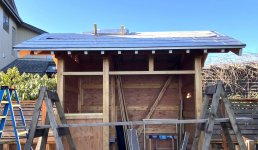
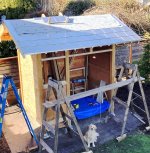
Almost done laying the panels after two days of glorious weather. One more to come before the cold rain sets in again. We should finish up to the ridge tomorrow. I slightly miscalculated and need to order 6 more to finish the job. Here are the views from the back garden and the kitchen. The layout may look a little off but it really isn't. That is the sunlight emphasizing every other panel fold. Each full panel has four sections, the offset is half of one of those sections. In any case, isn't Willa adorable?

F464E165-DCAC-4627-AE5A-791AF92FD8C0_1_201_a.jpegED731BFF-C869-4921-859F-0B3505433529_1_105_c.jpeg
 
Willa, the dog? Absolutely, never had a dog but am now in a very doggy family and am enjoying the experience, good thing is they seem to like me.
Well Gary I wasn’t sure if I would like those SS panels but seeing them in place I think they look brill.
Ian
 
Isn't it a shame that all the complexities of design and manufacture can hardly be seen in the finished article?
 
Andyp":1cbaz444 said:
Isn't it a shame that all the complexities of design and manufacture can hardly be seen in the finished article?


Agreed, and I often say the same about my instruments.
 
Malc2098":pmbo88x2 said:
Andyp":pmbo88x2 said:
Isn't it a shame that all the complexities of design and manufacture can hardly be seen in the finished article?
Agreed, and I often say the same about my instruments.

This is why I devour build threads. I love to see the action behind the scene.

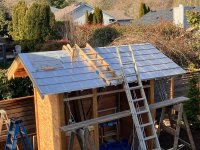
More incremental progress and nearly done. I'm not on the roof myself but my enthusiastic neighbour is. After discussing with him how to finish up to the ridge without walking on the metal panels, both for safety and for not scratching the finish on the panels, I made him a roof ladder padded with bits of yoga mat. He said it worked great
BC999E1B-F11D-48EF-B930-76A09A7EE96B.JPG

We hope to use up and install tomorrow the last of the panels I have while the weather holds. Then a week of cold and rain and maybe even snow is on the way.
 
Still needs the roof cap pieces. I am one short of the number I need and will place the order tomorrow. I'm OK with waiting since we are back to cold rain every day for the next week at least.

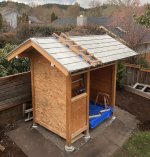
I didn't plan it but the way the panels engage the rake flashing gives them a little swoop up at the rake. An accidental and subtle Asian touch.

93B6A186-1195-4679-83A0-BAC7684327E3_1_201_a.jpegFE6B314A-507C-456B-9DCC-6DB70226AA64_1_201_a.jpeg
 
I definitely see what you mean.
But Gary that "shed" is way too good to store a spade in. It absolutely deserves a weekly tea ceremony in full Japanese style.
I have read Shogun a few times and was taken by the part where a tea house and ceremony is described in detail, right down to little bits of metal in the kettle to make a pleasing sound as it boils and a single drop of water on a flower, it was the husband trying to please his wife with the nice touches, very interesting, the whole book gives a good insight into the Japanese mindset imo.
Ian
 
Cabinetman":18twkyky said:
I definitely see what you mean.
But Gary that "shed" is way too good to store a spade in. It absolutely deserves a weekly tea ceremony in full Japanese style.
I have read Shogun a few times and was taken by the part where a tea house and ceremony is described in detail, right down to little bits of metal in the kettle to make a pleasing sound as it boils and a single drop of water on a flower, it was the husband trying to please his wife with the nice touches, very interesting, the whole book gives a good insight into the Japanese mindset imo.
Ian

If of interest, Shogun is just about to be released as a new mini-series on Disney - starts 27th Feb I believe and looks excellent (if not quite aligned with the book, trailers etc on YouTube as usual).
 
Ha! I enjoyed Shogun too. People argue about Adams as the real life inspiration and it's difficult to know what really happened 400 years ago as Japan was a closed society, but a lot of the details of Japanese life then seem credible, even though the book is really a western romance. Will be interesting to see the adaptation. Thanks for letting us know.
 
AJB Temple":1t9yt3vl said:
Ha! I enjoyed Shogun too. People argue about Adams as the real life inspiration and it's difficult to know what really happened 400 years ago as Japan was a closed society, but a lot of the details of Japanese life then seem credible, even though the book is really a western romance. Will be interesting to see the adaptation. Thanks for letting us know.

I enjoyed Shogun as well; it's really what got me first interested in Japan. I've seen the trailers for the new Disney version which looks quite interesting so I may have to talk to SWIMBO nicely as we don't have that channel at the moment - Rob
 
Woodbloke":1kx0rglo said:
AJB Temple":1kx0rglo said:
Ha! I enjoyed Shogun too. People argue about Adams as the real life inspiration and it's difficult to know what really happened 400 years ago as Japan was a closed society, but a lot of the details of Japanese life then seem credible, even though the book is really a western romance. Will be interesting to see the adaptation. Thanks for letting us know.

I enjoyed Shogun as well; it's really what got me first interested in Japan. I've seen the trailers for the new Disney version which looks quite interesting so I may have to talk to SWIMBO nicely as we don't have that channel at the moment - Rob

I enjoyed Shogun too. Regarding Disney+, we tend to build up a list of stuff we want to watch on it and then every year or two we take out a subscription for one month, watch everything of interest and then cancel the subscription.
 
wet, wet, wet.

It's a large overhang. Any splashback onto the walls?
 
A little splash onto the feet of the posts, but not onto the floor beams or walls. I also have gutters planned that should improve things at the eave edge more. And the ground around the shed at the drip line will be clean gravel so most of the remaining splash back will be water rather than mud. At least that's the plan.
 
AJB Temple":myfx2mft said:
Bell chain downpipe?

Funny you should mention that. Short answer is yes, and while I was walking the dog this morning I was mulling over how I was going to drain the water away from it. Still haven't come up with a plan I like, yet. One option is to drain into a ceramic pot filled with rocks and let the overflow simply drain onto the lawn. Other options involve trenching and drain pipes, which sound dangerously close to doing actual work.
 
Stainless chain is available btw. My bil used stainless cable/wire, not the right effect at all imo.
Wasn’t it the Japanese who had a sort of nodding donkey noise maker thing made from bamboo and powered by rain water?
Ian
 
Yes, I believe I've seen what you describe.

If I go with the rain chain I'd prefer to use copper. That might be a fun DIY job. I'll be using copper flashing for the bottom of the walls so I'll have some to play with.

Water features like this get a lot of use here in Corvallis. We get an average of 42" of rain per year, and half of that arrives in four months Nov-Feb. Not a lot on any one day, but a little most days.
 
If you do make the petals or bells or cups to fit on a copper chain, please do a thread. I need to acquire at least three lengths or make them. The ones available in the UK are ridiculously expensive for those that look authentic. In Japan we've also seen the cup sections made of glass and also green ceramic. Instant verdigris look.
 
AJB Temple":2ynkgq3m said:
If you do make the petals or bells or cups to fit on a copper chain, please do a thread. I need to acquire at least three lengths or make them. The ones available in the UK are ridiculously expensive for those that look authentic. In Japan we've also seen the cup sections made of glass and also green ceramic. Instant verdigris look.

Japanese chains are expensive here, too. I spent some time today looking at rainchains.com, based in the USA. They don't say where their chains are made but since they don't I suspect southeast Asia or China. They do have a nice selection and what seem to me fair prices. I don't think I could make one for what they are asking. But, that part is months away.

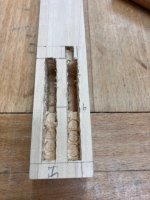
Back to working on the windows. I roughed out the mortices for the haunched tenons with my 100 year old morticer (described in an other thread). It is fast but it leaves the walls a little scalloped because the bit is just slightly larger in diameter than the chisel. The mortice is 1/4 inch wide and the depth is one inch. (6.4 mm and 25 mm). The odd looking small shallow extra mortice is to fix the the lattice frame. That will be clearer later.
6435FA86-2C97-4859-A1C8-E1A2076E5F19_4_5005_c.jpeg
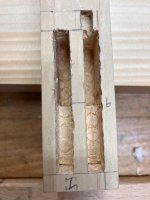
And after a bit of clean up. If you are used to Festool'd mortices and expect perfection, avert your eyes.
8F4EDE3D-C070-41B3-AC6F-35DF839B2D03.JPG

I used regular bench chisels for paring the walls but didn't want to overdo it. I had already sawn the tenons and used those to test the fit. With a single mortice and tenon I find it generally easier to fiddle with the tenon cheeks to get a friction fit. But with double tenons it is hard to access the space between the tenons and easier to pare the mortice walls.

I have read that in Japan a premium is paid for joints that don't expose end grain. Through tenons are avoided. But the longer the tenon the more glue surface one has and therefore the stronger the joint. Yet Japanese window and shoji stiles are relatively thin. Mine are are a commonly used 30 x 30 mm. That means the longest tenon that can be used without going through is about 29 mm. I have also read and seen pictures of mortices that approach so closely to the outside of the stile that light shows through! How then is an expert shoji maker to chop a mortice that close to the edge and not accidentally blow through the end of the mortice?

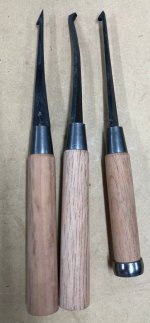
Special tiny morticing tools.
sokozarai.jpeg

three chisels.jpeg

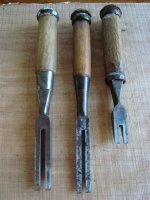
On the left is a harpoon used to break up chips made by hand morticing chisels so they can be removed more easily. In the center is a sokozorai, sort of like a swan neck chisel, to pare the bottom of the mortice. On the right is a chisel used to pull out the chips broken up by the harpoon. They are all 4. 5 mm wide to allow them to fit into typical 6 mm mortices. Not so useful for larger mortices.

These chisels are often sold as a set like this. But I often use my morticing machine which removes chips just fine and I use the sokozorai only rarely. I've used that to clean up the mortice bottoms here for a little extra clearance but I am not risking getting close enough to see light through the end. But it is also genius for when you need it to get into tight spaces. I did another project awhile ago where it was the only tool that would work and I was glad to have it.
 
All well and good but for a couple of mm's length on a tenon that’s more time and effort than it’s worth in my humble opinion, methinks they are just being clever for the sak’e of it. Interesting chisel shapes though.
I wonder if they dig the mortise and then plane the wood off the outside till it’s see through, or am I being cynical?
Ian
 
Why would you use a double M&T in a piece of wood only 30mm wide? That's a single 1/2" tenon for my money, pegged.
 
Very interesting Gary. I have not seen those tools before, or read that. Not that I am any kind of expert at all! If you look at temple architecture, which is possibly where you might expect to find high quality joinery, they have no compunction about exposing end grain. And this is in places exposed to rain and generally high humidity.

At Saihōji (Kokadera - the Moss Temple near Kyoto that you have to apply in advance by special postcard to get into -it's very cool in this day and age) at one end of the large sutra chanting room where you have to do the script copying, is a lattice screen on the outside wall. My wife and I took photos of this (not at home so can't access) and the construction is half lapped with through tenons all round and thin spreader wedges of the same wood (honoki cyprus is my unverified guess) tapped in to lock the tenons securely. There are hundreds of these joints, all spot on accurate to my eye and all with exposed end grain that can get wet in tropical storms.

So I think the Japanese do it both ways. 8-)

PS This is one of the most memorable gardens we have seen anywhere in the world. Very spiritual, even though I am not a believer in any of that stuff.
 
Not super impressed with the finish off that morticing machine. :o Looks like it is tearing the wood. I just keep it simple with hand mortices. Mark sides with gauge and knife cut the end lines. Drill out waste inside the mark line with a drill and depth stop. Pare down the sides with super sharp chisel and likewise corners. If I need to clean up the bottom I use my chisel as a scraper. Some may see this as chisel abuse, but it's just a metal edge and easy to sharpen again.

I know traditional way is fully chopped, but drilling is quicker. I don't own a morticing machine (but do have a domino which is about 100 times quicker :lol: ).
 
AJB Temple":39s0fol4 said:
Very interesting Gary. I have not seen those tools before, or read that.
Chisels like that can be purchased quite easily in the UK at Classic Hand Tools - Rob
 
AJB Temple":8jhablhc said:
Not super impressed with the finish off that morticing machine. .

I agree. Part of the problem is the softwood. The other is that I may need to sharpen the chisel a bit more. :D

I also agree that going through all the extra work to make the deepest-without-breaking-through mortice seems like an affectation, or showing off.

The double tenon, though, is standard on shoji screens. It doubles the glue area, and provides more resistance to twisting than a single tenon. I don't think I've ever seen shoji with a pegged tenon. Certainly it can be done that way.

When done by hand, there used to be a special chisel that would cut both mortices at the same time, a nihon mukomachi nomi. Today these are usually done by machine or hand chopping them individually.

nihon nomi.JPG
 
AJB Temple":einshxvy said:
Thanks for mentioning rain chains.com. ...I shall have to investigate getting a US friend to ship me a sample chain.

Their ordering page says that they will ship internationally.
 
Yes, but we have import silliness and duties to contend with. Makes it unpredictable. :?

Rob - thanks. I had a look out of interest although I don't need any more chisels. The Kanamoni and Sokasarai are both unavailable and they are £95 each :o
 
AJB Temple":2iptgpem said:
Yes, but we have import silliness and duties to contend with. Makes it unpredictable. :?

Rob - thanks. I had a look out of interest although I don't need any more chisels. The Kanamoni and Sokasarai are both unavailable and they are £95 each :o

What?!!! :shock: ...... My total chisel collection doesn't add up to anything like that much. Probably not even allowing for inflation.
 
Never seen anything like those flower rain chains, they’re beautiful. This build is so interesting for someone who knows little about Japanese construction.
 
MattS":3l631a2n said:
Never seen anything like those flower rain chains, they’re beautiful. This build is so interesting for someone who knows little about Japanese construction.

I first saw them about 40 years ago when I was in Yokohama for 10 days on a work trip. I worked during the weekdays but had time to wander around on my own in the evenings. I saw some of these on houses in a relatively wealthy neighborhood and was entranced. I asked my host where I could get one to take home with me. They thought it was funny that a rain chain is what I wanted to take back from Japan rather than the usual tourist fare and didn't know exactly where to get one but indulged me and took me to hardware store to talk to the owners. It turned out that I couldn't afford one on my meager salary but the idea has stayed with me. Now they are more widely available. I see a couple in my neighbourhood here in Oregon.
 
Back
Top