AJB Temple":2ynkgq3m said:
If you do make the petals or bells or cups to fit on a copper chain, please do a thread. I need to acquire at least three lengths or make them. The ones available in the UK are ridiculously expensive for those that look authentic. In Japan we've also seen the cup sections made of glass and also green ceramic. Instant verdigris look.
Japanese chains are expensive here, too. I spent some time today looking at rainchains.com, based in the USA. They don't say where their chains are made but since they don't I suspect southeast Asia or China. They do have a nice selection and what seem to me fair prices. I don't think I could make one for what they are asking. But, that part is months away.
Back to working on the windows. I roughed out the mortices for the haunched tenons with my 100 year old morticer (described in an other thread). It is fast but it leaves the walls a little scalloped because the bit is just slightly larger in diameter than the chisel. The mortice is 1/4 inch wide and the depth is one inch. (6.4 mm and 25 mm). The odd looking small shallow extra mortice is to fix the the lattice frame. That will be clearer later.
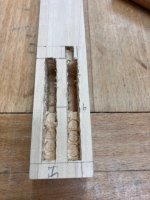
And after a bit of clean up. If you are used to Festool'd mortices and expect perfection, avert your eyes.
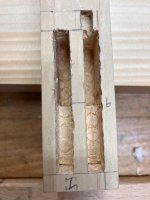
I used regular bench chisels for paring the walls but didn't want to overdo it. I had already sawn the tenons and used those to test the fit. With a single mortice and tenon I find it generally easier to fiddle with the tenon cheeks to get a friction fit. But with double tenons it is hard to access the space between the tenons and easier to pare the mortice walls.
I have read that in Japan a premium is paid for joints that don't expose end grain. Through tenons are avoided. But the longer the tenon the more glue surface one has and therefore the stronger the joint. Yet Japanese window and shoji stiles are relatively thin. Mine are are a commonly used 30 x 30 mm. That means the longest tenon that can be used without going through is about 29 mm. I have also read and seen pictures of mortices that approach so closely to the outside of the stile that light shows through! How then is an expert shoji maker to chop a mortice that close to the edge and not accidentally blow through the end of the mortice?
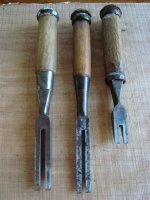
Special tiny morticing tools.
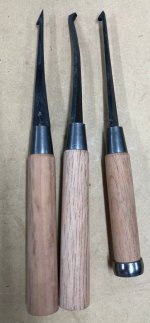
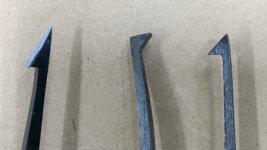
On the left is a harpoon used to break up chips made by hand morticing chisels so they can be removed more easily. In the center is a
sokozorai, sort of like a swan neck chisel, to pare the bottom of the mortice. On the right is a chisel used to pull out the chips broken up by the harpoon. They are all 4. 5 mm wide to allow them to fit into typical 6 mm mortices. Not so useful for larger mortices.
These chisels are often sold as a set like this. But I often use my morticing machine which removes chips just fine and I use the sokozorai only rarely. I've used that to clean up the mortice bottoms here for a little extra clearance but I am not risking getting close enough to see light through the end. But it is also genius for when you need it to get into tight spaces. I did another project awhile ago where it was the only tool that would work and I was glad to have it.







 Looks like it is tearing the wood. I just keep it simple with hand mortices. Mark sides with gauge and knife cut the end lines. Drill out waste inside the mark line with a drill and depth stop. Pare down the sides with super sharp chisel and likewise corners. If I need to clean up the bottom I use my chisel as a scraper. Some may see this as chisel abuse, but it's just a metal edge and easy to sharpen again.