• Hi all and welcome to TheWoodHaven2 brought into the 21st Century, kicking and screaming! We all have Alasdair to thank for the vast bulk of the heavy lifting to get us here, no more so than me because he's taken away a huge burden of responsibility from my shoulders and brought us to this new shiny home, with all your previous content (hopefully) still intact! Please peruse and feed back. There is still plenty to do, like changing the colour scheme, adding the banner graphic, tweaking the odd setting here and there so I have added a new thread in the 'Technical Issues, Bugs and Feature Requests' forum for you to add any issues you find, any missing settings or just anything you'd like to see added/removed from the feature set that Xenforo offers. We will get to everything over the coming weeks so please be patient, but add anything at all to the thread I mention above and we promise to get to them over the next few days/weeks/months. In the meantime, please enjoy!

Chair Steps Project

I tried that and it worked well but my missus was not at all amused that I used the oven and stunk the house out for days. :ROFLMAO:
I had that problem too but I minimised it by doing most of the "cooking" in the open air with a hot air gun first before finishing in the oven :)
 
I really like that modification to the 271. I've got a little Record router plane that looks the same (I can't remember the number but it might well be 271). I might have to make the same modification. Thanks for the idea.
One challenge to be overcome is making the screw to secure the threaded post to the body of the plane. The threaded holes in the body of my Stanley are of a weird size (as is often the case with Stanleys). The outer diameter is about 3/16" and the pitch is 28 TPI. It is probably an obsolete type of US No. 10 machine screw - it is not a UNC No. 10, which is 24 TPI, or a UNF No. 10, which is 32 TPI. As I had no suitable die I cut the thread of my screw using a screw cutting lathe - I find that hand cranking is good when making such small screws (I think it would be easy with a treadle-powered lathe too). You will need to find out the details of the screw thread in your Record - they often copied Stanley but not always.
 
It's fascinating to follow your build and try to think back to the details of mine from twelve years ago.
On the housings for the steps, I looked back at my photos and found that the cuts into the legs were probably about 3/16" at the front and only 1/8" at the back (where the slanting legs are thinner than the decorative front ones). I did dry-fit the parts to make sure that the surfaces of the four leg housings on each side were all in the same plane. I also worked the step pieces clamped together as single units, with straight sides. They have all stayed together nicely, just glued with liquid hide glue.

Where I did go wrong was that I cut the front leg housings all the way through, which would have been fine if the front edge of the step had been square. But when I put a moulding on the edge, it revealed a gap, which I had to fill in with a patch. I can see that you have cleverly avoided this trap by arranging for the full-size square section of the leg to coincide with the step, and have cut two stopped housings on each one. Smart!

And I am another fan of that ingenious modification to the little router. I really like how there's no need to permanently alter the original tool - the extra hole for the threaded post is already there, as is the hole for a locking screw to keep it in place. I'm definitely copying that one - thanks!
Thanks. Please see my reply to Dr.Al's comment concerning the router plane. With your lathe I think you are well equipped to do the job.
 
One challenge to be overcome is making the screw to secure the threaded post to the body of the plane. The threaded holes in the body of my Stanley are of a weird size (as is often the case with Stanleys). The outer diameter is about 3/16" and the pitch is 28 TPI. It is probably an obsolete type of US No. 10 machine screw - it is not a UNC No. 10, which is 24 TPI, or a UNF No. 10, which is 32 TPI. As I had no suitable die I cut the thread of my screw using a screw cutting lathe - I find that hand cranking is good when making such small screws (I think it would be easy with a treadle-powered lathe too). You will need to find out the details of the screw thread in your Record - they often copied Stanley but not always.
Being a someone who is now a major fan of metric (believe it or not, I used to use imperial exclusively, but learning metalwork showed me what a terrible system imperial is for machining), I'll probably just drill & re-tap the hole with a 0.5 mm or 1 mm thread. That'll make everything easier, even if it means the plane isn't standard any more.
 
  • Like
Reactions: rxh
I found a bit of workshop time this morning and made a start on my own little router. I can confirm that the necessary thread for the locking screw is indeed 3/16" and 28tpi.
I do have a very similar tap and die marked UNS 10-28, which is correct for the handle bolts on many Stanley planes, but it didn't seem to match the screw from my Stanley 271.
I could have made a little screw on the lathe, with a single point cutter, but in a triumph of keeping things that might come in useful, I found that I did have a matching screw that I could use. I've no idea where it came from, so I'm sorry but I can't suggest a source for a further supply :(

However, although I have a couple of 3/16 40tpi Model Engineering dies, I don't have a matching tap.
So on mine, if I finish it, the adjusters will be threaded 2BA, which I do have the bits for. That's a metric thread but doesn't come in simple round numbers. It's very close to M5 but about 32 tpi, so probably fine enough.

By using this variety of obsolete threads, I'm hoping to please both metric and imperial woodworkers without any favouritism or bias.

I'm also hoping to produce a suitable puzzle for some future tool collctor/user, long after this useful forum thread has disappeared into the world's collective amnesia! :)
 
  • Like
Reactions: rxh
Here is the first glue-up. I used liquid hide glue, following AndyT's example.
IMG_8219.JPG

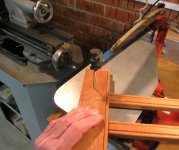
Then I cut the curved shape of the upper rail using a powered fretsaw:
IMG_8220.JPG

Then I cleaned up with a Corradi half round rasp:
IMG_8221.JPG

Followed by a half round file:
IMG_8222.JPG

I'm unlikely to make any more progress until after Christmas.
IMG_8223.JPG
 
I was able to spend some time in the workshop yesterday and today. I drilled and countersank the holes in the top rails for the holes for the screws that will attach the seat. I keep a dedicated hand drill with bit in it ready for countersinking.
IMG_8224.JPG

Then I worked beads in the upper front faces of the back legs.
IMG_8231.JPG

I am leaving the tops of the back legs unfinished until after possible final length adjustment.IMG_8233.JPG

Now I was ready for some test dry assemblies.
IMG_8234.JPG
IMG_8237.JPG

As I was satisfied that everything went together OK I wend ahead with glue-up. My workshop is very cold so I kept the components in a warm room for a while first, warmed the glue bottle in hot water and warmed the air with a fan heater. I put masking tape by the joints because I dislike cleaning off the excess glue.IMG_8240.JPG
IMG_8241.JPG
 
I was able to spend some time in the workshop yesterday and today. I drilled and countersank the holes in the top rails for the holes for the screws that will attach the seat. I keep a dedicated hand drill with bit in it ready for countersinking.
View attachment 30972

Then I worked beads in the upper front faces of the back legs.
View attachment 30973

I am leaving the tops of the back legs unfinished until after possible final length adjustment.View attachment 30974

Now I was ready for some test dry assemblies.
View attachment 30975
View attachment 30976

As I was satisfied that everything went together OK I wend ahead with glue-up. My workshop is very cold so I kept the components in a warm room for a while first, warmed the glue bottle in hot water and warmed the air with a fan heater. I put masking tape by the joints because I dislike cleaning off the excess glue.View attachment 30977
View attachment 30978
Very nice work!
 
  • Like
Reactions: rxh
I generally clamp on stops when using a scratch-stock to do stopped profiles. It's a bit easier doing that than re-doing all your profiles (beads in this instance) because you slipped over a line by mistake.
 
  • Like
Reactions: rxh
I generally clamp on stops when using a scratch-stock to do stopped profiles. It's a bit easier doing that than re-doing all your profiles (beads in this instance) because you slipped over a line by mistake.
Thanks - that is a valuable tip. It is easy to overshoot.
 
This looks interesting and could be very useful too, looking foward to seeing the end result.
 
  • Like
Reactions: rxh
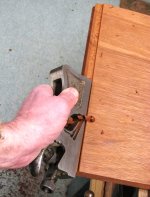
After removing the cramps I cleaned up the joints with a small plane.
IMG_8242.JPG
IMG_8244.JPG
IMG_8245.JPG

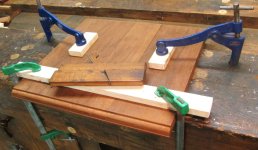
Then I trimmed the end grain of the sloping legs with a large mitre plane.
IMG_8256.JPG
IMG_8257.JPG

Now it was time to turn my attention to the joints between the back legs and the top step (which rests on the floor when in "chair mode"). This illustration is from the original design:
20141005_142017A.jpg

I varied the joint slightly because my infill parts "C" have the grain running at 90 degrees to that shown in the illustration and I wanted my dovetail slots to be in end grain. I sawed the board to produce the tails and cleaned up with chisels.
IMG_8259.JPG

Then I marked up the positions of the pins.
IMG_8263.JPG

I sawed as much as possible of the pins:
IMG_8264.JPG

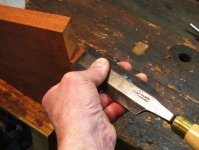
Then I set to work with chisels to remove the waste:
IMG_8265.JPG
 
Last edited:
Nice. I'm really, really enjoying reading this WIP (and seeing your plane collection!)

Thanks for sharing in so much detail, it really is appreciated.
 
  • Like
Reactions: rxh
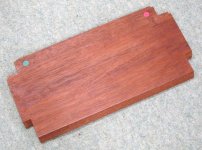
After completing the dovetails I cut the angled side of the step. I intend to plane it down to final size after it is glued in place.
IMG_8268.JPG

Then I moved on to the second to top step. I prepared a board a trifle longer than the intended final length. A Record 05 1/2 plane is satisfactory for shooting.
IMG_8269.JPG

I sawed off the corner areas that should engage with the housings in the legs.
IMG_8272.JPG

Then I pared them to a good fit.
IMG_8273.JPG
IMG_8274.JPG

Now it was time for a dry test assembly of the rear parts of the chair.
IMG_8276.JPG
IMG_8277.JPG
 
I moved on to the bottom step. It required exact tailoring to get it to fit the housings in the legs. To try and avoid mishaps I made a cardboard template to fit and used it to mark the step with the areas to be cut away.IMG_8278.JPG

This was the result. It didn't require much adjustment to get it to fit.
IMG_8279.JPG

This is a test dry assembly of the front part of the chair.
IMG_8280.JPG
IMG_8281.JPG

Here are both parts together (not glued yet and missing the seat parts but giving an idea of the final appearance).
IMG_8282.JPG

I feel that I am getting somewhere now but there are still some interesting challenges to be met and decisions to be made, including: what sort of mouldings to work on the seat components and how to work them, what sort of hinges to use (e.g. butt or counter flap), what sort of stain and finish to apply.
 
Templating was a very good idea! I think I may have had to glue a little bit of extra wood on when I made mine. Fortunately most of my mistakes live down in the shadows most of the time...
 
  • Like
Reactions: rxh
This is great. I'm currently trying to design a chair and that is proving very challenging! Making them will be even harder so I'm full of admiration.
 
  • Like
Reactions: rxh
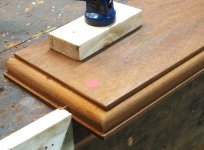
I'm waiting for the weather to get a bit warmer before doing the next glue-ups. In the meantime I have started work on the seat pieces. I wanted to have mouldings on the outer edges so had to choose a shape and a method of working them. I have a fair number of complex moulding planes but was not confident of being able to use them successfully on the end grain edges. Eventually I decided to cut ovolo shapes using a method rather similar to that of AndyT. Of course, an electric router could be used but I dislike them owing to the noise and the dust they make.

After shooting the boards to length I cut a shallow rebate.IMG_8284.JPG

Then I marked a line across the rebate and scored it deeper with a scalpel.
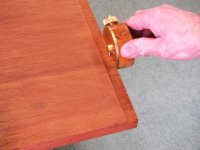
IMG_8285.JPG
IMG_8286.JPG

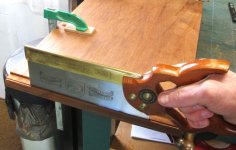
I used a paring chisel to cut a channel for starting a saw cut.
IMG_8287.JPG

After that, I sawed a deep rebate almost as far as the depth I wanted.
IMG_8291.JPG

The scored line marks the intended final depth.
IMG_8290.JPG

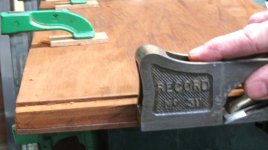
I removed most of the waste with a chisel.
IMG_8292.JPG

Then I finished to depth with a shoulder plane.
IMG_8293.JPG

Next, I planed a chamfer.
IMG_8294.JPG

After dealing with all the end grain edges of both boards in the same way I clamped the boards together and proceeded to complete the shape using a "hollow" moulding plane, working from both ends towards the middle in order to avoid tear-out at an end. I have AndyT to thank for his example in clamping the boards together with the aim of having them line up nicely on the completed chair.
IMG_8296.JPG
IMG_8297.JPG

From reference to Goodman's British Planemakers, 4th Edition, my plane appears to have been made by John Green, father or son, in York between 1765 and 1808. I find it very pleasing to use such an old tool.
IMG_8299.JPG

This is the moulding after a bit of cleaning up with abrasive paper.
IMG_8300.JPG
 
Last edited:
That looks brilliant.
And what a splendid set of clear photos. Thanks for taking the extra time to record all the steps.
 
  • Like
Reactions: rxh
+1. That was really nice to read and see the steps involved so clearly.

In the background of the first photo there's what looks like a screwdriver with a pin sticking out the side? What's that for?
Thanks. It is a screwdriver for adjusting the small rebate plane. The tip is for the screws that hold the depth stop and nickers. The pin fits in the holes in the fence rods to allow them to be removed completely or replaced in the other side of the plane for left handed use.
IMG_8301.JPG
IMG_7292A.JPG
 
I took a slightly different approach with the mouldings on the "along the grain" edges of the seat. Using a Record small plough plane I made 1/4" wide grooves, then removed most of the rest of the waste with a shoulder plane.
IMG_8304.JPG
IMG_8305.JPG

Then I finished with the "hollow" moulding plane.
IMG_8307.JPG

This is how a corner looks.
IMG_8309.JPG

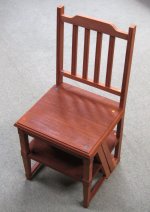
Here is a dry assembly in "chair" mode.
IMG_8310.JPG
IMG_8311.JPG

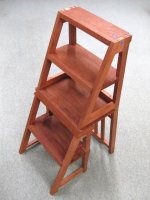
And here in "steps" mode.
IMG_8312.JPG
IMG_8313.JPG
 
Nice, how are you doig the glue up stages or all in one go?

Pete
Thanks. I have glued up the side frames and back slats parts. I intend to do a final glue up of the back portion of the chair in one go and the same for the front portion.
 
Looking nice.

What I will have to wait for, is how secure this design of chair steps feel in use ... I wonder if the top step with the dovetails would really be used, if not a version without it could be simplification (I've been thinking about having a go at one of these chairs since Andy T made his - I have a not very tall wife ...)
 
  • Like
Reactions: rxh
Looking nice.

What I will have to wait for, is how secure this design of chair steps feel in use ... I wonder if the top step with the dovetails would really be used, if not a version without it could be simplification (I've been thinking about having a go at one of these chairs since Andy T made his - I have a not very tall wife ...)
To be frank, it feels less secure as each year goes by...
MrsT is only just above 5' and I don't think she's ever stood on the top. I probably did when I made our steps, but certainly don't make a habit of it.

That said, in the room where ours lives, the bookcases go up quite high and you can put the steps alongside, so there's always a firm shelf on which you can rest a steadying hand. But most of the time, you'll only go up one step above the level of standing on the chair.

But don't let that put you off making one!

I've got pictures of some other variants and will see if I can find them and post them up.
 
They do look good. Where is the catch that stops the chair unfolding when picked up ?
Thanks. Following AndyT's example, I intend to attach a cabin hook to one side.
 
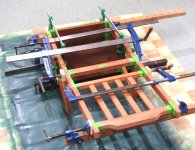
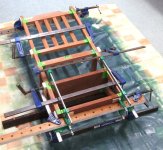
With some trepidation, I went for the big glue up.
IMG_8315.JPG
IMG_8316.JPG

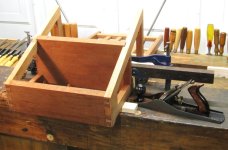
Then I planed the edges of the steps flush with the legs.
IMG_8317.JPG
IMG_8318.JPG

Cleaning up the top step was an opportunity to put my Shrenik Salva-Shah mitre plane to good use.
IMG_8320.JPG

Then I planed the ends of the steps with a block plane.
IMG_8321.JPG

And finished with a chariot plane.
IMG_8322.JPG
 
Back
Top