

I've done very little woodwork lately, and no proper projects. This isn't much, but it's the sort of thing that I like to harmlessly mess about with in my ̶w̶o̶r̶k̶s̶h̶o̶p̶ playroom, so I took some photos to show how I go about this sort of thing.
Some time ago, we redecorated one of the bedrooms and boxed in some pipes in the corner. This meant that there was a gap in the picture rail, like this:

No big deal really, but I fancied trying to plug the gap. It's not original picture rail but it's right for the age of the house and installed where there used to be some before fashions changed. Trouble is, the timber merchant where I bought the moulding closed down years ago and I don't know of anyone locally who would have it in stock. And if they did, they might not be very interested in selling me about 330 mm of it.
Instead, I found an offcut of nice, straight-grained, easy to work parana pine and planed it to the right size:

I then used my nice Temco template former to transfer the shape of the existing rail onto the ends of this new wood.

With that done, I marked out where the flats go, that define the different parts of the section. Two narrow grooves and a little rebate.

Then I ploughed the grooves

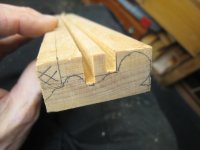
and cut the rebate

After that, there was a not terribly systematic sequence, using bench planes, rebate planes, hollows and rounds, to get the shape about right. Hard to photograph so these are just to give a general idea. I'm not presenting this as a tutorial - I've done similar odd jobs before but not very often and not on this small, fiddly scale.

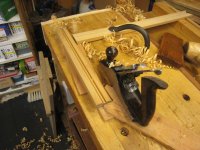

After a while, the shape was approximately correct,

so it was time to cut a scribe on one end. I knew that the way to do that is to first cut a mitre, then saw along the line.
Here's my fanciest mitre saw

and my "Olde Concepts" fretsaw

You'll be pleased to see that I have selected both of these (and many of my other tools) to use the same, standardised, cordless power source.
The fretsawing was soon done:


I know this is all totally unnecessary, but it kept me amused for a while and is one of the reasons why I have several shelves worth of old planes. If all I ever do is dust them, I might as well have a set of Meissen tableware or Ming vases, but old tools are not just for decoration - when jobs like this can be found, they can be justified as useful as well!
Stay tuned to find out if it will fit...
Some time ago, we redecorated one of the bedrooms and boxed in some pipes in the corner. This meant that there was a gap in the picture rail, like this:
No big deal really, but I fancied trying to plug the gap. It's not original picture rail but it's right for the age of the house and installed where there used to be some before fashions changed. Trouble is, the timber merchant where I bought the moulding closed down years ago and I don't know of anyone locally who would have it in stock. And if they did, they might not be very interested in selling me about 330 mm of it.
Instead, I found an offcut of nice, straight-grained, easy to work parana pine and planed it to the right size:
I then used my nice Temco template former to transfer the shape of the existing rail onto the ends of this new wood.
With that done, I marked out where the flats go, that define the different parts of the section. Two narrow grooves and a little rebate.
Then I ploughed the grooves
and cut the rebate
After that, there was a not terribly systematic sequence, using bench planes, rebate planes, hollows and rounds, to get the shape about right. Hard to photograph so these are just to give a general idea. I'm not presenting this as a tutorial - I've done similar odd jobs before but not very often and not on this small, fiddly scale.
After a while, the shape was approximately correct,
so it was time to cut a scribe on one end. I knew that the way to do that is to first cut a mitre, then saw along the line.
Here's my fanciest mitre saw
and my "Olde Concepts" fretsaw
You'll be pleased to see that I have selected both of these (and many of my other tools) to use the same, standardised, cordless power source.
The fretsawing was soon done:
I know this is all totally unnecessary, but it kept me amused for a while and is one of the reasons why I have several shelves worth of old planes. If all I ever do is dust them, I might as well have a set of Meissen tableware or Ming vases, but old tools are not just for decoration - when jobs like this can be found, they can be justified as useful as well!
Stay tuned to find out if it will fit...


 .
.


