• Hi all and welcome to TheWoodHaven2 brought into the 21st Century, kicking and screaming! We all have Alasdair to thank for the vast bulk of the heavy lifting to get us here, no more so than me because he's taken away a huge burden of responsibility from my shoulders and brought us to this new shiny home, with all your previous content (hopefully) still intact! Please peruse and feed back. There is still plenty to do, like changing the colour scheme, adding the banner graphic, tweaking the odd setting here and there so I have added a new thread in the 'Technical Issues, Bugs and Feature Requests' forum for you to add any issues you find, any missing settings or just anything you'd like to see added/removed from the feature set that Xenforo offers. We will get to everything over the coming weeks so please be patient, but add anything at all to the thread I mention above and we promise to get to them over the next few days/weeks/months. In the meantime, please enjoy!

Patching a picture rail

AndyT

Old Oak
Joined
Nov 23, 2020
Messages
3,633
Reaction score
1,413
Location
Bristol
Name
Andy
I've done very little woodwork lately, and no proper projects. This isn't much, but it's the sort of thing that I like to harmlessly mess about with in my ̶w̶o̶r̶k̶s̶h̶o̶p̶ playroom, so I took some photos to show how I go about this sort of thing.

Some time ago, we redecorated one of the bedrooms and boxed in some pipes in the corner. This meant that there was a gap in the picture rail, like this:

IMG_9155.JPG

No big deal really, but I fancied trying to plug the gap. It's not original picture rail but it's right for the age of the house and installed where there used to be some before fashions changed. Trouble is, the timber merchant where I bought the moulding closed down years ago and I don't know of anyone locally who would have it in stock. And if they did, they might not be very interested in selling me about 330 mm of it. :(

Instead, I found an offcut of nice, straight-grained, easy to work parana pine and planed it to the right size:

IMG_9132.JPG

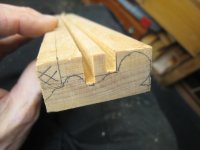
I then used my nice Temco template former to transfer the shape of the existing rail onto the ends of this new wood.

IMG_9134.JPG

With that done, I marked out where the flats go, that define the different parts of the section. Two narrow grooves and a little rebate.

IMG_9135.JPG

Then I ploughed the grooves

IMG_9136.JPG

IMG_9137.JPG

and cut the rebate

IMG_9142.JPG

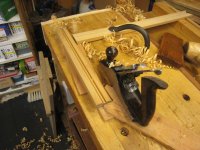
After that, there was a not terribly systematic sequence, using bench planes, rebate planes, hollows and rounds, to get the shape about right. Hard to photograph so these are just to give a general idea. I'm not presenting this as a tutorial - I've done similar odd jobs before but not very often and not on this small, fiddly scale.

IMG_9143.JPG

IMG_9145.JPG

IMG_9147.JPG

After a while, the shape was approximately correct,

IMG_9148.JPG

so it was time to cut a scribe on one end. I knew that the way to do that is to first cut a mitre, then saw along the line.

Here's my fanciest mitre saw

IMG_9149.JPG

and my "Olde Concepts" fretsaw

IMG_9150.JPG

You'll be pleased to see that I have selected both of these (and many of my other tools) to use the same, standardised, cordless power source. ;)

The fretsawing was soon done:

IMG_9153.JPG

IMG_9154.JPG

I know this is all totally unnecessary, but it kept me amused for a while and is one of the reasons why I have several shelves worth of old planes. If all I ever do is dust them, I might as well have a set of Meissen tableware or Ming vases, but old tools are not just for decoration - when jobs like this can be found, they can be justified as useful as well! :D

Stay tuned to find out if it will fit... ;)
 
I like that plough plane (or combination plane) with the screw adjustment, Andy. My lever adjustment is a thing of endless frustration.

As you know, coping perfectly isn't necessary, as filler and paint will hide any issue. But it is fun to try to get it right. I always undercut mine slightly (ie it's not at right angles to the face), and the fine work is done with files.
 
Mike G":2tram0rt said:
I like that plough plane (or combination plane) with the screw adjustment, Andy. My lever adjustment is a thing of endless frustration.

As you know, coping perfectly isn't necessary, as filler and paint will hide any issue. But it is fun to try to get it right. I always undercut mine slightly (ie it's not at right angles to the face), and the fine work is done with files.

It's a Record 405. I reckon it's a really well designed and well made tool. Because they were popular with joiners in the 50s and 60s, there are plenty of decent, complete examples around, in their original fitted boxes, and the prices are pretty low. I don't think any big YouTube stars have over-promoted it yet.

And you are perfectly correct about files, filler and paint - I think I'll be relying on them all!
 
It is interesting the different ways that moulding can be made by hand. I would have gone for one big rebate and then a shallow groove and stepped rebate rather than two grooves and a rebate. I suppose it would come down to which is faster a rebate plane or groove then No 5. I have no idea what the answer is but it made me question my methods which is good.
 
Andy, I can understand and appreciate your satisfaction in making this. Quality work, as ever. Excellent WIP and photos to boot.

Quick question....which supplier do you buy 'patience' from ? ;)
 
Peter - there are probably plenty of different ways to go about a composite moulding like this. I didn't try to be efficient or quick, I was just doodling with a bit of wood.

Roger and Bob - if I had been under time pressure, I'd just have left the gap, but my time is my own and I can let work expand to fill the time available :).
 
Lovely job, you'll have a sense of satisfaction everytime you look at it, even if no one else knows quite how much work went into 330mm of picture rail :lol:
 
I am really appreciating your love of doing things with hand tools Andy, now that I am retired and setting up a new workshop I am thinking more and more about not buying electric I bought a combination plane recently, still boxed and it still has the shaving deflector! also a rebate plane. But it didn’t stop me buying an old radial pillar drill the other day, just couldn’t resist it!
I am beginning to realise just how much time it took/wasted to set up my electric workshop to do simple little jobs.
Ian
 
MattS":1nvst9c8 said:
Lovely job, you'll have a sense of satisfaction everytime you look at it, even if no one else knows quite how much work went into 330mm of picture rail :lol:

Oh, yes, definitely. People on here are the only ones who will understand that!

And Ian, you're dead right about the simplicity of hand tools. I'm much happier bringing the tool to the job for a few more shavings than anything that needed a numerical setting.

But if I had space for a lovely old pillar drill, I'd have said yes as well :).
 
I have #405 wooden box and all the cutters, by grandfather's, for the small odd jobs I've used it for I've found it takes as long to refamiliarise myself and set it up then it does to do the job at hand. I've remarked before though that it takes a lot longer for things to go wrong than with a router.

Do you actually hang pictures off those rails? I am sure somewhere I have a box of the metal hooks used for that purpose which is strange as not since I was 14 have I lived in a house where I could use them.
 
Andyp":2xhcouso said:
I have #405 wooden box and all the cutters, by grandfather's, for the small odd jobs I've used it for I've found it takes as long to refamiliarise myself and set it up then it does to do the job at hand. I've remarked before though that it takes a lot longer for things to go wrong than with a router.

I've got the Stanley #45 (same thing as the Record #405 I think) and I generally think I can set it up and use it (for a simple groove) quicker than I could an electric router. These are even quicker than the #45 though - I can plough a groove quicker than I could find the right size router bit! I guess it does come down to familiarity partly (and also whether you have to dismantle the #45 to fit it in its box).

What I have found can be a difference (between electric and #45) is workholding. To rout a groove in a relatively thin piece is quite straightforward on a router table, but with something like a #45 you need to much about with sticking boards and things like that.

Andyp":2xhcouso said:
Do you actually hang pictures off those rails? I am sure somewhere I have a box of the metal hooks used for that purpose which is strange as not since I was 14 have I lived in a house where I could use them.

Our house has (much plainer design) picture rails (also known as dado rails I think) as well. We don't have anything hanging from them (although they give a handy place to put the keys for the window locks on!). When I was a student renting houses in Bristol, some of the houses had picture rails and we used the hooks to hang stuff off as we weren't allowed to put nails in the wall.


P.S. I really enjoyed reading the picture rail post AndyT - I don't think it would ever have occurred to me to make compound shapes in that way.
 
Taking the easiest question first, yes, we do use our picture rails and have plenty of bent brass hooks for the purpose. I very much doubt if this tiny insert will get anything hung from it though.

But turning to the slight digression about preferred plough planes... I don't quite have one plane per cutter but there is always going to be a bit of a pause before any groove gets cut, while I decide which tool to use :).

Naturally, a dedicated one-trick tool is always going to be quicker and easier, provided that you have the storage space. Al, I like the look of your grooving planes!

The simplest plough planes just make grooves along the grain, with the fence towards you.

You can add as many extra options as you please. The usual ones include

- a wider range of sizes of cutters
- a wider choice of reach and depth
- easier adjustment
- scoring cutters for cross-grain work
- support for cutting rebates
- ability to reference off the far side (fillister cuts)
- ability to cut beads
- ability to cut simple mouldings
- ability to cut complex asymmetrical mouldings
- fancy stuff on chamfers or at non-right angles.

(And that's all without getting onto curved cuts.)

That sequence gets you from a basic wooden plough, or a sweet little Record 043, up to a Stanley 55. The more options you add, the more parts and adjusters there are, and so the time to set up gets longer.

Over the years I have had a bit of a fascination with various plough and combination planes* and have bought examples across the range and will happily chat in as much detail as anyone wants to. But sometimes, the answer to "why did you use tool X?"is just "because I didn't use tool Y!"


*Encouraged by the likes of Alf and her Combi Plane Central.
 
Dr.Al":wsstryx5 said:
...Our house has (much plainer design) picture rails (also known as dado rails I think).....

It can be the same profile/moulding, (it generally isn't), but a dado is at hip level, and a picture rail is just down from the ceiling.
 
Mike G":21w7i7e9 said:
Dr.Al":21w7i7e9 said:
...Our house has (much plainer design) picture rails (also known as dado rails I think).....

It can be the same profile/moulding, (it generally isn't), but a dado is at hip level, and a picture rail is just down from the ceiling.

Ah! I didn't know that, thanks.
 
I have now filled and fixed the little patch

IMG_9156.JPG

and painted it.

IMG_9157.JPG

Any flaws in the painting are deliberate, so it matches the rest of the room 8-)

I hope this thread will encourage others to fix any gaps in mouldings they can find (and leave those boats un-anchored)!
 
This reminds me that I’ve got a 1920s style length of skirting board to replace once I've investigated the cause of rot in the original. Lets hope it has not spread to the adjacent floor board.
I cant see many hand tools coming into play in my project though!

Bob
 
9fingers":3lqjyufo said:
This reminds me that I’ve got a 1920s style length of skirting board to replace once I've investigated the cause of rot in the original. Lets hope it has not spread to the adjacent floor board.

I cant see many hand tools coming into play in my project though!

Bob

Well, 1920s does sound a bit modern... :D

Thanks guys.
 
Back
Top